


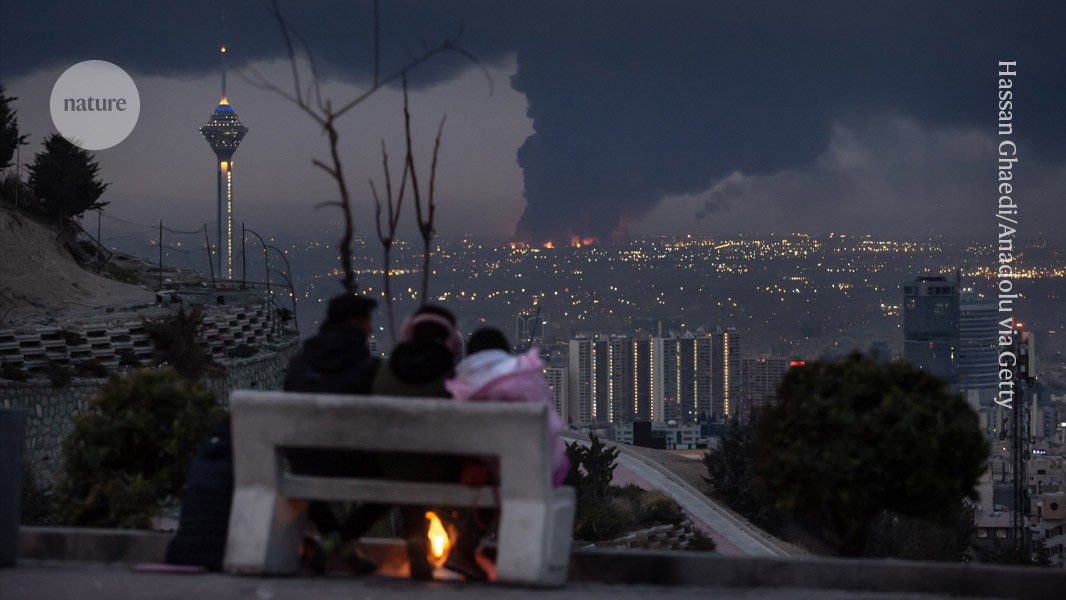

Black smoke from a burning oil depot engulfs the Tehran skyline.Credit: Hassan Ghaedi/Anadolu via Getty
Thick, toxic smoke and black, acid rain have blanketed Iran’s capital, Tehran, this week, after missiles damaged oil depots and refineries. Researchers warn that it probably contains chemicals that are harmful to people and the environment. What is black rain, how does it form and how long will it take to disperse?
Israel and the United States began launching missiles against Iran on 28 February. Iran retaliated with strikes against Israel and US military bases and embassies in multiple countries in the Middle East, including Saudi Arabia, the United Arab Emirates, Iraq, Qatar and Kuwait. More than 1,700 people have been killed in Iran and surrounding countries, according to some media reports.
A World Health Organization (WHO) spokesperson, Christian Lindmeier, told reporters on Tuesday that the damage to Iran’s oil facilities had released toxic hydrocarbons, sulfur oxides and nitrogen compounds into the air. The mix of rain and pollutants could cause chemical burns and lung damage, Lindmeier said. “It is a dangerous situation,” he added, and Iranian authorities have advised people to stay indoors.
What is black rain?
‘Black rain’ is a general term used to describe rain that contains pollutants from the atmosphere, says Farzana Kastury, an environmental scientist at the University of Adelaide, Australia. This kind of rain is often generated by bushfire smoke or the burning of heavy fuel, a thick, low-quality byproduct of crude oil refining. In Iran, the black rain probably contains pollutants from the burning of heavy fuel, says Kastury. This could include cancer-causing benzene, acetone, toluene and methylene chloride, she adds.
“Black rain is indicative of incredibly high levels of ambient air pollution,” says Gabriel da Silva, an atmospheric chemist at the University of Melbourne.
Footage taken by people in Iran also shows that the rain is black in colour — a phenomenon caused by the presence of soot or carbon from the fires, says Brian Oliver, a respiratory and pollution researcher at the University of Technology Sydney, Australia. The rain could also contain pollutants from destroyed building materials, such as asbestos or silica.
Meteorology has a role
Tehran sits in the shadows of the Alborz mountain range, which is likely to lead to temperature inversions, a phenomenon in which a layer of warmer air sits over a layer of cooler air near Earth’s surface, says da Silva.
Temperature inversions trap polluted air masses and stop them from mixing into the troposphere (the innermost layer of Earth’s atmosphere), says da Silva. Such effects are often seen in places such as Los Angeles with the San Gabriel mountains, and the capital of Chile, Santiago, with the Andes mountains, he adds.
Health effects
Inhaling smoke from the fires can trigger difficulty breathing or even heart attacks or strokes among people with pre-existing respiratory or circulation disorders, says Hui Chen, a clinician–neuroscientist at the University of Technology Sydney in Australia. Babies and young children are particularly vulnerable if exposed to toxic fumes, she adds. The chemicals in the smoke and rain can also damage people’s eyes, Chen says. But the severity of the symptoms depends on the concentration of chemicals and the time exposed.
Part of the issue is that the high temperature from the fires creates particulates that are smaller than 2.5 micrometres in diameter (PM2.5), which can penetrate deep into the lung. “The breathing of PM2.5 may lead to cardiovascular disease, stroke, increased blood pressure, decreased cognitive function” and other health issues, says Kastury.

