




Studies from Himachal Pradesh in northern India (pictured) have found that tree-planting schemes have not increased forest canopy cover.Credit: Pallava Bagla/Getty
Biodiversity loss is continuing at an unprecedented rate, with species becoming extinct at between 100 and 1,000 times the average pre-human, or ‘background’, rate. Human activities are the main cause. Although there are hundreds of local, regional and international initiatives to conserve and sustainably use species and ecosystems, many conservation scientists worry that measures such as interventions to conserve individual species or incentives to create protected areas are not supported by strong evidence from research1.

Scientists are building giant ‘evidence banks’ to create policies that actually work
“It always astonishes me how, while drowning in an ocean of information, we still don’t have the scientifically based answers to very simple questions,” says Sandra Díaz, an ecologist at the National University of Córdoba in Argentina.
This week, scientists are meeting in Manchester, UK, for the annual conference of the Intergovernmental Science-Policy Platform on Biodiversity and Ecosystem Services (IPBES). This is to biodiversity what the Intergovernmental Panel on Climate Change (IPCC) is to climate — a body of the world’s researchers that provides authoritative scientific assessments in response to requests from governments. How to improve both the availability and use of good evidence in policymaking does not necessarily make headlines, but it is something that needs to be high on the agenda for IPBES, as it is for the IPCC.
Last month, conservation scientists and practitioners met in Cambridge, UK, to discuss what one of Europe’s largest conservation groups, the UK-based Wildlife Trusts, is calling an “evidence emergency”. There was a consensus on at least two points. First, the quality of evidence used in drawing up conservation policies needs to improve. In northern India, for example, decades of tree-planting schemes have not increased forest canopy cover because of a failure to account for the reasons why cover was being lost to begin with2.
Second, it has been difficult for those outside academia to find evidence for what works and what doesn’t. The academic literature in particular is not organized in a way that allows such users to readily find answers to their queries. “There’s a tremendous amount of information in the scientific literature, but it’s largely inaccessible,” says Shahid Naeem, an ecologist at Columbia University in New York City, who was not at the meeting.
This is changing, thanks to a solution inspired by the synthesis of literature reviews commonly seen in medicine. A prominent example is the initiative Conservation Evidence, which is based at the University of Cambridge. It is an enormous undertaking involving hundreds of researchers, who have spent two decades working their way through more than 1.2 million research papers in 18 languages to identify studies that test the impact of conservation interventions. The team has summarized and indexed studies that qualify, and the results are available through a website that is free to access and can be searched by keyword (see go.nature.com/4tgddxj). In just one of several thousand examples, 47 studies have been reviewed to evaluate the effectiveness of schemes in which farmers are paid to alter their agricultural practices in the interests of conserving biodiversity.
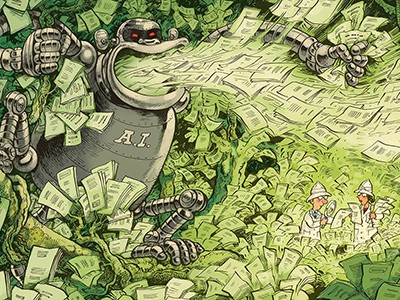
Will AI speed up literature reviews or derail them entirely?
Another initiative, the Collaboration for Environmental Evidence, involves a network of institutions, in countries including Canada, Chile, France, South Africa, Sweden and the United Kingdom. Its members publish evidence reviews and support others who wish to produce their own.
William Sutherland, a conservation scientist at the University of Cambridge who leads the Conservation Evidence project, says that his team is now deploying artificial intelligence to improve the speed and the thoroughness of the project’s process. The ambition is for users to be able to interrogate the data set with a specially designed ‘conservation chatbot’, meaning practical questions would be answered with a narrative summary and links provided to sources of evidence. The data set would constantly be updated to take account of new studies and retractions, with humans overseeing the process. The concept is described in a preprint that was published last year3.
For all their undoubted benefits, such projects do have some limitations. Foremost is that they are restricted to what is in the existing literature, which tends to be dominated by studies by researchers in high-income countries. The team members say that they are working on how to incorporate sources of Indigenous knowledge, which offers one way to start bridging this gap.
Then there’s the question of how the software will respond when it is asked a question for which the literature is insufficient for it to provide a clear answer. The chatbot’s designers say that it will own up to not knowing the answer to a query.

Can AI review the scientific literature — and figure out what it all means?
Díaz points out that the desire for improved evidence shouldn’t delay action in cases for which the appropriate biodiversity interventions are already known. The main causes of biodiversity decline4 are beyond doubt, she says: harmful subsidies, perverse incentives and a lack of enforcement of legislation. “The existing evidence pointing to where to start is massive; what is lacking is the will to act on its basis.”
Around the world, governments and businesses are funding projects intended to protect or use species and ecosystems sustainably and share their benefits — but without accurate knowledge of whether these interventions are working. At the same time, governments are scrambling to increase economic growth, and, in so doing, often disregarding the role nature has in sustaining this growth.
When it comes to conserving biodiversity, stronger evidence for what works and what doesn’t is sorely needed. IPBES is the world’s foremost body of biodiversity scientists. Its sponsoring governments should ask it to tackle these questions without delay.

