


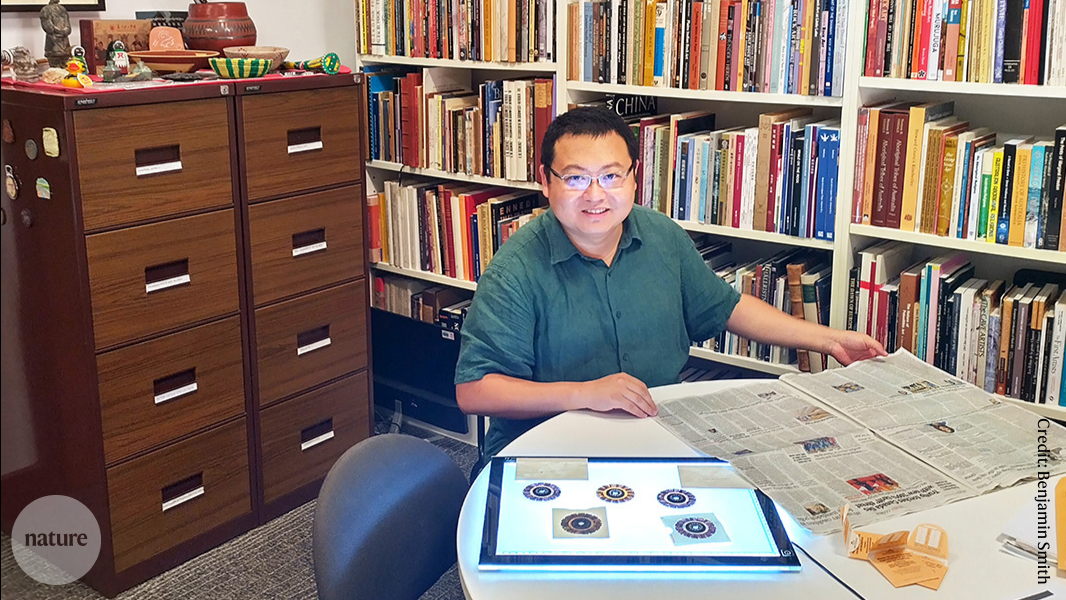

After reflecting on how the mid-career and midlife stages interact, Yu Tao developed several habits that he practises as a mid-career researcher.Credit: Benjamin Smith
One afternoon in November last year, two e-mails landed in my inbox minutes apart. The first was from my son’s school, reminding parents that the transition to secondary education would begin in a few months — a date that suddenly felt shockingly close. The second was from an academic programme that I had long admired, announcing its call for visiting fellowships. I opened the e-mail with excitement, only to find a line in the eligibility criteria saying that applicants must have received their PhD less than ten years ago.
The two e-mails made me realize that at the same time as my 11-year-old child was entering secondary school, I was officially ageing out of ‘early career’ status. Somehow, the timing of parenthood and my career had synchronized, and I found myself stepping into unfamiliar territory on both fronts.
I suppose that important life events lining up in this way and my feelings about the situation are hardly unique. The mid-career and midlife stages often unfold in parallel. Both arrive after years of hard work. Progress in this career stage is no longer measured by fresh beginnings but by the steady effort to keep advancing many things, such as projects, people and hopes.
For me, this shift became apparent around the same time as I received those two e-mails. I was juggling a new teaching responsibility, a junior colleague’s request for mentoring and a grant deadline while also trying to be fully present for childcare in the evenings. None of those demands felt optional to me. My tendency to say yes quickly, take pride in being reliable and meet every expectation with a can-do attitude — which I had once treated as a strength — now needed recalibrating or I would struggle to cope with these competing demands.

Collection: Resources for mid-career scientists
In my case, and I suspect for many fellow researchers, one way to make the midlife and mid-career stages less stressful is to let these two journeys inform one another. As a social scientist based in Perth, Australia, my research has taught me that perseverance outlasts passion, and that progress usually comes from sustained, incremental effort rather than big breakthroughs. Meanwhile, life outside work has taught me to be patient; progress in your career and personal life is often uneven.
With that in mind, I have developed several habits that I try (imperfectly) to practise as a mid-career scholar. Here, I have condensed them into three lessons for people who are in the same life stage.
Change your tactics
Early-career tactics — saying yes to everything, trying to produce a high volume of papers and covering many fronts — make less sense in the mid-career phase. In June last year, there was a moment when I tried to be everywhere in one day: a grant meeting, an important presentation by one of my PhD students, a public forum with community groups and a parents’ information night. The grant meeting went well, mainly because it was the first event of the day. But at the student’s presentation, I didn’t have the bandwidth to ask questions about the most compelling part of their argument; I was already thinking about the public forum across town and how long it would take me to get there. By the time I arrived, my attention had dwindled further: I lost my train of thought halfway through an answer and couldn’t retrieve the third point I’d meant to make. The result of trying to do too much in one day wasn’t heroism — it was mediocrity.
Since then, I have decided to keep only three types of work going at any one time: one that has a fast, clear, 12–18 month deadline, one slower piece of in-depth work with an uncertain pay-off and one type of mentoring or academic-service commitment. Several shifts in my perspective have motivated this strategic contraction of my responsibilities: making peace with the idea that less is more, recognizing that my capacity is limited and spending my energy where it counts.
Leadership is about delegation
In the mid-career and midlife phases, most researchers no longer need to prove themselves through the constant output of new data and papers, and complete control of lab processes. Trying to manage everything personally is not an effective strategy: it creates a bottleneck. I learnt this the hard way when I had to take leave during a particularly busy phase of a research project. The work continued, but my absence exposed several weak spots. Some routine decisions were not taken, questions for me accumulated and minor issues lingered longer than they needed to.
Since then, I’ve become much more explicit about which member of our research team is responsible for making which decisions, and I work with my colleagues to design workflows that don’t rely on any one person’s memory.
In practice, that means maintaining a single shared folder for transcripts, metadata and our codebook, and documenting the protocols for sub-projects so that more of my colleagues and students can contribute to the lab without my direct supervision.
The same principle applies to parenting. We should believe that our children can become independent, trust their developing judgement and guide them rather than take control of their path.

