


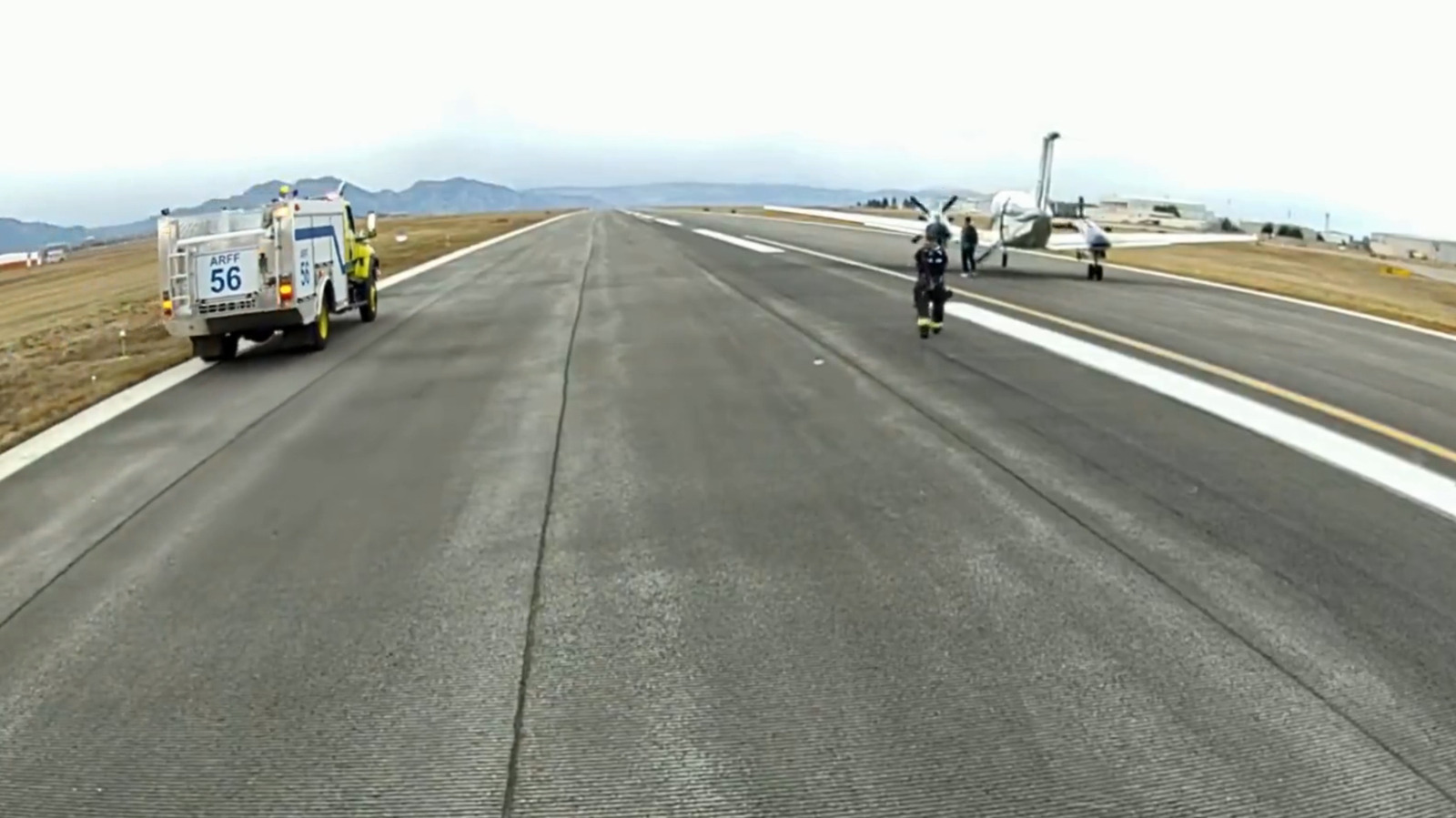
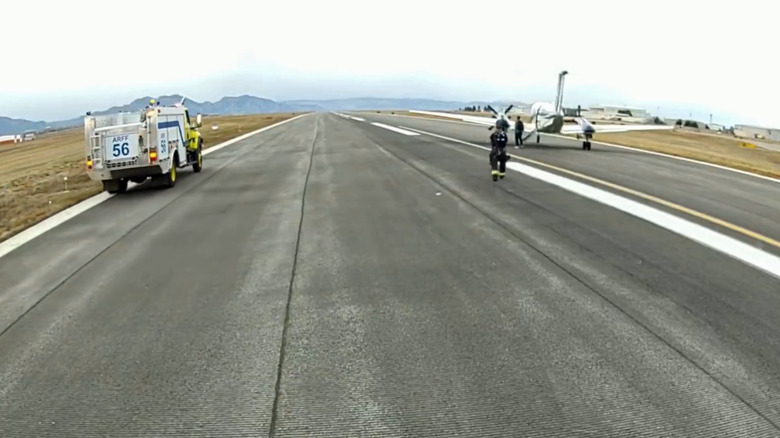
General aviation is statistically less safe than commercial aviation because regulators hold airlines to a much higher standard. However, innovations are slowly being adopted to close the gap and make flying safer. A small twin-engine plane made an emergency landing last Saturday at a public-use airport near Denver, Colorado. The incident made history as the first use of Garmin’s Autoland system during an emergency. The autonomous function safely guided the aircraft down to the runway, where first responders ensured the two pilots on board were unharmed.
On Saturday, Dec. 20 at approximately 2 p.m., North Metro Fire responded to an Alert II airplane incident at Rocky Mountain Metropolitan Airport in Jefferson County with ARFF65, BC61, E61, E64, E65, E68 and M61.
From Westminster Fire Department, SAM11, WFDBC1, WFDM4 and WFDTRK5… pic.twitter.com/7hgQrwVen2
— North Metro Fire (@NMFirePIO) December 22, 2025
A Beechcraft Super King Air took off from Aspen/Pitkin County Airport, but experienced an issue that required an immediate landing. According to KCNC-TV, the Beechcraft suffered a loss of pressurization, which triggered the Autoland system. The pilots donned oxygen masks and never lost consciousness. While the duo could’ve taken back control of the aircraft, they chose to let the plane land itself. Less than half an hour after takeoff, the plane touched down at Rocky Mountain Metropolitan Airport. Thankful, everyone walked away with the North Metro Fire Rescue District noted that “no patients were treated on scene or transported to local hospitals.” The system’s manufacturer stated:
“Garmin can confirm that an emergency Autoland activation occurred at Rocky Mountain Metropolitan Airport in Broomfield, Colorado. The Autoland took place on Saturday, Dec. 20, resulting in a successful landing. We look forward to sharing additional details at the appropriate time.”
Autoland can even talk to air traffic control

While Garmin might have gained its notoriety through producing GPS systems, the company launched its Autoland system in 2019. The product is far more advanced than conventional autopilot systems. Autoland can locate the nearest airport for an emergency landing based on factors such as onboard fuel and runway length. The plane won’t just mindlessly head towards the destination, but also communicate with air traffic control. In addition to self-activating when it detects a technical problem, Autoland can be manually engaged or triggered when there’s no control input for a predetermined period. The system is available for a wide range of small planes, from single-engine turboprops to jets like the Cessna Citation.
Autoland is a shining example of how autonomous transportation can benefit society. However, robotaxis are currently sitting on the opposite end of the spectrum. Waymo halted its driverless taxi service in San Francisco after its vehicles were unable to navigate during a power outage. The robotaxis would just freeze at intersections without functioning taxi lights and turn on their hazard lights. The error would be manageable in a one-off situation, but it would cause chaos during a widespread blackout. When emergency vehicles need to respond to more pertinent problems, a fleet of stopped cars shouldn’t be an extra obstacle.

