


Animals
All animal experiments were approved by the Salk Institute Institutional Animal Care and Use Committee (IACUC). Rats and mice were typically housed with a standard 12 h:12 h light:dark cycle in the Salk Institute animal facilities, with lights on at 06:00 and lights off at 18:00. Dark-reared mice were housed with a 24 h dark cycle since birth. Mice and rats were provided access to food and water ad libitum. Humidity ranged from 38–62% and temperature from 20 to 22 °C.
Mice
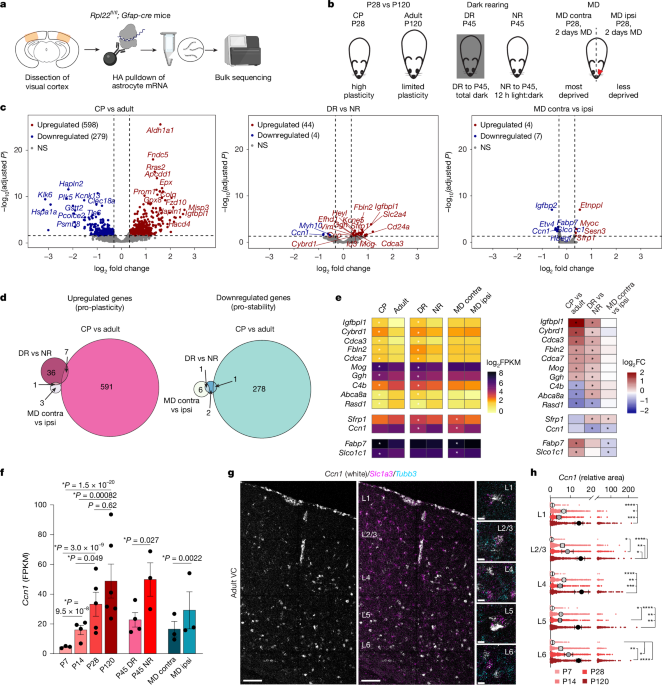
For bulk RNA=sequencing experiments, astrocyte-Ribotag mice were generated by crossing Gfap-cre hemizygous females (B6.Cg-Tg (GFAP-cre)73.12Mvs/J, Jax 012886) to homozygous flox-Rpl22-HA males (B6N.129-Rpl22tm1.1Psam/J, Jax 011029). Male mice hemizygous for cre and heterozygous for flox-Rpl22-HA (Rpl22-HA+;Gfap-cre+) were used for all experiments. Wild-type C57Bl6/J mice were used (Jax 000664) for experiments. For snRNA-seq, male wild-type mice were used. For smFISH experiments (Fig. 1h) validating the bulk RNA sequencing, male mice were used. For adult knockout experiments, Ccn1fl/fl mice were a gift from L. Lau51 and were maintained on a C57Bl6/J background. These mice were crossed to mice expressing tamoxifen-inducible Cre recombinase under an astrocytic promoter for temporal elimination (Aldh1;creERT2, Jax 029655 (ref. 52)). Experimental mice were homozygous for the Ccn1 floxed allele and either cre− or cre+ (wild type or Ccn1-cKO). For adult cKO experiments, mice were injected intraperitoneally with 75 mg kg−1 of tamoxifen (MP Biomedicals 156738) for 5 consecutive days at 1 month of age. For juvenile cKO experiments, mice were injected intraperitoneally once at P3–4 with 100 mg kg−1 of tamoxifen. Mice of both sexes were used and sexes were noted. Sample sizes were chosen on the basis of power analyses (80% power) and literature review. Experimenter was blinded to genotype or manipulation when analysing data.
Rats
Sprague-Dawley rats (Charles Rivers) were used at P1–2 for the preparation of primary cortical astrocyte cultures.
Surgical procedures
Juvenile viral injections
For adeno-associated virus (AAV) injections at P14–15, P11–12, or 3 months of age, C57Bl6/J mice were used. In brief, mice were administered pre-operative carprofen (5 mg kg−1) subcutaneously and anaesthetized using isoflurane. Stereotaxic coordinates for the binocular zone were 2.25 mm lateral and 0.5 mm anterior from lambda. Virus was injected at 3 sites at a depth of 500–600 µm from just below the skull surface. The pipette was kept in the brain for 3 min after each injection to allow the virus to diffuse. TdT, CCN1 and CCN1(D125A) viruses were injected for a total titre of ~2 × 10⁸ viral genomes (vg) per ml. For snRNA-seq and western blotting, bilateral injections of both binocular zones were performed. After injection, mice were sutured and placed back with the dam if pre-weaning.
Monocular enucleation and monocular deprivation
For ME at P28 or 4 months, mice were anaesthetized using isoflurane. The eye was removed using curved forceps and pressure was applied to stop any bleeding. GelFoam was inserted into the eye socket and 2 box sutures (Henry Schein 5616446) were used to close the eyelid. Lidocaine jelly (2.0%, glydo) and erythromycin (0.5%, Bausch + Lomb) was applied to the eyelid. Mice were monitored daily and administered ibuprofen water (0.15 mg ml−1) to minimize any swelling.
For MD at P23, P28, or 4 months, mice were anaesthetized using isoflurane. Eyelashes were trimmed down to the eyelid margins and 4 box sutures using nylon sutures (Ethilon 1647 G) were used to close the eyelid. Lidocaine jelly (2.0%, glydo) and erythromycin (0.5%, Bausch + Lomb) was applied to the eyelid. Mice were monitored daily and administered ibuprofen water (0.15 mg ml−1) to minimize any swelling. Mice were removed from the experiment if the eyelids opened. For suture removal, mice were again placed under isoflurane and sutures were removed. Mice were removed from the experiment if the eye looked damaged or cloudy.
Cranial window implantation and viral injections
For in vivo imaging of ocular dominance plasticity and neuronal response properties, cranial windows were implanted on ~3-month-old Ccn1 wild-type or Ccn1-cKO mice. Mice were injected with buprenorphine SR (1 mg kg−1, subcutaneously), Baytril (10 mg kg−1, intramuscularly) and dexamethasone (2 mg kg−1, intraperitoneally) prior to surgery for anaesthesia, infection prevention and inflammation prevention. Mice were anaesthetized with isoflurane inhalant (3%) and maintained at 1.5–2.5% during the surgery. Mice were mounted on a stereotaxic surgical stage via ear bars and a bite bar. Their body temperature was maintained at 37 °C using a heating pad. The scalp was shaved and the skin was removed and the skull surface was allowed to dry. The skull and scalp margins were covered with a thin layer of Vetbond (Fisher Scientific NC0304169). Avoiding the area above visual cortex, a layer of dental cement (Tetric evoflow A1, Henry Schein 9458634) was applied and a metal head plate was glued to skull. A 3 mm circular piece of skull over the binocular zone (coordinates from lambda: 3 mm lateral, 1.0 mm anterior) was removed with a high speed microdrill with a 0.5 mm burr. Care was taken not to damage the dura. Before window implantation, viral injections of AAV2/1-CAMK1a-gCaMP6f (Addgene #100834-AAV1) were made into the binocular zone. A volume of 150 nl was injected into each of 5 sites at a depth of 300 µm from the pia for a total titre of ~1.2 × 10¹⁰ vg. The pipette was kept in the brain after each injection for 3 min to ensure diffusion of the virus before being retracted. A 4 mm diameter coverslip was placed on the dura and sealed to the edges of the skull using Vetbond. Dental cement was then used to further seal the coverslip. Mice were injected subcutaneously with 10 ml kg−1 physiological saline and carprofen (5 mg kg−1,subcutaneously) and placed on a heating pad to recover. Carprofen was administered daily for three days post-surgery. Mice were maintained with Baytril (8.5 mg kg−1 day−1) in their water to prevent infection for 3 days.
Bulk RNA sequencing
Data for experiments from P28 (critical period) and P120 (adult) mice were obtained from Farhy-Tselnicker et al.18 (GEO GSE161398) and Boisvert et al.17 (GEO GSE99791). The samples presented in this study were collected, processed and run at the same time as the samples from Farhy-Tselnicker et al.18. Three P120 biological replicates from Boisvert et al.17 were included and mapped together with the other samples onto the genome. All samples were processed and collected in the same way.
Conditions for analysis
Developmental time course
For experiments comparing mice P28 (critical period) to P120 (adult), collection was performed as described17,18. The visual cortices from two mice (Rpl22-HA+;Gfap-cre+) were pooled for RNA isolation and RNA-sequencing library preparation (P28: n = 5 biological replicates (10 mice, 2 × 5); P120: n = 6 biological replicates (12 mice, 2 × 6)).
Dark rearing
Dark rearing was performed by housing mice in ventilated telemetry cabinets, in complete darkness, and all husbandry and cage changes were done under red light. Mice for dark rearing were born in the dark and remained there until P45, anaesthetized under red light, and perfused with a hood over their head to prevent light from reaching the eyes. For age-matched comparison mice were raised under 12 h light:12 h dark cycle until P45. The visual cortices from 2 mice (Rpl22-HA+; Gfap-cre+) were pooled for RNA isolation and RNA-sequencing library preparation (P45 DR: n = 4 biological replicates (8 mice, 2 × 4); P45: n = 3 biological replicates (6 mice, 2 × 3)).
Monocular deprivation
MD was performed at P26, for 2 days until P28, during the peak of the critical period. The visual cortex contralateral to the deprived eye (major loss of visual input) and ipsilateral to the deprived eye (minor loss of visual input) were collected separately for analysis and comparison. The visual cortices from 2 mice (Rpl22-HA+; Gfap-cre+) were pooled for RNA isolation and RNA-sequencing library preparation (MD contra: n = 3 biological replicates, (contralateral visual cortex from 6 mice, 2 × 3); MD ipsi: n = 3 biological replicates, (ipsilateral visual cortex from 6 mice, 2 × 3)).
Ribotag pulldown and RNA sequencing
Male mice heterozygous for flox-Rpl22-HA (Jax 011029) and hemizygous for Gfap-cre (Jax 012886) (astrocyte-Ribotag) were used to isolated astrocyte mRNA on the basis of a modified Ribotag protocol as described18.
Dissection
All mice were collected between 09:30 and 12:30 on the day of experiment. Dissection was performed as described17,18. In brief, mice were anaesthetized with an intraperitoneal injection of 100 mg kg−1 ketamine (Victor Medical Company) plus 20 mg kg−1 xylazine (Anased) and then transcardially perfused with 10 ml phosphate-buffered saline (PBS) and then 10 ml 1% paraformaldehyde (PFA). Visual cortices were dissected out in 2.5 mM HEPES-KOH (pH 7.4), 4 mM NaHCO3 in Hank’s balanced salt solution with 100 μg ml−1 cycloheximide added day of the dissection. Visual cortices were dissected by cutting at approximately −2.4 mm posterior from Bregma, lateral cuts were made at 1 mm and 3 mm from the midline, and the white matter and any subcortical structures were removed. For each time point or plasticity group, the visual cortices from two mice were pooled.
Ribotag pulldown
A modified Ribotag protocol was performed as described17,18. In brief, brains were homogenized, centrifuged and incubated with HA antibody-conjugated magnetic IgG beads. RNA was purified using the RNeasy plus micro kit (Qiagen 74034) and eluted into water and stored at −80 °C.
RNA-sequencing library generation and sequencing
Library preparation was performed as described17,18. In brief, RNA quality was measured with a TapeStation (Agilent) and Qubit Fluorimeter (ThermoFisher). More than 100 ng of RNA was used to make libraries, and mRNA was extracted with oligo-dT beads to capture polyA tails. cDNA libraries were made with Illumina TruSeq Stranded mRNA Library Preparation Kit (RS-122-2101) by the Salk Institute Razavi Newman Integrative Genomics and Bioinformatics core. Samples were sequenced on an Illumina HiSeq 2500 with single-end 50 base-pairs reads, at 12–60 millions reads per sample.
Processing and analysis
RNA-sequencing mapping, analysis and statistics
Sequencing data mapping, analysis and statistics were done as described17,18. All samples were processed and aligned to the genome at the same time. In brief, raw sequencing data was converted into FASTQ files using CASAVA (v.1.8.2). Alignment to the mm10 genome was performed using STAR aligner (v.2.5.1b). Mapping was performed using the default parameters, and >75% uniquely mapped reads were confirmed with exonic alignment. Raw and normalized (FPKM) gene expression was quantified across all genes using the top-expressed isoform using HOMER (v.4.10). This resulted in 10–55 million uniquely mapped reads in exons. Differential gene expression was carried using DESeq2 (v.1.14.1) using the HOMER getDiffExpression.pl script with default normalization and replicates used to compute within-group dispersion. Significance for differential expression was set using adjusted P <0.05, using Benjamini–Hochberg correction for multiple comparisons adjustments.
Selection of DEGs
DEG analysis was run in the following comparisons: (1) P28 (critical period) versus P120 (adult); (2) P45 DR versus P45 NR; and (3) MD contralateral hemisphere versus ipsilateral hemisphere. Selection of DEGs for subsequent analysis was performed as follows: (1) FPKM >1 in mean of samples of at least one group per comparison; (2) Ribotag pulldown FPKM (astrocyte)/input FPKM (all cells) >0.75 in at least one group per comparison; (3) adjusted P value <0.05; and (4) fold change >|1.25| or log2FC >|0.3219|.
Venn diagrams of overlapping DEGs in different experimental comparisons were generated using R. Heat maps showing the LFC of DEGs were generated in R using the Pheatmap package. The predicted functional interaction network of CCN1 was generated using the STRING database53 (Extended Data Fig. 2b).
Pathway analysis
Gene-set enrichment analysis (GSEA) was performed to determine which predefined sets of genes were significantly enriched across the plasticity paradigms54. Enrichment of gene sets and pathways from the GO, Reactome and KEGG databases was carried out. Selection of DEGs for pathway analysis was performed as described above, but without a log2FC cut-off. Genes were ranked on the basis of descending log2FC in each comparison. A cut-off of adjusted P < 0.05 was used to determine significantly enriched pathways and terms. Simplifying GSEA results for visualization was conducted by only selecting pathways that were differentially expressed in at least two comparisons. Furthermore, we selected the top three downregulated and upregulated (negative and positive normalized enrichment score, respectively) Reactome pathways in each comparison (Extended Data Fig. 1b). ORA was performed to determine GO terms that were enriched in the significant DEGs across the plasticity paradigms (Extended Data Fig. 1c,d). Lists of upregulated and downregulated DEGs based on the same criteria as for the heat maps and Venn diagrams were included and the background list of genes were those that had FPKM >1 in the sample mean of at least one group per comparison. The following criteria were used to select significantly enriched GO terms: adjusted P value <0.05 (Benjamini–Hochberg correction) and q value < 0.01. The clusterProfiler package (v.4.10.0) was used to perform GSEA and ORA55.
Single-nucleus RNA sequencing
Tissue collection
P14 wild-type male mice were bilaterally injected with AAV-tdT or AAV-CCN1-HA. Mice were collected at P28. Mice were anaesthetized with intraperitoneal injection of 100 mg kg−1 ketamine/20 mg kg−1 xylazine mix and then decapitated. The brains were extracted and the injected visual cortices were dissected in ice-cold Dulbecco’s PBS (dPBS). To dissect the entire area expressing AAV, brains were cut from 2.4 mm posterior from bregma; lateral cuts from 1 to 3 mm from the midline were made to dissect the visual cortex. Two mice (four cortices) were pooled for each biological replicate. Two biological replicates were collected per viral group (four samples total).
Nuclei preparation and flow cytometry
Nuclei were extracted from the dissected visual cortices using the protocol in Farhy-Tselnicker et al.18 and nuclei were labelled with Hoechst 33342 solution. Fifty thousand single nuclei were purified using FACS using a BD FACS Aria Fusion with a 70-µm nozzle. Single Hoechst-positive nuclei were gated using fluorescence measured in the BV421 channel, and debris was excluded using forward and side scatter area and width parameters (FSC-A versus FSC-W, and SSC-A versus SSC-W). Nuclei were kept on ice for all the steps. TdT and CCN1 injected samples were processed in parallel on the same day for each repeat.
10X Chromium barcoding, library preparation and sequencing
Single nuclei separation, barcoding and cDNA generation were performed using the Chromium single cell 3′ kit following the manufacturer’s protocol (v.3.1 HT, 10X Genomics, 1000494 Kit and 1000371 Chip). cDNA concentration and quality measurements were performed using an Agilent Tape Station. Library preparation was carried out immediately after cDNA quality control. Libraries were generated as per the 10X instructions using the V3.1 HT kit. Quality and concentration were measured using an Agilent Tape Station and a Qubit Fluorimeter. Sequencing was performed at the University of Calfornia San Diego IGM Genomics Center using a NovaSeqX (Illumina) at 300 million reads per sample, or ~52 K average reads per cell.
Data preprocessing
Sequencing reads were mapped onto the mouse genome (mm10) using CellRanger count v.8.0.1. Median unique molecular identifier (UMI) counts per cell were as follows: tdt_replicate1: 6,428, ccn1_replicate1: 7,626, tdt_replicate2: 2,496, ccn1_replicate2: 2,810. Total genes detected were as follows: tdt_replicate1: 26,053, ccn1_replicate1: 25,318, tdt_replicate2: 24,940, ccn1_replicate2: 24,752. Median genes per cell: tdt_replicate1: 2,502, ccn1_replicate1: 2,720, tdt_replicate2: 1,272, ccn1_replicate2: 1,382. Mean reads per cell: tdt_replicate1: 67,863, ccn1_replicate1: 74,455, tdt_replicate2: 26,638, ccn1_replicate2: 41,400. Biological replicates were aggregated separately as they were sequenced in separate runs (replicate 1 and replicate 2) using CellRanger Aggr v.8.0.1 using normalization default parameters. Subsequent analyses were run in R Studio (R v.4.4.1) using Seurat (v.5.1.0). We discarded nuclei with less than 200 and more than 8,000 detected unique genes, with over 20% of sequencing reads mapped to mitochondrial genes and with over 10,000 detected RNA molecules per nucleus (UMI). Raw counts were normalized and scaled using the SCTransform function from Seurat and the default parameters, and log-normalized using NormalizeData. SCT data (normalized and scaled) were only used for visualization purposes for clustering, whereas normalized counts were used in differential expression analysis and all other analyses and visualizations.
To integrate the samples from the two different sequencing runs, the IntegrateLayers function from Seurat was used, with the Harmony integration method run using the SCT assay. Clustering was performed using the integrated data, with 30 principal component dimensions for reduction. UMAP embedding was used to visualize the data.
Clustering using MapMyCells
A count matrix as an AnnData object was extracted and uploaded to the Allen Brain Atlas MapMyCells website. The reference taxonomy was the 10x Whole Mouse Brain (CCN20230722), with Hierarchical mapping as the mapping algorithm. Classes, subclasses, and supertypes were mapped onto the Seurat object metadata and used to exclude non-visual cortex neuronal cell types.
DEG analyses
DEG analyses were performed using the normalized RNA counts. The Seurat FindMarkers function with Wilcoxon ranked sum tests with Bonferroni corrections for multiple comparisons were used. A min.pct = 0.01 and a log fold change cut-off of 0.0 was used. log2FC and min.pct cut-offs were adjusted for subsequent data visualization in the extended data figures as described in the legends.
Overrepresentation analysis
ORA was carried out using gene lists filtered out for up or downregulated significant DEGs (adjusted P <0.05). The clusterProfiler package (v.4.12.6) was used to perform ORA using GO terms (enrichGO)55.
Gene signatures
UCell Module scores were calculated for each gene using the UCell package (v.2.8.0)56. UCell module scoring is robust to dataset size and composition56, an advantage for examining the heterogeneous oligodendrocyte lineage. Lipid metabolism and myelin-associated gene lists were obtained from Gene Ontology. Wilcoxon signed rank tests were run between the tdT and CCN1 samples for each signature with Holm’s corrections for multiple comparisons.
AUGUR analysis
AUGUR cell-type prioritization analysis57 (v.1.0.3) was performed using the random forest classifier and setting the minimum number of cells to 100 and the subsample size to 100. This excluded some cell types with low abundance in the dataset, such as border-associated macrophages. In brief, AUGUR withholds a subset of labelled cell-type data (‘test’ data) and trains random forest classifiers for each cell type. Predictions are made on the unlabelled test data and accuracy is calculated on the basis of the area under the AUC of the classifier predictions. To minimize the confound introduced by differing number of cells in each cell type, AUGUR selects small subsamples from the dataset and calculates the mean AUC across subsamples.
Cloning
For the overexpression of HA-tagged CCN1, cDNA for the coding sequence of mouse CCN1 (Origene MR221828) was used. This cDNA was MYC-Flag tagged, so we amplified the cDNA with PCR primers (forward: GCGATCGCCATGAGCTCC, reverse: ttaaccggttgcataatccggaacatcatacggataGAGCGGCCGCGTACG) to insert an HA tag at the end of the C terminus in lieu of MYC-Flag. The fragment was then amplified again with primers optimized for InFusion cloning (Takara Bio 638909) (forward: cgactcactataggctagcgccaccATGAGC; reverse: tgtctgctcgaagcggccgcttaaccggttgcataatccggaacatcatacg). The linearized product was run out on a 0.8% agarose TAE gel and extracted. We used a pZac2.1 AAV2 backbone for overexpression. pZac2.1-gfaABC1D-tdTomato (GFAP-tdTomato) from Addgene (#44332) was digested with NheI and NotI to remove the tdTomato. The linearized product was run out on a 0.8% agarose TAE gel and extracted. An InFusion reaction was performed with the linearized PCR-amplified CCN1-HA and the linearized vector. Clones were selected using carbenicillin and sequenced to confirm presence of the inserted CCN1-HA. The cloned CCN1 plasmid was validated in vitro using astrocyte and HEK 293T/Cre cell cultures.
For synthesis of the CCN1(D125A) plasmid, the cloned CCN1 plasmid was sent to Genscript for point mutagenesis. The aspartic acid at position 125 was mutated into an alanine4. The mutated sequence was confirmed by next-generation sequencing.
The GFAP-CCN1-HA and GFAP-CCN1(D125A)-HA plasmids were sequenced and sent to the Salk Institute Gene Transfer, Targeting, and Therapeutics Core and were packaged into an AAV2/5 virus. Obtained titre ranged from 2–4 × 10¹² vg ml−1. For the control virus, we obtained the AAV2/5 virus of the GFAP -tdTomato vector from Addgene (#44332-AAV2/5). Titres ranged from 1–4 × 10¹³ vg ml−1.
Cell culture
For validation of the plasmids, in vitro overexpression was performed in astrocytes purified from Sprague-Dawley P1–2 rats and in human embryonic kidney (HEK) 293T/Cre cells (ATCC CRL-3216, authenticated by ATCC and by morphology). The astrocytes were purified using the McCarthy–de Vellis method58, and were grown in culture media containing DMEM (Life Technologies 11960044), 10% Fetal bovine serum (Life Technologies 10437028), 1% penicillin-streptomycin (Life Technologies 15140122), 1% Glutamax (Life Technologies 35050061), 1% sodium pyruvate (Life Technologies 11360070), 5 μg ml−1 NAC (Sigma A8199), 5 μg ml−1 insulin (Sigma 11882) and 10 µM hydrocortisone (filtered with 0.22-µm filter). Cell culture dishes were coated with poly-D-lysine (Sigma P6407) before splitting cultured astrocytes onto them. Cultured astrocytes were passaged 2–3 times before being transfected.
HEK cells were grown in HEK cell growth media containing DMEM, 10% fetal bovine serum, 1% penicillin-streptomycin, 1% Glutamax, and 1% sodium pyruvate. HEK cells were passaged 4–5 times before being transfected. Cells were not routinely tested for mycoplasma contamination.
Plasmid validation
To validate plasmids via immunocytochemistry (Extended Data Fig. 3d,e), cultured astrocytes and HEK cells were plated in 24-well plates containing glass coverslips. For HEK cells, coverslips were coated with 1:50 CELLstart (ThermoFisher A1014201) diluted in water. For astrocytes, coverslips were coated with poly-D-lysine as described above. HEK cells and astrocytes were transfected the day after plating with 500 ng of plasmid DNA using Lipofectamine 2000 (Invitrogen 11668019) and OptiMEM (Life Technologies 31985-070). After transfection, astrocytes were maintained in astrocyte growth media, while HEK cells were maintained in HEK cell growth media. After 5 days of expression, cells were fixed with 4% PFA. Cells were then permeabilized with 1% BSA and 0.2% Triton X-100. Coverslips were incubated overnight at 4 °C in primary antibodies diluted in 1% BSA. For HEK cells, rabbit anti-HA antibodies (CST 3724), and sheep anti-CCN1 (R&D Systems AF4055) were used at 1:500. Secondaries were used at 1:1,000 for 2 h at room temperature. For astrocytes, mouse anti-GFAP (Millipore 360) and rabbit anti-HA were used. SlowFade Gold with DAPI mounting media (LifeTech S36939) was used. Coverslips were imaged using an Axio Imager.Z2 fluorescent microscope (Zeiss) with an AxioCam HR3 camera (Zeiss) at 20x magnification.
Mouse tissue collection
Tissue for single-molecule fluorescent in situ hybridization (smFISH) in Fig. 1 and Extended Data Fig. 2 was collected at P7, P14, P28, P45 and P120. Tissue for Ccn1-cKO validation was collected at two months of age. Tissue for smFISH against Arc was collected at P33 or 4 months of age. Tissue for immunohistochemistry was collected at approximately 1 month of age and 4 months of age.
smFISH
All mice for smFISH were collected between 13:00 and 17:00. Mice were anaesthetized by intraperitoneal injection of 100 mg kg−1 ketamine (Victor Medical Company)/20 mg kg−1 xylazine (Anased) mix and transcardially perfused with PBS. Brains were removed and embedded in OCT media (Sakura 4583), frozen in dry ice–ethanol slurry solution, and stored at –80 °C until use. Sagittal sections were obtained using a cryostat (Hacker Industries OTF5000) at a slice thickness of 18–20 µm. Sections were mounted on Superfrost Plus slides (Fisher 1255015). smFISH was performed on the same day as sectioning. Three to six mice were used for each experimental group. For each mouse (biological replicate), two or three sections (technical replicates) were imaged and analysed.
Arc induction
All mice for Arc induction were collected from the vivarium right before the end of the dark cycle (lights on at 06:00). Mice were brought back to the laboratory space and exposed to bright light for 30 min. Mice were then anaesthetized by intraperitoneal injection of 100 mg kg−1 ketamine (Victor Medical Company)/20 mg kg−1 xylazine (Anased) mix. Mice were decapitated, brains were extracted, embedded in OCT and flash frozen in dry ice–ethanol slurry mix. Brains were stored at −80 °C until use. Coronal sections were obtained using a cryostat at a slice thickness of 18–20 µm. Sections were mounted on Superfrost Plus slides (Fisher 1255015). smFISH was performed on the same day as sectioning. 3–6 mice were used for each experimental group. For each mouse (biological replicate), 3–6 sections (technical replicates) were imaged and analysed.
Immunohistochemistry
Mice were collected from the vivarium between 13:00 and 17:00 and were anaesthetized by intraperitoneal injection of 100 mg kg−1 ketamine/20 mg kg−1 xylazine mix and transcardially perfused with PBS, then 4% PFA at room temperature. Brains were removed and incubated in 4% PFA overnight at 4 °C, then washed 3 times for 10 min with PBS, and cryoprotected in 30% sucrose for 2–3 days. Brains were then embedded in tissue freezing media (TFM; General Data Healthcare TFM-5), frozen in dry ice–ethanol slurry solution, and stored at –80 °C until use. Brains were sectioned using a cryostat (Hacker Industries OTF5000) in sagittal or coronal orientations depending on experimental needs at a slice thickness of 18–20 µm. Sections were mounted on Superfrost Plus slides (Fisher 1255015). Three to eight mice were used for each experimental group. For each mouse (biological replicate), two or three sections (technical replicates) were imaged and analysed.
Western blot
Mice were collected between 13:00 and 17:00 and were anaesthetized by intraperitoneal injection of 100 mg kg−1 ketamine/20 mg kg−1 xylazine mix and transcardially perfused with dPBS. Brains were removed and bilaterally injected visual cortices were dissected out in ice-cold dPBS. To dissect the entire area expressing AAV, brains were cut from 2.4 mm posterior from bregma; lateral cuts from 1 to 3 mm from the midline were made to dissect the visual cortex. Both cortices were pooled per mouse. RIPA buffer with 1:100 Halt protease and phosphatase inhibitors (ThermoFisher 78430, 78420) was added (300 µl per sample) and homogenates were placed on a rotator for 1 h at 4 °C. Samples were spun down for 20 min at 13,000 RPM at 4 °C and supernatant was collected and frozen for subsequent analysis. Three mice for tdT and six mice for CCN1 were used. For each mouse (biological replicate), two immunoblots (technical replicates) were run and analysed.
Histology
Immunohistochemistry on mouse brain tissue
Slides containing the sections were blocked for 1 h at room temperature in blocking buffer consisting of 1% BSA and 0.2% Triton X-100 diluted in PBS. Primary antibodies were diluted in this blocking buffer and incubated overnight at 4 °C. The next day, slides were washed 3 times for 10 min with PBS and secondary antibodies conjugated to Alexa Fluor were diluted in blocking buffer and applied for 2 h at room temperature. Slides were mounted with the SlowFade Gold with DAPI mounting media, covered with 1.5 glass coverslip (Fisher 12544E), and sealed with clear nail polish. All secondary antibodies were applied at 1:500 dilution.
For validation of the viral vectors, the following antibodies were used: goat anti-SOX9 (R&D Systems af3075, 1:250), rabbit anti-HA (CST 3724, 1:500), mouse anti-NEUN (Millipore MAB377 1:100), mouse anti-GFAP (Millipore 360, 1:500). Secondary antibodies were donkey anti-goat Alexa Fluor 488 (Jackson ImmunoResearch 705-545-147), donkey anti-rabbit Alexa Fluor 568 (ThermoFisher A-10042), donkey anti-mouse Alexa Fluor 647 (Jackson ImmunoResearch 715-605-150), and goat anti-mouse Alexa Fluor 647 (ThermoFisher A-21235).
For PNN deposition experiments, the following antibodies were used: rabbit anti-HA (CST 3724, 1:500), mouse anti-parvalbumin (Millipore Sigma p3088, 1:500). Biotinylated WFA (Vector Laboratories B-1355-2, 1:500) was used at the same time as the primary antibodies to stain for the PNNs. Secondaries were used at 1:500 and included goat anti-rabbit Alexa Fluor 647 (ThermoFisher A-21245), goat anti-mouse Alexa Fluor 488 (ThermoFisher A-11001) and streptavidin conjugated Alexa Fluor 568 (adult mice, ThermoFisher S-11226) or 647 (critical period mice, ThermoFisher S-21374) to stain for PNNs.
For aggrecan staining, the following antibodies were used: rabbit anti-aggrecan (Millipore Sigma AB1031, 1:500), rat anti-HA (Sigma 11867423001, 1:100), and mouse anti-parvalbumin (Millipore Sigma p3088, 1:500). Secondaries were used at 1:500 and were goat anti-mouse Alexa Fluor 647 (ThermoFisher A-21236), goat anti-rat Alexa Fluor Plus 555 (ThermoFisher A48263), and goat anti-rabbit Alexa Fluor 488 (ThermoFisher A-11034).
For microglia morphology and phagocytosis experiments, the following antibodies were used: rabbit anti-IBA1 (Fuji Film Wako 162001, 1:500), rat anti-CD68 (Bio-Rad MCA1957GA, 1:100), and biotinylated WFA (Vector Laboratories B-1355-2, 1:500). Secondaries were used at 1:500 and were goat anti-rabbit Alexa Fluor 488 (ThermoFisher A-11008), goat anti-rat Alexa Fluor 594 (ThermoFisher A-11007), and streptavidin conjugated Alexa Fluor 647 (ThermoFisher S-21374).
For oligodendrocyte experiments, sections were counterstained with DAPI at 1:10,000 to enable easy cell counting. For all juvenile experiments, to confirm the presence of CCN1 or CCN1(D125A), an antibody against HA was used. To label oligodendrocyte progenitor cells (OPCs), rabbit anti-NG2 (1:200, Sigma Aldrich AB5320) and rat anti-HA (1:100, Sigma 11867423001) for juvenile experiments were used. Secondary antibodies were goat anti-rabbit Alexa Fluor 488 (ThermoFisher A-11034) and goat anti-rat Alexa Fluor Plus 555 (ThermoFisher A48263).
To label newly differentiated oligodendrocytes and myelin, mouse anti-BCAS1 (1:300, Santa Cruz SC-136342), rat anti-myelin basic protein (MBP, 1:200, Millipore MAB386), and rabbit anti-HA (1:500, CST 3724S) for juvenile experiments were used. For juvenile experiments, secondaries were goat anti-mouse Alexa Fluor Plus 488 (ThermoFisher A32723), goat anti-rat Alexa Fluor Plus 647 (ThermoFisher A48265), and goat anti-rabbit Alexa Fluor 555 (ThermoFisher A21429). For adult experiments, secondaries were goat anti-mouse Alexa Fluor 555 (ThermoFisher A21424) and goat anti-rat Alexa Fluor Plus 647 (ThermoFisher A48265).
To label mature oligodendrocytes, rabbit anti-OLIG2 (1:400, Millipore AB9610), mouse anti-APC (1:100, Millipore OP80), and rat anti-HA for juvenile experiments were used. For juvenile experiments, secondaries were goat anti-mouse Alexa Fluor Plus 488 (ThermoFisher A32723), goat anti-rat Alexa Fluor Plus 555 (ThermoFisher A48263), and goat anti-rabbit Alexa Fluor 647 (ThermoFisher A21245). For adult experiments, secondaries were goat anti-mouse Alexa Fluor 488 (ThermoFisher A-11001) and goat anti-rabbit Alexa Fluor 555 (ThermoFisher A21429).
For all immunohistochemistry, two or three sections (technical replicates) per mouse were imaged and averaged.
smFISH
All smFISH experiments were done as described18 except on fresh- frozen tissue as described in ‘Mouse tissue collection’. For tissue from P7 mice, slides were incubated with protease plus for 15 min; for P14–P120, protease 3 or 4 10–20 min. Probes used were: Arc (Biotechne 316911-C1), Ccn1 (Biotechne 429001-C1), Tubb3 (Biotechne 423391-C3) and Slc1a3 (Biotechne 430781-C2).
For experiments done in Fig. 2 and Extended Data Fig. 3k,m, the RNAScope V1 Multiplex assay was performed (Biotechne 320851). For the experiments done in Extended Data Fig. 4d–m, the RNAScope V2 Multiplex assay was run (Biotechne 323100) according to manufacturer instructions. The tissue baking step was eliminated and the hydrogen peroxide step was performed at room temperature for 10 min.
For Arc smFISH, three to six sections (technical replicates) were imaged and averaged per mouse (biological replicate). For Ccn1 smFISH, two to three sections (technical replicates) were imaged and averaged per mouse (biological replicate).
Western blot
Protein concentrations of the whole visual cortex lysates were quantified using the Bradford Protein Assay (Bio-Rad 5000006) on a plate reader (Tecan Infinite 200 PRO). Samples were diluted at least 40× to ensure accurate protein measurements and BSA was used as a standard. Reducing sample buffer (ThermoFisher 39000) was added to 20 µg of total proteins and samples were denatured at 55 °C for 45 min. Samples were then loaded into a 12-well Bolt 4–12% Bis-Tris gradient gel (ThermoFisher NW04122), using a PageRuler Prestained Protein Ladder (ThermoFisher 26626). Gels were run at 100 V for 1.5 h using a Mini gel tank (ThermoFisher A25977) and Bio-Rad PowerPac using MOPS running buffer (ThermoFisher NP000102). Transfer was done in Mini Trans-Blot Gel tank (Bio-Rad 1703930), using Tris-glycine transfer buffer (ThermoFisher 28363) with 20% methanol onto a PVDF membrane (Millipore Immobilin-FL IPFL00010). Membranes were blocked at room temperature for 1 h using 1% casein in Tris buffered saline (TBS; Bio-Rad 1610782). Primary antibodies were incubated overnight at 4 °C. Following primary antibody incubation, membranes were washed 3 times for 10 min in TBS (ChemCruz SC-362186) with 1% Tween (TBS-T). Secondary antibodies were used at 1:10,000 for 1 h at room temperature. Membranes were washed with 3 times for 10 min TBS-T and then placed in TBS until they were imaged.
For CCN1 overexpression validation, sheep anti-CCN1 (1:650, R&D AF4055) and mouse anti-pan actin (1:5000, Sigma Aldrich A1978) were used. Secondaries were donkey anti- sheep Alexa Fluor 680 (ThermoFisher A21102) and donkey anti-mouse Alexa Fluor 800 (ThermoFisher A32789). CCN1 and actin were probed for in the same blot, with CCN1 imaged in the 700 nm channel and actin in the 800 nm channel. The expected molecular mass of CCN1 is 37 kDa and the expected molecular mass of actin is 42 kDa.
Imaging and analysis
Membranes were imaged on a Licor Odyssey Imager Clx at a resolution of 84 μm (300 dpi). Automatic exposure was used. Analysis was conducted using ImageStudio and background lane fluorescence was used for normalization. CCN1 band intensities were additionally normalized using the actin loading control within each blot. The CCN1 group was also normalized to the tdT group for each membrane.
Histology imaging and analysis
Epifluorescence microscopy
Imaging was performed using an Axio Imager.Z2 fluorescent microscope (Zeiss) with the apotome module (Apotome2) and AxioCam HR3 camera (Zeiss) at 10× or 20× magnification, depending on the experiment. Tile images that contained the entire primary visual cortex (from pial surface to white matter tract) were acquired. Number of tiles were maintained consistent within each experiment. Images were 14 bit. All tiles had 10% overlap. For critical period experiments looking at WFA expression, all sections were confirmed to have viral vector expression.
For the Arc smFISH (Figs. 2b,e and 4d and Extended Data Fig. 4e,l), images were acquired at a single plane at 10× magnification, and the entire section was tiled. Arc activation width was measured along layer 4 (ref. 59) using the distance tool in Zen Blue.
For smFISH in Extended Data Figs. 3k and 4h for the Ccn1-cKO validation, images were acquired at 20×, with 3 tiles of the entire visual cortex taken, and a z-stack width of 10–12 μm.
For the immunohistochemistry for viral vector validation in Fig. 5 and Extended Data Fig. 2, images were acquired at 20× with 6 tiles taken of the visual cortex at 10% overlap and a z-stack width of 10–12 μm. For WFA and parvalbumin staining, images were acquired at 20× with 3 tiles taken of the visual cortex at 10% overlap and a z-stack width of 10–12 μm. For NG2, CC1 and OLIG2 staining in Fig. 5, images were also acquired at 20× with 3 tiles taken of the cortex at 10% overlap and a z-stack width of 10–12 μm.
In all cases, when comparing wild type and cKO or different viruses per given experiment, slides were imaged on the same day using the same acquisition settings, most notably camera exposure time was kept the same.
Confocal and super-resolution microscopy
smFISH images used for layer-specific developmental profile of Ccn1 expression were acquired using a Zeiss LSM 700 confocal scanning microscope. Images were acquired at 8-bit depth, 1,024 × 1,024 resolution using a 20× objective with a pixel dwell time of 0.79 µs. The scaling per pixel was 0.31 µm × 0.31 µm and 2 frames were averaged per plane. z-stacks at 1 µm steps were taken and the visual cortex was tiled at 10% overlap. Number of tiles remained consistent between experiments.
For microglia engulfment analysis, a Zeiss LSM 880 with Airyscan module was used. The images were acquired in super-resolution mode with a Fast Airyscan module using an oil-immersion 63× objective with a numerical aperture of 1.46 at a pixel dwell time of 0.60 µs. The scaling per pixel was 0.041 µm × 0.041 µm. z-stacks with 0.110 µm steps were acquired using a piezo, typically 150–200 planes per image. For the critical period mice expressing tdTomato, the 563 laser was used to photobleach the tdTomato signal prior to imaging the engulfment. To confirm that critical period mice injected with CCN1–HA, we confirmed viral vector expression with half the sections on each slide that were stained with rabbit anti-HA. The WFA channel (647) was imaged with an excitation beamsplitter of 488/561/633 and an emission filter set of 570–620 bandpass and 645 longpass. The CD68 channel (594) was imaged with an excitation beamsplitter of 488/594 and an emission filter set of 420–480 bandpass and 495–620 bandpass. The IBA1 channel (488) was imaged with an excitation beamsplitter of 488/561/633 and an emission filter set of 420–480 bandpass and 495–550 bandpass. Laser power for acquisition was kept the same across experiments. Images were processed by Airyscan in automatic mode.
For microglia morphology analysis, the same microscope was used as for the engulfment assay but in normal confocal mode. Images were acquired at 16-bit depth using a 20× objective with a pixel dwell time of 2.05 µs. The scaling per pixel was 0.21 µm × 0.21 µm. z-stacks at 2 µm steps were taken and the visual cortex was tiled at 15% overlap. Number of tiles remained consistent between experiments.
For analysis of newly differentiated oligodendrocytes (BCAS1-labelled oligodendrocytes) and myelin (MBP levels), a Zeiss LSM 900 was used. Images were acquired at 16-bit depth, 2,392 × 2,456 resolution using a 20× objective with a pixel dwell time of 0.41 µs. The scaling per pixel was 0.124 µm × 0.124 µm. z-stacks at 1 µm steps were taken and the visual cortex was tiled at 10% overlap. Four times two tiles were acquired (total eight tiles).
Image analysis
All image analysis of the smFISH in Fig. 1 and the Ccn1-cKO validation in Extended Data Figs. 3k and 4h was performed in ImageJ using a custom macro developed in the laboratory. The Slc1a3 signal was thresholded and used to segment astrocyte regions of interest (ROI). The Ccn1 probe signal was also thresholded and the total area within each astrocyte ROI was quantified. Thresholds were kept the same within experiments (for example, images acquired on the same day).
For quantification of the immunohistochemistry validating the viral vectors, the cell counter plug-in in ImageJ was used to count the number of transduced cells. For quantifying astrocyte GFAP level in Extended Data Fig. 3h,i, GFAP signal was thresholded equally in each pair of mice (tdT versus CCN1) and total area was quantified and compared.
To quantify the PNN around parvalbumin-expressing (PV) cells, a custom ROI detection pipeline was developed in CellProfiler. The PV channel intensity was rescaled in order to use the full intensity range to increase the brightness of the image for ROI selection. Both channels had a gaussian filter with a sigma of 1 applied. In order to reduce image heterogeneity and optimize ROI detection, the lower quartile of pixel intensity values were subtracted from the WFA and PV channels. ROIs were manually curated and added or removed. Finalized WFA and PV ROIs were then overlaid with the original, unprocessed images and the integrated density of WFA or PV per ROI was obtained. To separately quantify only WFA that surrounded PV cells, ROIs were overlaid and excluded if overlap was absent. The overlapping ROIs were overlaid with the original, unprocessed images and the integrated density per ROI was obtained. Values were exported to a csv file.
For oligodendrocyte and oligodendrocyte progenitor cells (OPCs), the cell counter plug-in in ImageJ was used to count the number of positive cells labelled by the different markers.
For analysis of microglia engulfment, images were analysed using pyclesperanto in the Napari viewer (https://github.com/clEsperanto/napari_pyclesperanto_assistant). In brief, the WFA, IBA1 and CD68 channels were independently segmented. A gaussian filter followed by a gamma correction at 1.5 were applied to the WFA signal prior to thresholding using the Otsu method. The IBA1 and CD68 signals were thresholded using the Otsu method. However, for critical period mice, for the CD68 signal the manual thresholding value was set to 900 instead of using the Otsu method due to differences in the CD68 signal in critical period aged mice. The overlapping regions (WFA + CD68 + IBA1 and CD68 + IBA1) were generated using the segmentations and saved as tiff files. To extract volumes of the segmentations, the tiff files were analysed in ImageJ using the 3D Object Counter plug-in and using the same thresholding for all images (Extended Data Figs. 6 and 9).
Microglia morphological classification
For microglia morphology analysis, images were processed in a custom ImageJ macro and analysed using a custom CellProfiler pipeline. In ImageJ, the contrast for each image was normalized so that at least 70% of the pixels are saturated, and the image was despeckled to remove noise. The pia and white matter were excluded from analysis to standardize the microglia morphology in each image. Then, in CellProfiler, the EnhanceOrSuppressFeatures module was used to suppress feature sizes of ten to segment soma from processes. The soma was identified as the primary object via the adaptive two-class Otsu thresholding method (threshold smoothing scale: 1, threshold correction factor: 1, size of adaptive window: 100). Soma area was measured using the MeasureObjectSizeShape module. The non-suppressed image underwent a gaussian filter (sigma 1) and thresholded using the global robust background method (averaging method: mean, variance method: standard deviation, no. of deviations: 0.8, threshold smoothing scale: 1, threshold correction factor: 0.9). From the thresholded image, secondary objects (processes) were identified via propagation from the overlaid primary objects (soma) using the adaptive two-class Otsu thresholding method (threshold smoothing scale: 0.3, threshold correction factor: 1, size of adaptive window: 10, regularization factor: 1). Microglia that had processes touching the borders of the image were excluded from analysis to remove artificial decreases in measurements. The MorphologicalSkeleton module was used to generate skeletons within the processes, and the MeasureObjectSkeleton module quantified number of trunks, non-truck branches, and total skeleton length of each microglia. Average branch length was calculated by dividing the total skeleton length by the sum of the number of trunk and non-trunk branches. All measurements were converted to microns.
For microglial morphology clustering analysis, Python sci-kit learn was used to scale and perform dimensionality reduction on all the extracted morphology features using principal component analysis (PCA). The number of components was chosen as the minimum number that explained 80% of the variance. Then, k-means clustering was performed and the elbow method was used to minimize the within cluster sum of squares. The number of chosen clusters was four for both critical period and adult mice, which is in line with the literature60,61,62,63. To plot the cluster heat maps, we used the scaled mean of each feature; we identified each cluster as amoeboid, rod-like, ramified (resting) or hyper-ramified on the basis of descriptions from the literature. The mean proportion per cluster for each mouse was calculated and a linear mixed effects model with a beta distribution was built in R using the glmmTMB and DHARMa libraries64. Post hoc tests looking at pairwise comparisons of clusters across viral groups or genotypes and manipulations were performed with P value adjustments for multiple comparisons.
Electrophysiology
Acute slice preparation
Coronal slices of the binocular zone of the visual cortex were prepared from P27–28 or P33–34 wild-type mice, that had been injected at P14 with GFAP–TdTomato or CCN1–HA, following described protocols65,66. Animals were deeply anaesthetized by injection with Avertin and decapitated. The brain was removed, hemi-sected, and cut into 300 µm coronal sections using a Leica VT1000s vibratome. The brain dissection was performed in cold, sucrose-based dissection solution consisting of (in mM): 2.5 KCl, 7.0 MgCl2, 1.25 Na2HPO4, 11 glucose, 234 sucrose, 0.50 CaCl2, and 24 NaHCO3 and equilibrated with carbogen (95% O2/5% CO2). Slices were then placed in a recovery chamber containing artificial cerebrospinal fluid (aCSF) consisting of (in mM): 126 NaCl, 26 NaHCO3, 1.25 Na2HPO4, 2.5 KCl, 2 CaCl2, 1 MgCl2, 25 glucose, and saturated with carbogen. Slices recovered for 30 min at 34 °C and were then maintained at room temperature until recordings were performed for 4–6 h after slicing.
Electrophysiology
Slices were placed in a recording chamber and perfused with a recirculating bath of carbogen-saturated aCSF maintained at 31 °C. Whole-cell patch clamp recordings were obtained from neurons in layer 2/3 of the injected binocular zone that were visualized using IR-DIC on a Scientifica microscope. Open pipette resistances were 2–5 MΩ (borosilicate glass pipette; Harvard Apparatus 30-0057). Recordings were performed using a Multiclamp 700B amplifier (Molecular Devices). All recordings were sampled at 10 kHz. For measuring the cell membrane properties, data were filtered at 10 kHz and measurements for analysis were taken 5 min after patching onto the cell. Recordings were discarded if the series resistances were >25 MΩ or changed >25% during the entire recording. For each mouse, 1–5 cells were recorded.
For experiments recording sEPSCs and sIPSCs at P27–28, sEPSCs were recorded in voltage clamp holding the cell at −60 mV and sIPSCs were recorded at +0 mV. Five minutes after breaking into the cell, cell membrane properties were measured as described above at −60 mV. sEPSCs were then recorded for 5 min with a filter of 2 kHz and a gain of 10 to allow the detection of small events and then the cell membrane properties were recorded again as described above. The holding voltage was then set to +0 mV to record sIPSCs for 5 min, filtered at 2 kHz and with a gain of 10. After recording sIPSCs, the holding voltage was set back to −60 mV to measure the membrane properties again. For each cell, sEPSCs or sIPSCs were excluded if series resistances changed >25% before and after recording or if cell seal was inadequate. Thus, for some cells, both sEPSCs and sIPSCs were analysed but for others only sEPSCs or sIPSCs were analysed. A caesium methanesulfonate internal was used (in mM): 100 caesium methanesulfonate, 20 KCl, 10 HEPES, 4 Mg-ATP, 0.3 Na-GTP, 10 Na-phosphocreatine, 3 QX 314 Chloride (Tocris 2313). Osmolarity and pH of the internal solutions were adjusted to 290–310 mOsm and pH 7.3–7.4 with double-distilled water and with CsOH.
For experiments recording sEPSCs from pyramidal and fast-spiking cells at P33–34, aCSF containing 40 µM bicuculline methochloride (Tocris 0131) was washed in. sEPSCs were recorded at −70 mV for 5 min and were filtered at 2 kHz and acquired at a gain of 10 to allow the detection of small events. Fast-spiking cells were confirmed as fast-spiking with little-to-no spike-frequency adaptation by injecting a 100 ms current step and noting the frequency and AP width in current-clamp mode. Additionally, fast-spiking neurons had a low input resistance (<150 MΩ) and multipolar morphology25. In these experiments, a potassium gluconate internal consisting of (in mM) was used: 115.0 potassium gluconate, 20.0 KCl, 10.0 phosphocreatine disodium salt, 10.0 HEPES acid, 0.2 EGTA, 4.0 Mg-ATP, and 0.3 Na-GTP. Osmolarity and pH of the internal solutions were adjusted to 290–310 mOsm and pH 7.3-7.4 with double-distilled water and with KOH.
Data analysis
Off-line data analyses were performed using MiniAnalysis (Synaptosoft) and MATLAB. sEPSC and sIPSC recordings were filtered post hoc with a 1 kHz low-pass Bessel 8-pole filter in Clampfit (Molecular Devices). For all experiments, 1–5 cells were analysed per mouse.
Visual cliff assay
The visual cliff experiments34,67,68 were conducted in a quiet room during the 12-h light cycle. The apparatus consisted of an open field behaviour box with clear walls and bottom. The arena was 40 cm × 40 cm and placed on the edge of a 1-m-tall table with half the box extended out over the table. A black and white checkboard mat was placed on the bench top and dropped down to the floor and extended out to create the ‘cliff’. A lamp was placed directly over the box to provide 30 lux of light but oriented to prevent any reflections on the plexiglass bottom. A camera was placed directly overhead pointed down at the arena and connected to AnyMaze tracking software. Mice were brought to the room 1 h prior to testing for habituation. The mouse’s movements were tracked during the duration of the entire 5 min trial. Measurements were binned by 1 min intervals. The arena was cleaned with Virkon followed by RO water between each mouse.
In vivo two-photon imaging
Two-photon calcium imaging
Recordings and habituation were performed during the 12 h light cycle. After recovery from viral injection and cranial window implantation, mice were habituated to handling and head fixation on a linear treadmill (LabMaker) over the course of one week. Imaging was performed during the day cycle of the mouse. We used a custom-built two-photon laser scanning microscope from Neurolabware equipped with a pulsed femtosecond Ti:Sapphire laser (Chameleon Vision II, Coherent) controlled by Scanbox acquisition software. The laser was tuned to 920 nm for imaging gCaMP6f and focused through a 16× water-immersion objective (Nikon, 0.8 numerical aperture). Images were acquired at a frequency of 15.5 Hz at a depth of 150–300 µm below the pial surface for layer 2/3. Images were 512 × 796 pixels (500 × 600 µm). A rotary encoder was used to track the running speed of the mice on the linear treadmill. A camera fitted with a 740 nm longpass filter was used to track pupil diameter during imaging (Mako U-015B). Both the encoder and the pupil camera were triggered at the scanning frame rate. To measure the responses of neurons to presentation of visual stimuli to either eye independently, an opaque eye path was placed in front of the other, non-imaged eye.
Binocular zone confirmation
Imaged areas that were stereotaxically identified during cranial window implantation (see above) as the binocular zone were confirmed as such by performing retinotopic mapping. A BENQ LCD 27-inch monitor (60 Hz refresh rate) was used for visual stimulus presentation, was placed 20 cm from the eyes, and covered approximately 113° in azimuth and 60° in elevation. Stimuli were designed in PsychoPy 2.22 and custom code was written to enable communication between the stimulus computer and the imaging computer. Stimulus presentation onset was tracked using a photodiode (Thorlabs, FDS1010) that was fed to an Arduino UNO rev. 3 and generated a transistor-transistor logic (TTL) pulse that was sampled by the imaging computer and time-stamped with the imaged frame. To confirm that the imaged area was indeed binocular, small checkerboard stimuli were presented pseudo-randomly at 15 neighbouring positions at a rate of 3 Hz. Stimuli were presented to either eye independently and randomly and regions were considered binocular if the peak responses in both eyes were evoked by stimuli presented in the central, upper visual field (−20° to +20° azimuth relative to the midline)33 (Extended Data Fig. 7a–c). Regions with no or weak ipsilateral responses were also not considered binocular.
Visual stimulus presentation for ocular dominance mapping
Drifting sinusoidal gratings were presented to each eye independently and randomly. The stimuli consisted of 16 directions (from 0° to 337.5°) and 2 spatial frequencies (0.03 and 0.13 cycles per degree) at 80% contrast. They were generated in PsychoPy 2.22. The full stimulus set was presented 5 times in one experiment in pseudo-random sequence. Gratings drifted at 1 Hz for 2 s, followed by a 4 s grey screen. Stimulus presentation onset was tracked using a photodiode and TTL pulses were generated and sampled by the imaging microscope to synchronize stimulation and imaging data.
Analysis
Image processing
Scanbox.sbx files were converted to tiff format and motion-corrected and segmented using Suite2p in Python (https://github.com/MouseLand/suite2p). The files from the contralateral and ipsilateral eye stimulation were aligned together to ensure the same cells were segmented. Files from different days were aligned and segmented separately. Rigid and non-rigid registration were run. After automated cell detection, the registered binary was manually checked and additional ROIs were drawn if necessary.
Identification of visually responsive cells
The F for the entire fluorescent trace of each cell was calculated by subtracting 0.7 × Fneuropil from Fcell. ΔF/F was calculated as (F − F0)/F0, where F0 is the baseline fluorescence. F0 was calculated as the 25th percentile of the fluorescence signal in a 30 s sliding window69,70. ΔFstimulus/F was calculated as the ΔF/F during the stimulus window and ΔFoff/F was calculated as the ΔF/F during the grey screen presentation. To compute whether a neuron was significantly visually responsive, we performed a Wilcoxon signed ranks test comparing ΔFstimulus/F and ΔFoff/F with a Bonferroni-corrected α = 0.05/number of unique trials (32 trials; α = 0.00156) to correct for multiple comparisons. Cells were considered visually responsive if they passed significance threshold for at least 25% of the trials of the single stimulus condition35,71. Cells were considered monocular if they had significant visual response to one or more stimulus conditions presented to either the contralateral or ipsilateral eye. Cells were considered binocular if they had a significant visual response to one or more stimulus conditions presented to each eye.
Ocular dominance index
The ODI of individual neurons was calculated as the ratio between the difference and the sum of the mean ΔFstimulus-peak/F in response to the ipsilateral or contralateral eye experimentally determined preferred drifting direction: ODI = (Rc − Ri)/(Rc + Ri), where Rc is the contralateral eye response to its preferred direction, and Ri is the ipsilateral eye response to its preferred direction. An ODI of −1 or +1 indicates ipsilateral or contralateral eye dominance, respectively. The stimulus-triggered response, ΔFstimulus-peak/F, was calculated by subtracting the mean ΔF/F for the 16 frames prior to stimulus presentation from the mean ΔF/F 7 to 31 frames (0.5 s to 2 s) after stimulus presentation (averaged 4 frames around the peak). Only neurons that were longitudinally tracked and responsive across imaging sessions were used for ODI calculations. For Fig. 3m, we used data only from longitudinally tracked neurons and binned the cells on the basis of their pre-MD ODI. We made 8 bins and calculated the median change in the binned cells’ contralateral eye responses and ipsilateral eye responses.
Orientation tuning
The preferred orientation of a neuron was calculated as:
$$\mathrmOrientation=\arctan ((\Sigma _n\rmO_n\times \rme^2i\rm\pi \theta /180)/2)$$
On is the peak neuronal response to the 18 different orientations (0° to 170° spaced every 18°). θ is the orientation.
Global orientation selectivity was calculated as:
$$\mathrmCircular\,\mathrmvariance=1-|(\Sigma _n\rmO_n\times \rme^2i\rm\pi \theta /180)/\Sigma _n\rmO_n|.$$
Cardinal proportions were calculated as the proportion of neurons having an orientation preference to 0° or 90°, ± 11.25°.
Binocular matching for binocular neurons was quantified as the absolute difference in preferred orientation of the contralateral and the ipsilateral eyes. \(\Delta \rmOrientation=|\rmOri_\rmcontra-\rmOri_\rmipsi|\).
If ΔOrientation > 90°, then the actual value is 180°- ΔOrientation.
Spiking correlations
Using Suite2p, the deconvolved spike train was extracted from each cell. An unconstrained non-negative deconvolution using exponential kernels was used. The kernel decay timescale was set to 1.0 and a gaussian filter with a smoothing constant of 10 was applied to the neuropil subtracted fluorescence trace. The neuropil subtraction coefficient was set to 0.7. The spiking activity of each pair of significantly responsive, longitudinally tracked neurons was calculated by concatenating the spiking activity for all trial-on periods and performing a pairwise Pearson’s correlation. This was done independently for contralateral and ipsilateral eye responses.
Response reliability
For all responsive, longitudinally tracked neurons, the response reliability was calculated by the coefficient of variation (cv = σ/μ) of the neuron across all trials of each unique stimulus condition. σ is the standard deviation of the neuron’s responses to all trials of a specific stimulus and μ is the mean of the trial responses.
Longitudinal imaging
To locate the same imaging plane for longitudinal imaging, we used the images acquired on previous days as reference, such as the vascular map of the brain surface acquired with the PCO camera and epifluorescence and the mean motion-corrected two-photon fluorescence images. The angle of the objective was kept the same. Fine adjustment of imaging depth and x,y location was performed using the Scanbox built-in plug-in searchref. In brief, a z-stack was automatically acquired and projected onto the mean motion-correct image from the prior imaging. The plug-in computes (using fast Fourier transform) the optimal translation of the microscope and moves the scope to best align the images (https://scanbox.org/2019/07/18/scanbox-searches-for-a-population/).
Longitudinal cell tracking
To track cells across multiple imaging sessions across different days, roiMatchPub.m, a MATLAB package written by A. Ranson was used (https://github.com/ransona/ROIMatchPub). In brief, the package uses a control point-based affine geometric transformation to correct for the plane rotation. The transformation is then applied to the image from the second imaging time point (‘post MD’). The overlap of ROIs between the mask file from the reference image and the transformed mask file from the second imaging time point is calculated. Overlapping ROIs were considered as longitudinally tracked after visual inspection and verification (Extended Data Fig. 7d,e). The average percentage of cells that were segmented before MD that were longitudinally tracked and also segmented post MD was 46 ± 6% (Extended Data Fig. 7f). For naive mice, the average percentage of cells that were longitudinally tracked from day 1 to day 6 of imaging was 26 ± 3.0% for wild-type mice and 35.9 ± 9.2% for Ccn1-cKO mice (Extended Data Fig. 8j). The difference in number of neurons that were longitudinally tracked between the two genotypes, combined with a lower number of mice in the wild-type naive condition, could account for the difference in the unresponsive number of neurons for all segmented cells versus longitudinally tracked unresponsive neurons (Extended Data Fig. 8d,j,k).
For experiments looking at cell proportions (Fig. 3d–j and Extended Data Figs. 7g–l and 8a–h), we used cells that were longitudinally tracked but not necessarily responsive, as we were also interested in cells that were unresponsive and became responsive after MD or vice versa. Contralateral, ipsilateral and binocular proportions were reported as a proportion of those cells that were responsive either pre MD or post MD32,47,72. For experiments looking at ODI, spiking correlations, locomotion, or tuning properties (Fig. 3k–n and Extended Data Figs. 7m,n and 8l–q), we looked at cells that were longitudinally tracked as responsive pre and post MD.
Bootstrapping
For bootstrapping analysis in Fig. 3k, we performed a hierarchical bootstrapping method73 with two levels: the animal level and the cells level. Sampling was performed 10,000 times for the dataset. A sample was taken with replacement at the first level (mice) with the sample size being equal to the number of mice. Then, a sample was taken with replacement at the second level, the neurons imaged. We chose a sample size of 100 which was slightly larger than the maximum number of neurons imaged per mouse. We reported the median across the 10,000 samples and directly calculated a P value (Pboot) that represents the probability that the mean ODI of the pre-MD group is larger than that of the post-MD group. The Pboot was used to determine statistically significant differences for the pre-MD and post-MD samples. For the bootstrapping analysis in Fig. 3m, inset, we used the bootci function in MATLAB for 1,000 samples for each of the pre-MD ODI bins. We calculated the mean for these 1,000 samples and a 95% confidence interval.
Locomotion analysis
Spiking data for each trial were extracted as described above. Locomotion data was obtained from the Scanbox quadrature file. Locomotion was converted to speed during each trial. Correlations between speed and spiking for all trials per responsive, longitudinally tracked cell were calculated using pairwise Spearman correlations to account for any non-normality in the locomotion data.
Statistical analysis and reproducibility
For most experiments, analyses were performed in GraphPad Prism (v.8.4.3 and v.10), with P values calculated to four decimal points. For WFA and PV quantifications, two-photon in vivo imaging data, and microglial morphology analyses were run in MATLAB (MathWorks) and Python. Significance was set at α = 0.05. Data were tested for normality, and two-tailed parametric or non-parametric tests were run as appropriate. Tests were corrected for multiple comparisons using either the Tukey or Sidak method for two-way ANOVA. For nested ANOVA for the electrophysiology, Tukey’s correction for multiple comparisons was used. For non-parametric multiple comparisons, the Dunn method was applied. Adjusted P values are shown. For the majority of statistical tests presented, the adjusted P values corrected for multiple comparisons are shown. For chi-square tests of proportions done in MATLAB, a Bonferroni correction for multiple comparisons was used to calculate the corrected α threshold (corrected α = 0.05/number of comparisons). For chi-square tests in Fig. 3 and Extended Data Figs. 7g and 8a–h, unadjusted P values are shown, with significance indicated based on Bonferroni-corrected α. For Wilcoxon Signed Rank tests of locomotion modulation the unadjusted P value is shown, with significance indicated based on Bonferroni-corrected α. For Kolmogorov–Smirnov tests, the unadjusted P value is shown, with significance indicated based on Bonferroni-corrected α. For microglia morphology, bulk RNA-sequencing and snRNA-seq analyses, R studio was also used. All statistical analyses excluding the sequencing are in Supplementary Table 7.
For data comparing mouse averages, biological replicates are an average of technical replicates, with the exception of the visual cliff assay, which was run once per mouse. Each experiment was repeated a minimum of two times. No data were excluded from analyses unless viral injection was off-target or if electrophysiology recordings had series resistances that were >25 MΩ or changed > 25% during the entire recording.
Data presentation
Figure legends indicate whether mean and s.e.m. or median and the 95% confidence interval are shown. P values are shown to 2 significant figures, except in the case of P < 0.0001 or P > 0.9999. Box plots show median and upper and lower quartiles. Violin plots represent all the data points, with medium smoothing. Bar graphs represent mean, with error bars showing s.e.m. Dot plots show all data points, with line at median and error bars showing 95% confidence intervals.
Reporting summary
Further information on research design is available in the Nature Portfolio Reporting Summary linked to this article.

