


On 28 October 2025, United Nations secretary-general António Guterres acknowledged that the totemic goal of the Paris climate agreement is going to be missed: “The truth is that we have failed to avoid an overshooting above 1.5 °C in the next few years”1.

Approaching 1.5 °C: how will we know we’ve reached this crucial warming mark?
Guterres was merely stating the obvious. In 2024, Earth’s global mean surface temperature averaged 1.55 °C above pre-industrial levels2, and the average for 2023–25 is 1.48 °C, perilously close to the limit. Keeping to the Paris target now looks impossible by any realistic measure. Yet this moment should not invite despair. Instead, it demands an urgent reframing of how climate progress is measured and mobilized.
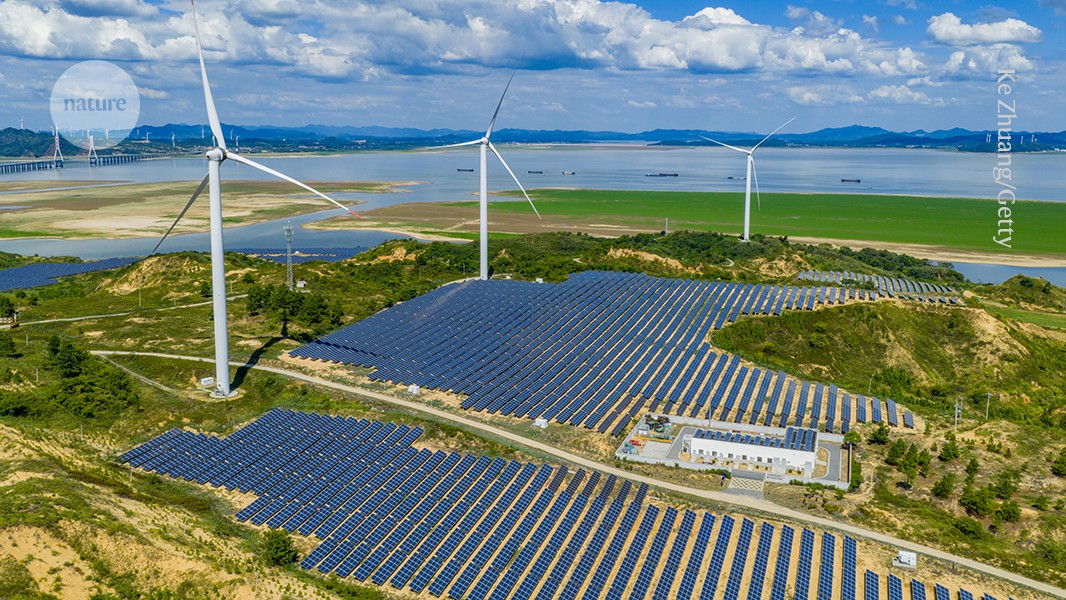
The world today looks very different from that in 2015 when the Paris goal was framed. Although emissions are still rising and global actions on climate change are slow, a lot of progress has been made. Clean energy is expanding rapidly and decarbonization, not fossil fuels, is the new ‘business as usual’. In the first three quarters of 2025, growth in clean electricity generation outpaced that in energy demand for the first time, implying that fossil fuels are being displaced (see go.nature.com/3jvqzcb).
We argue that the main focus of climate action in 2026 and beyond should be on accelerating the clean-energy revolution. And the rate at which clean energy displaces fossil fuels in the global economy should become the key measure of climate progress. Here we describe how such progress can be tracked and incentivized using a metric we call the clean-energy shift. Unlike chasing intangible temperature targets, cleaning up the energy sector is a more-focused battle that the world can win.
Beyond average temperatures
To move forwards, climate scientists and policymakers must first accept that the Paris 1.5 °C target has outlived its usefulness. Although initially valuable as a unifying focus for international efforts to increase mitigation, continuing to emphasize a failed temperature target might produce more harm than good.
One reason is the difficulty of determining when and whether the world has crossed the line. Forecasts suggest that Earth is likely to exceed the 1.5 °C threshold around 2028, for instance (see go.nature.com/4pf95x6). But in the terminology of the Intergovernmental Panel on Climate Change (IPCC), “exceedance” of 1.5 °C refers to the midpoint of a 20-year period at that level3. Confirmation would therefore not come until a decade after the fact.

Environmental treaties are paralysed — here’s how we can do better
Such a target, requiring years of expert interpretation to assess, could never have great salience for decision makers. And it challenges public understanding because, by definition, no person experiences global average temperatures. Moving to a higher number when 1.5 °C is crossed, such as 1.6 °C or 1.7 °C, would only make climate target setting seem arbitrary and unrooted in scientific evidence.
More concerningly, the emphasis on keeping Earth’s temperature below 1.5 °C might serve to justify risky interventions in the climate system. For example, injecting vast amounts of sulfate aerosols into the stratosphere through ‘solar radiation modification’ could be one of the few remaining ways to bring 1.5 °C back into reach. But it might also alter precipitation patterns or result in a burst of warming if the programme were suddenly halted.
More complex temperature targets won’t help. Discussions have begun around the concept of ‘overshoot’, in which the planet’s average temperature would be brought back to 1.5 °C by 2100 after a period exceeding that level4. But its achievement would be even harder to pin down. While in overshoot, no one can be sure whether it is permanent or temporary. A successful return to 1.5 °C could be confirmed only at the end of the century.
Any approach based on projections to 2100 is unlikely to inspire public interest or political action because the goal is so far off. It is hubristic to think that researchers can predict accurately how emerging technologies such as artificial intelligence will affect the climate, or how Earth’s climate system itself will respond to unprecedented conditions.
The clean-energy shift
Instead, we propose that policymakers focus on rapidly building the clean-energy systems that can deliver the safer climate and thriving economies that populations demand. These goals are already agreed. For example, in 2023 at the UN Conference of the Parties (COP) 28 climate summit in Dubai, United Arab Emirates, countries called for a tripling of renewable-energy capacity globally by 2030 and the transition away from fossil fuels to reach net zero by 2050. Whereas delegates at COP30 in Belém, Brazil, in 2025, struggled to agree to phase out fossil fuels, support for accelerating clean energy is almost universal.
To fulfil this mandate, the world needs one clear number with which to measure climate progress during a transition that ends the use of fossil fuels. We think the most promising metric is one we term the ‘clean-energy shift’. Building on a concept initially proposed by Bloomberg New Energy Finance founder Michael Liebreich (see go.nature.com/3zr5y1), we define it as the growth rate in clean-energy generation minus the growth rate in total energy demand for a given time interval.
This metric emphasizes that clean-energy supply must expand faster than overall energy demand for decarbonization. When the percentage growth of clean-energy supply exceeds the growth in total energy use, fossil fuels get squeezed out of the system. By contrast, simply measuring clean energy share is insufficient, because fossil fuels might also rise overall to meet extra demand.

Clouds of steam emanate from a geothermal plant in Iceland.Credit: Getty
For example, if clean-energy grows by 6% each year and total energy demand grows by 3%, the clean-energy shift is +3%, meaning that clean energy is displacing fossil energy as a share of total energy generation. The bigger the number, the faster the exit from fossil fuels.
Clean-energy shift measures progress in a positive way5, towards a 100% clean economy, rather than negatively towards net zero. This would reduce the political resistance that arises from the perceived economic sacrifice of limiting emissions. Chasing the number zero will never motivate politicians concerned about economic development. Framing decarbonization as a story of building clean-energy industries and jobs is more appealing. The metric points to policies that are politically feasible, economically desirable and already advancing rapidly technologically, including solar, wind, batteries, geothermal, hydro and nuclear — without picking winners.
The power of pursuing this approach is evident in recent energy trends. Between 2018 and 2020, the annual percentage growth of clean-energy generation rose sharply, driven by rapid additions of solar, wind and storage capacities. Total global energy demand also grew, but at a slower rate, implying that growth in clean-energy production began eating into the share of fossil fuels. If this clean-energy shift can be increased further, the world would see a peak and then a steady decline in fossil-fuel use and related emissions. Indeed, data from China suggest the nation’s emissions peak could come as soon as this year6.
It is up to policymakers to determine how high the clean-energy shift should be. For example, to eliminate fossil fuels by 2050, the metric would need to rise substantially, from around 4% over the past five years, and keep climbing through the 2030s and 2040s. This means that clean-energy generation must continue its current rapid growth, rising several percentage points faster than total energy demand each year.
Although challenging, trends in solar, wind and storage deployment suggest that this acceleration is achievable — although it will require expanded manufacturing capacity, grids built to integrate renewable technologies, continued reductions in battery costs and political will.
Climbing the climate ladder
To achieve global decarbonization by 2050, policymakers need short-term milestones. We suggest they might set global targets of clean-energy shifts in five-year intervals — like rungs on a ladder, each climbing closer to a safe climate. It should be noted that the intervals are non-linear in terms of added capacity: because clean-energy shift is a percentage-growth metric, the higher rungs reflect increasingly rapid rates of clean-energy expansion, rather than a constant yearly addition.
Encouragingly, the world has already climbed the first two rungs. We calculate an average shift of about 3.4% during 2014–19, rising to about 5.7% in 2024. The next rungs would need to sustain or increase these numbers to enable a fossil-fuels exit by 2050. Lower numbers would mean fossil fuels staying longer as part of the energy mix.
Climate change is devastating mining of minerals needed to fight it
These intervals can be aligned with the five-year timelines used by the UN Framework Convention on Climate Change (UNFCCC) policy process, such as major COP agreements, reviews of ‘nationally determined contributions’ and ‘global stocktakes’ of progress towards the Paris goals for emissions reductions.
The clean-energy shift metric also respects long-established UN principles of equity and accountability, including the concept of ‘common but differentiated responsibilities and respective capabilities’ in climate policy. The metric would not be a legally binding top-down number but the upward product of the collective efforts of all countries, which would continue to determine their own energy policies.
Individual countries can use the metric to track their own progress. And several major emitters already include clean-energy targets in their Paris commitments. For example, India met its 50% non-fossil power capacity goal five years ahead of its 2030 target. China has more than doubled its wind and solar capacity over the past three years. The European Union currently has about one-quarter of its energy consumption supplied by renewable sources, which it has mandated should rise to 42.5% within five years.
Fossil focus
No metric can cover everything. And the clean-energy shift excludes emissions from sources other than fossil fuels, such as greenhouse gases resulting from deforestation, soil cultivation or wildfires. But the climate damage caused by fossil fuels is unique in its scale — comprising 90% of the carbon dioxide problem (38 of 42 gigatonnes in 2024)7.

