


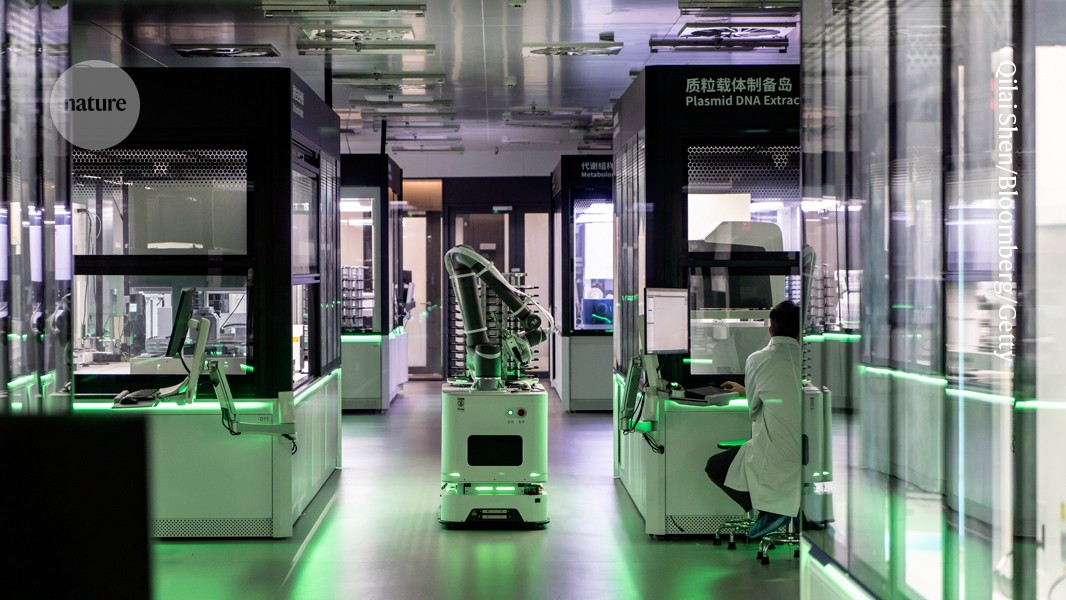
AI-controlled robots will not replace bench scientists soon, but AI systems are already taking work from human data analysts and research coders. Credit: Qilai Shen/Bloomberg/Getty
Artificial intelligence is threatening many jobs, and those in science seem unlikely to be exempt. So which jobs are most at risk?
Seeking answers, Nature spoke to more than four dozen researchers across academia and industry who use AI in their work. Many of them say that AI’s ascendance is already reducing demand for human researchers who can write code or do basic data analysis – tasks often handled by graduate students, postdocs or those without graduate training.
Obsolescence of some basic roles in areas such as computer modelling “is not even in the future. It’s happening now,” says Xuanhe Zhao, a mechanical engineer at the Massachusetts Institute of Technology in Cambridge, because “AI is doing this much better than entry-level scientists”. Workers in some science-adjacent jobs, such as translating papers from one language to another, are also seeing their careers slip away.
This GPT-powered robot chemist designs reactions and makes drugs — on its own
Researchers tend to think that positions involving hands-on experimentation are safer, as are the jobs of senior scientists who organize and coordinate research projects. But a few argue that AI is catching up with humans, even on these higher-level functions.
Jobs involving “purely cognitive tasks will be first” to go, says Anton Korinek, an economist at the University of Virginia in Charlottesville. “Traditionally, these are the jobs that were most closely associated with scientific research,” he says. “They will shortly be taken over by AI.”
Disruptive force
Researchers are already using AI tools for many tasks, such as editing papers and summarizing literature. But at the moment, AI’s ability to generate code and process data is most disruptive to the scientific job market, researchers say.
For example, some academic laboratories employ research programmers to write packages of code that other scientists use. With the advent of AI, such jobs “are now obsolete”, says Brian Hie, a computational biologist at Stanford University in California. Positions that focus on creating simulations and analysing data can now be filled with AI, agrees Zhao.
Will AI ever win its own Nobel? Some predict a prize-worthy science discovery soon
Even if AI has not yet led to lay-offs of such workers, it is already curtailing new positions in science. Hannah Wayment-Steele, a computational biologist at the University of Wisconsin–Madison, says that if she’d been starting her lab five years ago, she “would have thought it would be a really great thing to hire a research programmer. … But now, I really don’t see a need for that” because AI can do even heavy coding, she says.
Nanshu Lu, a materials engineer at the University of Texas at Austin, agrees. “We are much more conservative in hiring future graduate research assistants and postdoctoral researchers,” she says, in part because of funding uncertainties and because of “AI, for sure”.
Some scientists warn of potential dangers if undergraduate students, graduate students and technicians can no longer secure academic laboratory jobs, which provide a stepping stone to other scientific positions. “You might temporarily get more research per dollar,” says Claus Wilke, a computational biologist at the University of Texas at Austin, “but the cost would be a collapse of your pipeline and long-term decline”.
Job losses
Evidence suggests that AI has already triggered job losses in some science-related fields. As AI-powered translators have improved and proliferated, the American Translators Association has seen membership in their Science & Technology Division decline by 26% in a little less than two and a half years.
Some translators have pivoted to new work. For example, Jaime Russell in Chapel Hill, North Carolina, who used to translate clinical-trial documents, is now a medical interpreter, translating spoken conversations between patients and clinicians. But she knows former translators who are now drivers for the food-delivery service DoorDash. “It’s very sad,” she says.
Model limitations
But many researchers say that AI can not yet perform the higher-level tasks that scientists do – for example, deciding the right ideas to pursue as research questions. Jonathan Oppenheim, a quantum physicist at University College London, is no stranger to AI: he has it create mock peer-review reports of each of his manuscripts before submitting to a journal. He finds its critiques helpful, but AI “is not able to really come up with novel ideas”, he says.

