


SiO2 accounts for up to 60% of the Earth’s crust, primarily in minerals such as olivine and pyroxene1. Extraterrestrial bodies, including the Moon2, rocky planets3, chondrules and asteroids2, are derived from SiO2 and other oxides (Al2O3, MgO and so on). Given their ubiquity, these materials play important roles in many natural processes. Of particular consequence is the exchange of electrical charge, or CE, that occurs when two oxides touch. For instance, electrostatic forces on CE-charged particles are implicated in the long residence times and extraordinary distances of fine sands (SiO2) transported during Saharan dust storms4. In volcanic plumes, CE creates displays of ‘volcanic lightning’5,6 that, beyond spectacle, may have provided an energy source to convert primordial molecules into amino acids7. On the Moon, Mars and asteroids, CE presents substantial challenges during space missions8,9,13. Within stellar disks, attractive forces from CE are crucial for the early stages of rocky planet growth10, helping large objects form before gas drag causes them to spiral into their stars14,15.
Despite this universal relevance, we do not know why CE occurs in most situations, including the restricted case of insulator oxides. Furthermore, CE does not just occur between different oxides (for example, SiO2 and Al2O3) but also between samples of the same oxide (for example, SiO2 and SiO2). In the scenarios mentioned above, this ‘same-material’ CE is at play, despite any obvious symmetry-breaking parameter. Experiments show that work-function differences drive electron transfer between metals16,17,18, but no related mechanism has been demonstrated for oxides, different or same material. Different-oxide CE may correlate with acid/base properties, yet this again fails to explain same-material CE (refs. 19,20,21). Other experiments show that adding even a single monolayer of artificial molecular adsorbates can alter CE behaviour. For example, a fused silica (amorphous SiO2) surface dressed with (γ-aminopropyl)dimethylethoxysilane charges positively to a ‘natural’ surface22 (that is, clean and stored in air). Similarly, soda–lime glass dressed with trimethylchlorosilane charges negatively to ‘natural’ soda lime23. This latter result23 is one of many that have pointed towards adsorbed water as an important factor in CE, with oxides and beyond24,25,26,27,28,29, although a definitive connection has remained elusive. Considering these factors, we might speculate that the symmetry-breaking factor responsible for same-material oxide CE resides in the ‘natural’ adsorbates that adhere to surfaces from their environment. Yet this raises questions. Do ‘natural’ adsorbates alone affect oxide CE at all? Which ones matter? And how can two samples in the same environmental conditions acquire differences in these adsorbates to break symmetry?
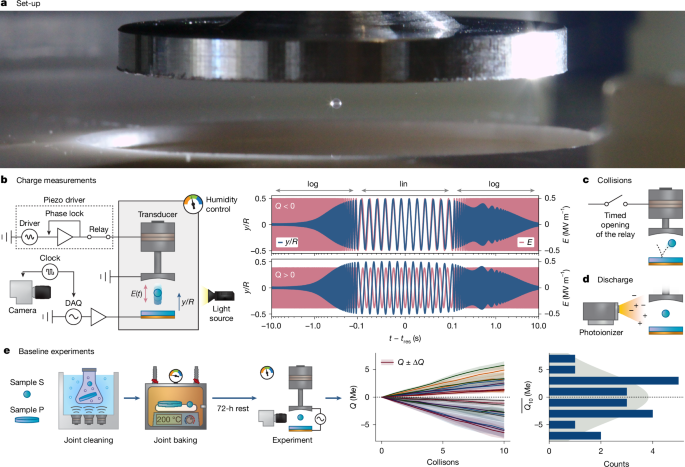
We explore these questions with the experiment shown in Fig. 1a–d. We use acoustic levitation to suspend a small (d ≈ 500 μm) spherical particle above a plate (Fig. 1a), both made from high-purity fused silica (Methods). We measure the charge of the sphere by applying an AC electric field sweep across the acoustic cavity (Fig. 1b) and fitting its trajectory to the equation of motion (Methods). To cause a collision, we briefly (roughly 25 ms) interrupt the acoustic field, letting the sphere fall and bounce off the plate (Fig. 1c). At the apex of its rebound, we reinitiate to ‘catch’ the sphere. Supplementary Video 1 further illustrates how the experiments work. We ensure that spheres/plates begin with zero charge through photoionization of the surrounding air (Fig. 1d and Extended Data Fig. 1). Spheres/plates are subjected to a standardized cleaning protocol: 30 min sonication in acetone, 30 min sonication in methanol, 30 min sonication in ultrapure water, 2 h baking at 200 °C and then storage for >72 h in the experimental chamber. Humidity (30 ± 1% relative humidity) and temperature (25 ± 1 °C) are controlled.

a, We levitate a 500-μm silica sphere in an acoustic trap above a silica target plate. b, Charge is measured by applying a frequency-swept electric field, E(t), and extracting the trajectory of the sphere, y(t), using a high-speed camera. The amplitude and phase of y(t) at resonance depend, respectively, on the magnitude and sign of the particle’s charge, Q. c, Timed interruptions of the acoustic field trigger charge-exchanging collisions between the sphere and the plate, in which the sphere falls, bounces off the plate and is then ‘caught’ again. d, The entire system can be discharged using an X-ray photoionizer. e, Every sphere charges with a systematic sign and magnitude against its partner plate, but the slopes for an ensemble of sphere/plate pairs are spread randomly about zero.
Figure 1e shows the charge acquired over sequential bounces for an ensemble of sphere/plate pairs (see Methods for details on protocol and error bands). Each sphere charges with a definite sign and constant slope against its partner plate, yet for many pairs, the slopes spread randomly about zero. This behaviour—a systematic difference between any two samples but randomized across the ensemble—can be considered the baseline for what is to follow30. Paradoxically, it indicates that each SiO2 sample behaves as a different material in relation to CE.
To test whether atmospheric adsorbates underlie this behaviour, we alter samples not by addition of artificial molecules22,23 but instead by subtraction of those naturally present. We do this with two common treatments: exposure to low-power plasma or mild baking. Both are widely used for removal of adsorbates, for example, in ultrahigh vacuum (UHV) or cleanrooms31. The procedure is shown in Fig. 2a. Two samples are prepared jointly with the standard protocol and their ‘baseline’ CE is measured. Then, one sample (S or P) is retrieved and either plasma treated (5 min) or baked (typically 2 h at 200 °C). The CE measurement is repeated immediately thereafter.

a, We introduce a bias by exposing one sample, plate (P) or sphere (S) to either heat or mild plasma, with the intention of removing naturally occurring adsorbates. b, Spheres treated with plasma always charge negatively to their partner plate, regardless of how they charged before. Conversely, if the plate is treated with plasma, its partner sphere will charge more positively. c, Baking affects the samples in a similar way: baked samples always charge more negatively, to the point of polarity reversal if the temperature/duration of the bake is sufficiently high/long. d, Even a gentle bake of 75 °C for 15 min has a measurable effect, which is cumulative if done successively.
Figure 2b shows results for the case of plasma. The blue curves correspond to the baseline charging of two spheres against their partner plates. In both instances, CE happens to be positive at approximately 105 e per collision. After plasma treating a sphere, it charges negatively (about −105 e per collision). Conversely, treating a plate results in its partner sphere charging more positively (about 5 × 10⁵ e per collision). Baking has the same effect: baking a sphere causes it to charge more negatively, whereas baking a plate causes its partner sphere to charge more positively (Fig. 2c). Temperature and duration matter: baking at 300 °C for 2 h almost always results in negative charging; baking at 200 °C for 2 h usually does; but even 75 °C for 15 min has an effect, which is cumulative if done successively (Fig. 2d).
These data contradict widespread arguments implicating adsorbed water as the symmetry breaker in oxide CE. Generally, it is argued that a hydrophilic surface charges positively to a hydrophobic one by means of donation of OH− (refs. 23,25). Plasma and baking make samples more hydrophilic and adsorbed water reaches equilibrium quickly owing to its abundance in air32,33. Yet we observe that these surfaces charge negatively, not positively. Figure 2 therefore offers provisional insight into our first question; naturally occurring adsorbates do indeed matter in same-material oxide CE but it is not clear that water is the symmetry breaker.
To search for other candidates, we perform time-of-flight secondary ion mass spectrometry (ToF-SIMS) on a silica plate after our standard cleaning protocol (Fig. 3a). Far from just SiO2 and H2O, the surface hosts a cocktail of molecular and atomic species, with adventitious carbon—that is, naturally occurring carbonaceous molecules from the environment—as the marquee ingredient. Detected species include small moieties such as CH3 (m/z = 15) but also larger ones such as C3H6, C4H10 and C6H10 (m/z ≈ 42, 58 and 82, respectively). We use spatially resolved ToF-SIMS to image two of these, C3H6 and C4H10, which reveals extensive coverage (Fig. 3b). If we plasma treat or bake, these species are greatly reduced (see also inset to Fig. 3a and Extended Data Fig. 2). If we remove the sample from UHV, store it in air for several hours and image again, some return. In contrast to water, which readsorbs to an air-exposed32,33 or even UHV-exposed34 surface essentially instantly, these data suggest hours-scale dynamics in the readsorption of adventitious carbon. This allows us to make a prediction about the CE behaviour after baking or plasma—if it is connected to adventitious carbon, it should slowly change with time.

a, Spectra from ToF-SIMS show a cocktail of adsorbed species, especially carbon-based moieties. After plasma treatment (inset plots) or bake (Extended Data Fig. 2), peaks corresponding to these are greatly reduced. The H2O peak increases, highlighting the quick readsorption and equilibration of water, whereas peaks corresponding to the SiO2 matrix are broadly unchanged. b, Spatially resolved ToF-SIMS shows the spread of carbon species about the surface. These species are removed by plasma or baking but then readsorb over time. c, Although a measured charging rate is constant after our standard cleaning and 72-h storage, it evolves over time directly after plasma/baking. The relaxation half-life is typically around 10 h. d, We measure the time-dependent atomic composition of a surface’s outermost atomic layer using LEIS, exposing it to air between measurements. The signal for C is reduced to virtually zero immediately after plasma, then comes back over the same order of time as the charging relaxation. The H signal follows a similar trend, although with an offset at t = 0 h owing to the fast equilibration of silanols and surface water. The Si and O increase immediately after plasma as the bulk is exposed but then decrease as the carbon layer develops. We observe the same trends if we keep a sample in UHV, although with a much longer timescale (about 36 h, dashed line).
We test this prediction by measuring the charging rate (average charge after ten collisions, \(\overline{{Q}_{10}}\)) versus time after treatment. Extended Data Fig. 3 confirms that, after standard cleaning (and the 72-h wait), the charging rate between two samples is stable. Figure 3c shows the evolution immediately after plasma. The two data points before t = 0 h correspond to the initial stable rate. Immediately afterwards, the rate becomes strongly negative, consistent with Fig. 2b. However, thereafter, it evolves over a scale of hours, trending towards its pretreatment value but stabilizing at a new one. As we show in Extended Data Fig. 4, charge-exchange relaxation after baking occurs in the same way. The timescale varies from run to run but is typically around 10 h.
Notably, the readsorption of adventitious carbon exhibits nearly identical post-treatment dynamics. We ascertain this using low-energy ion scattering spectroscopy (LEIS) to monitor the atomic composition of the outermost atomic/molecular layer versus atmospheric storage time (Fig. 3d). Baseline LEIS signals before plasma (t < 0 s) corroborate the presence of adventitious species, with both C and H present (Methods and Extended Data Fig. 5). Immediately after plasma, the Si and O signals increase sharply, whereas C plummets. This confirms the removal of the carbon layer and exposure of the bulk. As a function of storage time, all signals slowly move towards their baseline values but, like the charging data, settle at new ones. Using Fourier transform infrared (FTIR) spectroscopy (Methods), we observe largely identical trends when monitoring CHx stretching modes before and after baking (Extended Data Fig. 6). Crucially, the timescale for the formation of a full carbon layer on the surface, as judged by the evolution of both the LEIS Si/O/C and FTIR CHx signals, is also around 10 h—as observed in the charge-exchange measurements.
The fact that carbon readsorption and charging evolve at a similar rate can be considered a ‘smoking gun’ in the context of CE. In other domains, however, adventitious carbon is so ubiquitously dealt with that its presence and influence might be taken for granted. For example, X-ray photoelectron spectroscopy (XPS) studies routinely use adventitious carbon as a binding energy standard—precisely because it is present on all surfaces35,36. XPS experiments show that adventitious carbon accumulates indefinitely, for which one exceptionally long study found no bound even after 7 months37. Outside vacuum, FTIR spectroscopy has connected adventitious carbon to hydrophobic recovery after plasma treatment38, for which the contact angle evolution occurs on a similar timescale (see Extended Data Figs. 6 and 7, in which we have confirmed this ourselves). Such experiments reveal that the relevant molecules are: (1) present in air at the parts per trillion scale38; (2) susceptible to environmental fluctuations; and (3) not in equilibrium with the surface37. Hence, the precise cocktails on two objects in the same conditions need not be the same—they will depend on the histories of the objects. Our observations reiterate this history dependence: (1) charging rates do not revert to their pretreatment values after plasma/baking (Fig. 3c); (2) LEIS Si/O/C and FTIR CHx signals similarly do not revert (Fig. 3d and Extended Data Fig. 6); and (3) relaxation timescales vary from run to run (Extended Data Fig. 4). Returning to our third question: because of this history-dependent, out-of-equilibrium nature, differences in carbon coverage are the rule not the exception.
These results naturally raise a broader question: do adsorbed carbonaceous molecules also influence CE between different oxides? We imagine three scenarios. In the first, a ‘strong’ carbon effect controls all oxide charging, same or different material. In a second ‘intermediate’ scenario, both the carbon and the material properties matter. In a third ‘weak’ scenario, material effects always dominate. To investigate these possibilities, we assemble samples of several different oxides: alumina (Al2O3), spinel (MgAl2O4), silica (SiO2) and zirconia (ZrO2, stabilized with Y2O3). These vary by solid structure (amorphous, monocrystalline and polycrystalline), compositional homo/heterogeneity (simple oxides, complex oxides and oxides doped with impurities) and orders of magnitude in roughness (from about 1 nm to >200 nm). The materials and their properties are listed in Fig. 4a. We first determine the baseline behaviour of ‘natural’ inter-oxide CE after standard cleaning. The CE outcomes for all material combinations are plotted in matrix form in Fig. 4b, in which the colour indicates the charging rate \(\overline{{Q}_{10}}\) corresponding to either the column ((1)–(5)) or the line material ((6)). Despite marked variability in roughness, crystallinity and so on, these samples form a coherent triboelectric series, that is, a transitive ordering on the basis of the sign of charge acquired. For instance, alumina charges positively against all others, placing it atop the series, whereas spinel charges negatively to alumina but positively to the rest and so on.

a, Samples of four different oxides, with different composition, surface roughness and crystalline structure, are tested against each other. b, When measuring every pair combination with just our standard cleaning protocol, a perfect triboelectric series forms with alumina (Al2O3) at the top and silica (SiO2) at the bottom. c, For every pair combination, we bake the positively charging sample (sphere or plate) to reverse the charging polarity. d, The result is an ‘inverted’ triboelectric series with SiO2 at the top and Al2O3 at the bottom. These data illustrate that the ‘carbon effect’ competes with an underlying material effect. The latter is stronger if full carbon layers are present, whereas the former dominates if one surface is largely absent from carbon.
These data are consistent with previous reports19,20,21 and seemingly support the intermediate or weak scenarios. To differentiate between the two, we perform further experiments with carbon-removing treatments. After each baseline experiment, we retrieve whichever sample charged positively, bake it and perform a second measurement. In every case, removal of carbon reverses the sign of charging (Fig. 4c). This is akin to inverting the triboelectric series (Fig. 4d). As we show in Extended Data Fig. 8, we cause the same sign flips with plasma and the effect extends to all oxides we have tried (MgO, sapphire, borosilicate glass, soda–lime glass). These data support the intermediate scenario. If carbon asymmetry is minimal, charging is influenced by the underlying material. But if one surface is largely stripped of carbon, the material effect can be overridden.
The literature is replete with allusions to ‘surface contamination’ as a confounding factor to be considered in CE, both with oxides and generally, sometimes even calling out ‘organic contaminants’, ‘hydrocarbons’ or ‘adventitious carbon’ by name11,28,39,40,41,42,43. However, we are not aware of studies specifically aimed at understanding its role. It has long been considered as ‘noise’ and not ‘signal’. Here we come to an alternative interpretation: the difference in the adventitious carbon on two same-material oxide surfaces is the symmetry-breaking factor that underlies why they exchange charge. As we show in Extended Data Fig. 9, iteratively removing carbon from both samples of a plate/sphere pair leads to the suppression of CE altogether. For different-oxide CE, the ‘noise’ interpretation is more appropriate. UHV experiments to study CE in the ‘absence’ of adventitious carbon would be valuable, but even there it reaccumulates (see Extended Data Fig. 10). Moreover, the natural phenomena that make oxide CE consequential occur in conditions far less pristine than UHV.
We restrict our conclusions about adventitious carbon to CE among insulating oxides but we would not be surprised if they extend more broadly. For the oxide CE mechanism at the atomic/molecular level, our experiments do not permit a conclusion but do bring to light a largely overlooked factor—it is sensitive to trace carbonaceous adsorbates from the environment. Proposed mechanisms should be compatible with this fact. It is well known that carbon adsorption alters the work function of a metal44,45. Hence, if some ‘work-function’ mechanism occurs with oxides, differences in carbon coverage could matter. Theoretical work argues46 that adsorbates can alter and potentially flip the sign of flexoelectric coefficients. Although we are not aware of experimental evidence for this, if it is confirmed, then mechanisms based on flexoelectricity could be plausible46,47,48. For the role of water in oxide CE (refs. 25,26,27,28), our data show that it is not as simple as previously imagined. We foresee mechanisms involving both carbon and water, for example, in which differences in carbon break symmetry whereas water enhances charge mobility49. Although it is clear that adventitious carbon matters critically, these issues remain unresolved.

