


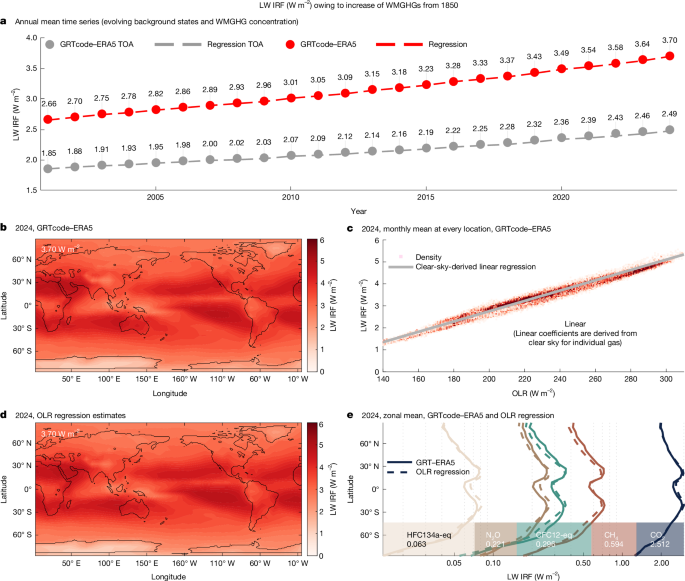
Forster, P. et al. in Climate Change 2021: The Physical Science Basis (eds Masson-Delmotte, V. et al.) Ch. 7 (Cambridge Univ. Press, 2021).
Forster, P. M. et al. Indicators of global climate change 2024: annual update of key indicators of the state of the climate system and human influence. Earth Syst. Sci. Data 17, 2641–2680 (2025).
Collins, W. D. et al. Radiative forcing by well-mixed greenhouse gases: estimates from climate models in the Intergovernmental Panel on Climate Change (IPCC) Fourth Assessment Report (AR4). J. Geophys. Res. Atmos. 111, D14317 (2006).
Hodnebrog, Ø et al. Global warming potentials and radiative efficiencies of halocarbons and related compounds: a comprehensive review. Rev. Geophys. 51, 300–378 (2013).
Huang, Y., Tan, X. & Xia, Y. Inhomogeneous radiative forcing of homogeneous greenhouse gases. J. Geophys. Res. Atmos. 121, 2780–2789 (2016).
Soden, B. J., Collins, W. D. & Feldman, D. R. Reducing uncertainties in climate models. Science 361, 326–327 (2018).
He, H., Kramer, R. J., Soden, B. J. & Jeevanjee, N. State dependence of CO2 forcing and its implications for climate sensitivity. Science 382, 1051–1056 (2023).
Fels, S., Mahlman, J., Schwarzkopf, M. & Sinclair, R. Stratospheric sensitivity to perturbations in ozone and carbon dioxide: radiative and dynamical response. J. Atmos. Sci. 37, 2265–2297 (1980).
Shine, K. P. et al. in Climate Change: The IPCC Scientific Assessment 41–68 (Cambridge Univ. Press, 1990).
Ramaswamy, V. et al. Radiative forcing of climate: the historical evolution of the radiative forcing concept, the forcing agents and their quantification, and applications. Meteorol. Monogr. 59, 14.1–14.101 (2019).
Smith, C. et al. Understanding rapid adjustments to diverse forcing agents. Geophys. Res. Lett. 45, 12–023 (2018).
Meinshausen, M. et al. Historical greenhouse gas concentrations for climate modelling (CMIP6). Geosci. Model Dev. 10, 2057–2116 (2017).
Nicholls, Z., Meinshausen, M., Pflüger, M. & Lewis, J. CMIP GHG Forcing (v1.0.0). Zenodo https://doi.org/10.5281/zenodo.14892947 (2025).
Mlynczak, M. G. et al. The spectroscopic foundation of radiative forcing of climate by carbon dioxide. Geophys. Res. Lett. 43, 5318–5325 (2016).
Etminan, M., Myhre, G., Highwood, E. J. & Shine, K. P. Radiative forcing of carbon dioxide, methane, and nitrous oxide: a significant revision of the methane radiative forcing. Geophys. Res. Lett. 43, 12–614 (2016).
Pincus, R. et al. Benchmark calculations of radiative forcing by greenhouse gases. J. Geophys. Res. Atmos. 125, e2020JD033483 (2020).
Andrews, T. & Forster, P. M. CO2 forcing induces semi-direct effects with consequences for climate feedback interpretations. Geophys. Res. Lett. 35, L04802 (2008).
Zhang, M. & Huang, Y. Radiative forcing of quadrupling CO2. J. Clim. 27, 2496–2508 (2014).
Jeevanjee, N., Seeley, J. T., Paynter, D. & Fueglistaler, S. An analytical model for spatially varying clear-sky CO2 forcing. J. Clim. 34, 9463–9480 (2021).
Myhre, G., Stordal, F., Gausemel, I., Nielsen, C. J. & Mahieu, E. Line-by-line calculations of thermal infrared radiation representative for global condition: CFC-12 as an example. J. Quant. Spectrosc. Radiat. Transfer 97, 317–331 (2006).
Byrom, R. E. & Shine, K. P. Methane’s solar radiative forcing. Geophys. Res. Lett. 49, e2022GL098270 (2022).
Czarnecki, P., Polvani, L. M. & Pincus, R. Analytical models of instantaneous radiative forcing across opacity regimes. J. Clim. 38, 7351–7368 (2025).
Koll, D. D. & Cronin, T. W. Earth’s outgoing longwave radiation linear due to H2O greenhouse effect. Proc. Natl Acad. Sci. USA 115, 10293–10298 (2018).
Feng, J., Paynter, D., Wang, C. & Menzel, R. How atmospheric humidity drives the outgoing longwave radiation–surface temperature relationship and inter-model spread. Environ. Res. Lett. 18, 104033 (2023).
Pincus, R., Hemler, R. & Klein, S. A. Using stochastically generated subcolumns to represent cloud structure in a large-scale model. Mon. Weather Rev. 134, 3644–3656 (2006).
Wright, J. S. et al. Differences in tropical high clouds among reanalyses: origins and radiative impacts. Atmos. Chem. Phys. 20, 8989–9030 (2020).
Huang, H. & Huang, Y. Diagnosing the radiation biases in global climate models using radiative kernels. Geophys. Res. Lett. 50, e2023GL103723 (2023).
Smith, C. J. et al. Effective radiative forcing and adjustments in CMIP6 models. Atmos. Chem. Phys. 20, 9591–9618 (2020).
Strow, L. L. & DeSouza-Machado, S. Establishment of AIRS climate-level radiometric stability using radiance anomaly retrievals of minor gases and sea surface temperature. Atmos. Meas. Tech. 13, 4619–4644 (2020).
Teixeira, J., Wilson, R. C. & Thrastarson, H. T. Direct observational evidence from space of the effect of CO2 increase on longwave spectral radiances: the unique role of high-spectral-resolution measurements. Atmos. Chem. Phys. 24, 6375–6383 (2024).
Kramer, R. J. et al. Observational evidence of increasing global radiative forcing. Geophys. Res. Lett. 48, e2020GL091585 (2021).
Hersbach, H. et al. The ERA5 global reanalysis. Q. J. R. Meteorol. Soc. 146, 1999–2049 (2020).
Lan, X., Thoning, K. W. & Dlugokencky, E. J. Trends in globally-averaged CH4, N2O, and SF6 determined from NOAA Global Monitoring Laboratory measurements. Version 2025-05. NOAA Global Monitoring Laboratory (2025).
Oreopoulos, L., Cho, N. & Lee, D. Revisiting cloud overlap with a merged dataset of liquid and ice cloud extinction from CloudSat and CALIPSO. Front. Remote Sens. 3, 1076471 (2022).
Mie, G. Beiträge zur Optik trüber Medien, speziell kolloidaler Metallösungen. Ann. Phys. 330, 377–445 (1908).
Mitchell, D. L. Effective diameter in radiation transfer: general definition, applications, and limitations. J. Atmos. Sci. 59, 2330–2346 (2002).
Feng, J., Menzel, R. & Paynter, D. Toward transparency and consistency: an open-source optics parameterization for clouds and precipitation. J. Adv. Model. Earth Syst. 17, e2024MS004478 (2025).
Loeb, N. G. et al. Clouds and the Earth’s Radiant Energy System (CERES) Energy Balanced and Filled (EBAF) top-of-atmosphere (TOA) edition-4.0 data product. J. Clim. 31, 895–918 (2018).
Loeb, N. G. et al. Toward optimal closure of the Earth’s top-of-atmosphere radiation budget. J. Clim. 22, 748–766 (2009).
Pincus, R., Mlawer, E. J. & Delamere, J. S. Balancing accuracy, efficiency, and flexibility in radiation calculations for dynamical models. J. Adv. Model. Earth Syst. 11, 3074–3089 (2019).
Roemer, F. E., Buehler, S. A. & Menang, K. P. How to think about the clear-sky shortwave water vapor feedback. npj Clim. Atmos. Sci. 8, 274 (2025).
Goodwin, P., Williams, R. G., Ceppi, P. & Cael, B. Climate feedbacks derived from spatial gradients in recent climatology. J. Geophys. Res. Atmos. 130, e2024JD043186 (2025).
Gristey, J. J. A perspective on shortwave radiative energy flows in the Earth system. Adv. Atmos. Sci. 43, 295–306 (2026).
Shi, C. et al. Near-global monitoring of surface solar radiation through the construction of a geostationary satellite network observation system. Innovation 6, 100876 (2025).
Shine, K. P., Byrom, R. E. & Checa-Garcia, R. Separating the shortwave and longwave components of greenhouse gas radiative forcing. Atmos. Sci. Lett. 23, e1116 (2022).
Loeb, N. G. et al. Continuity in top-of-atmosphere earth radiation budget observations. J. Clim. 37, 6093–6108 (2024).
Feng, J. Scripts and data for “a strong constraint on radiative forcing of well-mixed greenhouse gases”. Zenodo https://doi.org/10.5281/zenodo.17458936 (2025).
NASA/LARC/SD/ASDC. CERES Energy Balanced and Filled (EBAF) TOA and surface monthly means data in netCDF edition 4.2. ASDC https://doi.org/10.5067/TERRA-AQUA-NOAA20/CERES/EBAF_L3B004.2 (2023).
Eyring, V. et al. Overview of the Coupled Model Intercomparison Project Phase 6 (CMIP6) experimental design and organization. Geosci. Model Dev. 9, 1937–1958 (2016).
Gordon, I. E. et al. The HITRAN2016 molecular spectroscopic database. J. Quant. Spectrosc. Radiat. Transfer 203, 3–69 (2017).
Mlawer, E. J. et al. Development and recent evaluation of the MT_CKD model of continuum absorption. Philos. Trans. R. Soc. A Math. Phys. Eng. Sci. 370, 2520–2556 (2012).
Clough, S. A. et al. Atmospheric radiative transfer modeling: a summary of the AER codes. J. Quant. Spectrosc. Radiat. Transfer 91, 233–244 (2005).
Dudhia, A. The reference forward model (RFM). J. Quant. Spectrosc. Radiat. Transfer 186, 243–253 (2017).
Cheruy, F., Scott, N., Armante, R., Tournier, B. & Chedin, A. Contribution to the development of radiative transfer models for high spectral resolution observations in the infrared. J. Quant. Spectrosc. Radiat. Transfer 53, 597–611 (1995).
Buehler, S. A. et al. ARTS, the Atmospheric Radiative Transfer Simulator–version 2.2, the planetary toolbox edition. Geosci. Model Dev. 11, 1537–1556 (2018).
Feng, J. & Huang, Y. Impacts of tropical cyclones on the thermodynamic conditions in the tropical tropopause layer observed by A-Train satellites. Atmos. Chem. Phys. 21, 15493–15518 (2021).
Liu, L., Huang, Y. & Gyakum, J. R. Clouds reduce downwelling longwave radiation over land in a warming climate. Nature 637, 868–874 (2025).
Yang, P. et al. Spectrally consistent scattering, absorption, and polarization properties of atmospheric ice crystals at wavelengths from 0.2 to 100 μm. J. Atmos. Sci. 70, 330–347 (2013).
Raghuraman, S. P., Paynter, D., Ramaswamy, V., Menzel, R. & Huang, X. Greenhouse gas forcing and climate feedback signatures identified in hyperspectral infrared satellite observations. Geophys. Res. Lett. 50, e2023GL103947 (2023).
Letu, H. et al. Ice cloud properties from Himawari-8/AHI next-generation geostationary satellite: capability of the AHI to monitor the DC cloud generation process. IEEE Trans. Geosci. Remote Sens. 57, 3229–3239 (2018).
Li, M. et al. Investigation of ice cloud modeling capabilities for the irregularly shaped Voronoi ice scattering models in climate simulations. Atmos. Chem. Phys. 22, 4809–4825 (2022).
Hersbach, H. et al. ERA5 monthly averaged data on pressure levels from 1940 to present. Climate Data Store https://doi.org/10.24381/cds.6860a573 (2023).
Lan, X. et al. Trends in globally-averaged CO2 determined from NOAA Global Monitoring Laboratory measurements. NOAA Global Monitoring Laboratory (2023).
Huang, Y. & Bani Shahabadi, M. Why logarithmic? A note on the dependence of radiative forcing on gas concentration. J. Geophys. Res. Atmos. 119, 13–683 (2014).
Forster, P. M. de F. et al. Resolution of the uncertainties in the radiative forcing of HFC-134a. J. Quant. Spectrosc. Radiat. Transfer 93, 447–460 (2005).
Chen, Y.-T., Merlis, T. M. & Huang, Y. The cause of negative CO2 forcing at the top-of-atmosphere: the role of stratospheric versus tropospheric temperature inversions. Geophys. Res. Lett. 51, e2023GL106433 (2024).
Young, P. J., Thompson, D. W., Rosenlof, K. H., Solomon, S. & Lamarque, J.-F. The seasonal cycle and interannual variability in stratospheric temperatures and links to the Brewer–Dobson circulation: an analysis of MSU and SSU data. J. Clim. 24, 6243–6258 (2011).
Cronin, T. W. & Dutta, I. How well do we understand the Planck feedback? J. Adv. Model. Earth Syst. 15, e2023MS003729 (2023).
WMO. Report of the meeting of experts on potential climatic effects of ozone and other minor trace gases. Technical report (1982).
Griggs, D. J. & Noguer, M. Climate change 2001: the scientific basis. Contribution of Working Group I to the Third Assessment Report of the Intergovernmental Panel on Climate Change. Weather 57, 267–269 (2002).
Myhre, G. et al. in Climate Change 2013: The Physical Science Basis (eds Stocker, T. F. et al.) 659–740 (Cambridge Univ. Press, 2013).
Chen, Y.-T., Huang, Y. & Merlis, T. M. The global patterns of instantaneous CO2 forcing at the top of the atmosphere and the surface. J. Clim. 36, 6331–6347 (2023).
Byrne, B. & Goldblatt, C. Radiative forcing at high concentrations of well-mixed greenhouse gases. Geophys. Res. Lett. 41, 152–160 (2014).
Shine, K. P. & Myhre, G. The spectral nature of stratospheric temperature adjustment and its application to halocarbon radiative forcing. J. Adv. Model. Earth Syst. 12, e2019MS001951 (2020).
The MathWorks, Inc. Mapping Toolbox. https://www.mathworks.com (2021).
Feng, J. Scripts for “a strong constraint on radiative forcing of well-mixed greenhouse gases”. Code Ocean https://doi.org/10.24433/CO.0711190.v2 (2026).
Wu, T. et al. The Beijing Climate Center Climate System Model (BCC-CSM): the main progress from CMIP5 to CMIP6. Geosci. Model Dev. 12, 1573–1600 (2019).
Voldoire, A. et al. Evaluation of CMIP6 deck experiments with CNRM-CM6-1. J. Adv. Model. Earth Syst. 11, 2177–2213 (2019).
Boucher, O. et al. Presentation and evaluation of the IPSL-CM6A-LR climate model. J. Adv. Model. Earth Syst. 12, e2019MS002010 (2020).
Watanabe, M. et al. Improved climate simulation by MIROC5: mean states, variability, and climate sensitivity. J. Clim. 23, 6312–6335 (2010).
Held, I. et al. Structure and performance of GFDL’s CM4.0 climate model. J. Adv. Model. Earth Syst. 11, 3691–3727 (2019).
Williams, K. D. et al. The Met Office global coupled model 3.0 and 3.1 (GC3.0 and GC3.1) configurations. J. Adv. Model. Earth Syst. 10, 357–380 (2018).

