


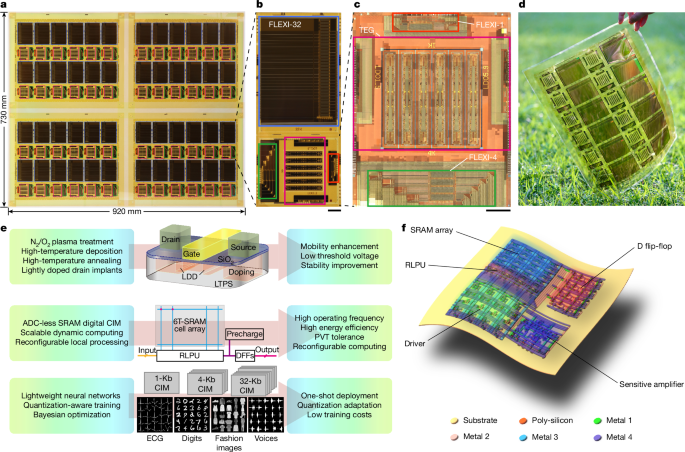
Takeda, Y. et al. Fabrication of ultra-thin printed organic TFT CMOS logic circuits optimized for low-voltage wearable sensor applications. Sci. Rep. 6, 25714 (2016).
Musk, E. An integrated brain-machine interface platform with thousands of channels. J. Med. Internet Res. 21, e16194 (2019).
McGlynn, E. et al. The future of neuroscience: flexible and wireless implantable neural electronics. Adv. Sci. 8, 2002693 (2021).
Zhan, Y., Mei, Y. & Zheng, L. Materials capability and device performance in flexible electronics for the Internet of Things. J. Mater. Chem. C 2, 1220–1232 (2014).
Khan, A. I., Keshavarzi, A. & Datta, S. The future of ferroelectric field-effect transistor technology. Nat. Electron. 3, 588–597 (2020).
Liu, Z. et al. A three-dimensionally architected electronic skin mimicking human mechanosensation. Science 384, 987–994 (2024).
Jung, Y. H. et al. A wireless haptic interface for programmable patterns of touch across large areas of the skin. Nat. Electron. 5, 374–385 (2022).
Jiang, Y. et al. A universal interface for plug-and-play assembly of stretchable devices. Nature 614, 456–462 (2023).
He, J. et al. Scalable production of high-performing woven lithium-ion fibre batteries. Nature 597, 57–63 (2021).
Shi, R. et al. An integrated analog front-end system on flexible substrate for the acquisition of bio-potential signals. Adv. Sci. 10, 2207683 (2023).
Papadopoulos, N. et al. Touchscreen tags based on thin-film electronics for the Internet of Everything. Nat. Electron. 2, 606–611 (2019).
Wang, W. et al. Neuromorphic sensorimotor loop embodied by monolithically integrated, low-voltage, soft e-skin. Science 380, 735–742 (2023).
Dembo, H. et al. RFCPUs on glass and plastic substrates fabricated by TFT transfer technology. In IEEE International Electron Devices Meeting (IEDM) 125–127 (IEEE, 2005).
Karaki, N. et al. A flexible 8b asynchronous microprocessor based on low-temperature poly-silicon TFT technology. In IEEE International Solid-State Circuits Conference (ISSCC) 272–589 (IEEE, 2005).
Kurokawa, Y. et al. UHF RFCPUs on flexible and glass substrates for secure RFID systems. IEEE J. Solid State Circuit 43, 292–299 (2008).
Geng, D. et al. Thin-film transistors for large-area electronics. Nat. Electron. 6, 963–972 (2023).
Yan, A. et al. Thin-film transistors for integrated circuits: fundamentals and recent progress. Adv. Funct. Mater. 34, 2304409 (2024).
Biggs, J. et al. A natively flexible 32-bit Arm microprocessor. Nature 595, 532–536 (2021).
Celiker, H., Dehaene, W. & Myny, K. Multi-project wafers for flexible thin-film electronics by independent foundries. Nature 629, 335–340 (2024).
Ozer, E. et al. Bendable non-silicon RISC-V microprocessor. Nature 634, 341–346 (2024).
Ozer, E. et al. A hardwired machine learning processing engine fabricated with submicron metal-oxide thin-film transistors on a flexible substrate. Nat. Electron. 3, 419–425 (2020).
Ozer, E. et al. Malodour classification with low-cost flexible electronics. Nat. Commun. 14, 777 (2023).
Si, J. et al. A carbon-nanotube-based tensor processing unit. Nat. Electron. 7, 684–693 (2024).
Liu, J. et al. TFT-based near-sensor in-memory computing: circuits and architecture perspectives of large-area eDRAM and ROM CiM chips. IEEE Trans. Circuits Syst. I 71, 620–633 (2024).
Tang, W. et al. Low-power and scalable BEOL-compatible IGZO TFT eDRAM-based charge-domain computing. IEEE Trans. Circuits Syst. I 70, 5166–5179 (2023).
Sun, Z. et al. A full spectrum of computing-in-memory technologies. Nat. Electron. 6, 823–835 (2023).
Grossar, E., Stucchi, M., Maex, K. & Dehaene, W. Read stability and write-ability analysis of SRAM cells for nanometer technologies. IEEE J. Solid State Circuit 41, 2577–2588 (2006).
Liu, A. et al. Selenium-alloyed tellurium oxide for amorphous p-channel transistors. Nature 629, 798–802 (2024).
Myny, K. The development of flexible integrated circuits based on thin-film transistors. Nat. Electron. 1, 30–39 (2018).
Shulaker, M. et al. Carbon nanotube computer. Nature 501, 526–530 (2013).
Hills, G. et al. Modern microprocessor built from complementary carbon nanotube transistors. Nature 572, 595–602 (2019).
Shen, Y., Liu, X., Guo, X., Zhang, W. & Zhu, X. The back-channel effect in low temperature poly-Si thin film transistors. In SID Symposium Digest of Technical Papers 1418–1420 (IEEE, 2024).
Yan, B. et al. A 1.041-Mb/mm2 27.38-TOPS/W signed-INT8 dynamic-logic-based ADC-less SRAM compute-in-memory macro in 28nm with reconfigurable bitwise operation for AI and embedded applications. In IEEE International Solid-State Circuits Conference (ISSCC) 188–190 (IEEE, 2022).
Moody, G. & Mark, R. The impact of the MIT-BIH arrhythmia database. IEEE Eng. Med. Biol. Mag. 20, 45–50 (2001).
Zhong, Y. et al. A memristor-based analogue reservoir computing system for real-time and power-efficient signal processing. Nat. Electron. 5, 672–681 (2022).
Howard, A. G. Mobilenets: efficient convolutional neural networks for mobile vision applications. Preprint at https://arxiv.org/abs/1704.04861 (2017).
Iandola, F. N. SqueezeNet: AlexNet-level accuracy with 50x fewer parameters and <0.5 MB model size. Preprint at https://arxiv.org/abs/1602.07360 (2016).
Xu, C. et al. Depth-based subgraph convolutional neural networks. In 2018 24th International Conference on Pattern Recognition (ICPR) 1024–1029 (IEEE, 2018).
Chollet, F. Xception: deep learning with depthwise separable convolutions. In Proc. IEEE Conference on Computer Vision and Pattern Recognition (CVPR) 1251–1258 (IEEE, 2017).
Lin, M., Chen, Q., & Yan, S. Network in network. In 2nd International Conference on Learning Representations (ICLR, 2014).
Krizhevsky, A., Sutskever, I. & Hinton, G. ImageNet classification with deep convolutional neural networks. Commun. ACM 60, 84–90 (2017).
Jacob, B. et al. Quantization and training of neural networks for efficient integer-arithmetic-only inference. In Proc. IEEE Conference on Computer Vision and Pattern Recognition (CVPR) 2704–2713 (IEEE, 2018).
Hubara, I., Courbariaux, M., Soudry, D., El-Yaniv, R. & Bengio, Y. Quantized neural networks: training neural networks with low precision weights and activations. J. Mach. Learn. Res. 18, 187 (2018).
Bergstra, J., Bardenet, R., Bengio, Y. & Kégl, B. Algorithms for hyper-parameter optimization. Adv. Neural Inf. Process. Syst. 24, 2546–2554 (2011).
Absel, K., Manuel, L. & Kavitha, R. Low-power dual dynamic node pulsed hybrid flip-flop featuring efficient embedded logic. IEEE Trans. VLSI Syst. 21, 1693–1704 (2013).
Celiker, H., Sou, A., Cobb, B., Dehaene, W. & Myny, K. Flex6502: a flexible 8b microprocessor in 0.8mum metal-oxide thin-film transistor technology implemented with a complete digital design flow running complex assembly code. In IEEE International Solid-State Circuits Conference (ISSCC) 272–274 (IEEE, 2022).
Myny, K. et al. An 8-bit, 40-instructions-per-second organic microprocessor on plastic foil. IEEE J. Solid State Circuit 47, 284–291 (2012).
Bleier, N. et al. FlexiCores: low footprint, high yield, field reprogrammable flexible microprocessors. In 49th IEEE/ACM Annual International Symposium on Computer Architecture (ISCA) 831–846 (IEEE, 2022).
Myny, K. et al. 8b thin-film microprocessor using a hybrid oxide-organic complementary technology with inkjet-printed P2ROM memory. In IEEE International Solid-State Circuits Conference Digest of Technical Papers (ISSCC) 486–487 (IEEE, 2014).
Ozer, E. et al. Binary neural network as a flexible integrated circuit for odour classification. In 2nd IEEE International Conference on Flexible and Printable Sensors and Systems (FLEPS) 1–4 (IEEE, 2020).
Shen, P. A flexible all-digital compute-in-memory AI chip for edge-computing. Zenodo https://doi.org/10.5281/zenodo.14268923 (2024).

