


You have full access to this article via your institution.
Hello Nature readers, would you like to get this Briefing in your inbox free every day? Sign up here.

Taking multivitamins daily was associated with changes in epigenetic ageing ‘clocks’.Credit: Halfpoint Images/Getty
Taking a multivitamin every day seems to slow some markers of biological ageing. Researchers found that, in older adults, the daily supplement could slow epigenetic ‘clocks’ — markers that indicate a person’s biological age — by around four months over two years. The effect was particularly pronounced in people who were already biologically older than their years, which raises the question of whether multivitamins are slowing these clocks, or can actually roll them back, says epigeneticist Chiara Herzog.
Reference: Nature Medicine paper
Read more from ageing researchers Daniel Belsky and Calen Ryan in Nature Medicine News & Views (6 min read)
Researchers have trained artificial-intelligence agents to mimic the behaviours of people in an attempt to replicate the way in which human groups interact. Companies such as AI start-up Simile hope to use these AI ‘societies’ to model people’s behaviours in situations such as conflict resolution, policy decision-making and consumer markets. But other projects, such as the AI social-media platform Moltbook, have revealed that the modes of social interaction shown by people and bots are fundamentally different, presenting a big hurdle in the quest to accurately simulate human behaviours, researchers say.
Haematologist and oncologist Vinay Prasad is to leave the US Food and Drug Administration (FDA), where he is chief science and medical officer, and head of vaccines. (He was fired in July 2025, then re-joined a few weeks later.) Prasad has been a focus of controversy at the agency and his departure is the latest in a series of tumultuous leadership changes. Chaos at the agency can have a global ripple effect: for example, many countries rely on FDA assessments to guide their own policies.
In January, a feature in The New Yorker raised questions about the validity of reports that babies can be exposed to opioids from painkillers, such as Tylenol 3, taken by a breastfeeding mother. Case studies in The Lancet, Canadian Family Physician and Canadian Pharmacists Journal that supported the idea have now been retracted or have an expression of concern attached. In the meantime, the discredited studies have been cited hundreds of times and served as evidence in court cases. Another side-effect of The New Yorker coverage: 138 case reports in the journal Paediatrics & Child Health have been newly labelled as fiction. The case reports — including one that fed into the idea that codeine can kill if passed through breastfeeding — were always “a teaching tool”, says the journal.
The New Yorker | 52 min read & Retraction Watch | 12 min read
Reference: The Lancet paper (expression of concern), Canadian Family Physician paper (retracted), Canadian Pharmacists Journal paper (retracted) & Paediatrics & Child Health paper (corrected)
Features & opinion
The social-media-fuelled pursuit of youthful, glowing skin has made people “much more likely to experiment on themselves” with multi-step skincare routines than they have been in the past, says dermatologist Rajani Katta. But many viral skincare trends use products with little to no scientific backing, and misinformation is rife. Dermatologists agree that sunscreen and a well-balanced moisturizer can help to keep skin healthy, but evidence suggests that lifestyle factors — such as eating a nutrient-dense diet — are arguably more important.
Archaeologists have long focused on bones and other relatively macroscopic artefacts, but they are now teaming up with geochemists, palaeoecologists and biologists to dig ever deeper. Sediment cores pulled from caves, swamps and permafrost that have long hosted human settlements reveal the remains of organic material that contain clues about past climates, traces of DNA, pollutants from fires and even enduring molecules from human faeces. But analysing such traces can be fiendishly difficult.
In Salt Lakes, geographer Caroline Tracey uniquely blends an academic survey of the titular bodies of water, a coming-of-age memoir and an introduction to ‘queer ecology’ — a field that aims to break down the fixed, binary categories that characterize conventional environmental conservation. “Salt Lakes is a book of leaps, gaps and juxtapositions,” writes science journalist Josie Glausiusz in her review. Tracey covers various examples of salt lakes, past and present, and the threats they face, but devotes little attention to solutions, which “makes for uneven reading”, Glausiusz writes.
Image of the week

Credit: Jono Allen
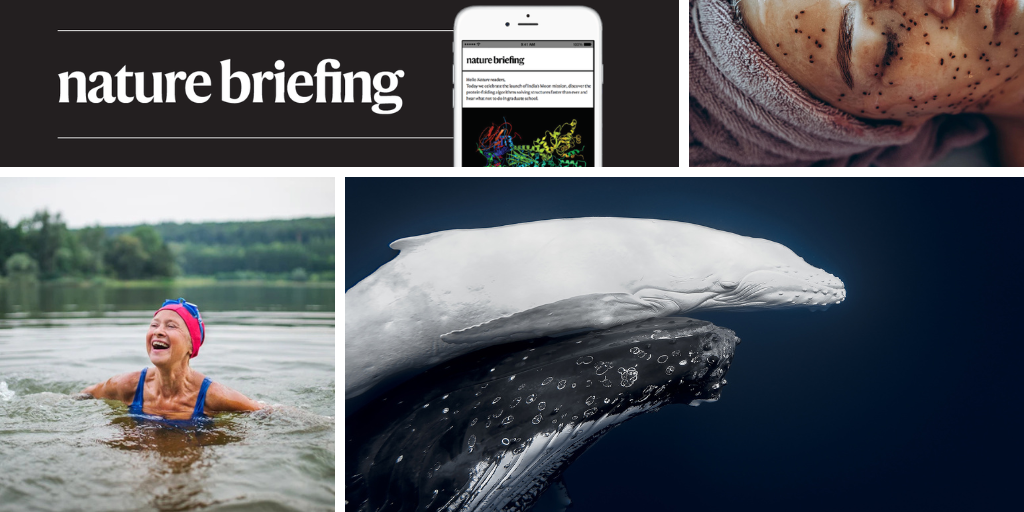
This photograph that captures the unique bond between a rare white humpback whale (Megaptera novaeangliae) and her mother won the grand prize in the World Nature Photographer of the Year. Photographer Jono Allen took the image in the South Pacific Ocean near Tonga. The calf — named Mãhina, which means ‘moon’ in Tongan — was born without pigmentation, a 1-in-40,000 occurrence. “It was undoubtedly one of the most extraordinary days I have ever experienced in the ocean — and perhaps ever will,” said Allen.
See more of the month’s sharpest science shots, selected by Nature’s photo team. (Jono Allen)
Today I’m celebrating the reproductive success of New Zealand’s kākāpōs (Strigops habroptilus). The gorgeously goofy flightless parrots are caring for more than 240 eggs this year in response to a bumper crop of berries from the rimu tree (Dacrydium cupressinum). Kākāpō mating is triggered by an abundant rimu ‘mast’ year, and this is the first since 2022. There were only 236 kākāpōs at the start of the year, so every chick that survives will be very welcome.
It also gives me another chance to highlight the kākāpō closest to my heart, and those of many Briefing readers: Steve (voiced by comedian Rhys Darby).
While I stay glued to the webcam of Rakiura the kākāpō’s underground nest, why not send me your feedback on this newsletter? Your e-mails are always welcome at [email protected].
Thanks for reading,
Flora Graham, senior editor, Nature Briefing
With contributions by Jacob Smith
• Nature Briefing: Careers — insights, advice and award-winning journalism to help you optimize your working life
• Nature Briefing: Microbiology — the most abundant living entities on our planet — microorganisms — and the role they play in health, the environment and food systems
• Nature Briefing: Anthropocene — climate change, biodiversity, sustainability and geoengineering
• Nature Briefing: AI & Robotics — 100% written by humans, of course
• Nature Briefing: Cancer — a weekly newsletter written with cancer researchers in mind
• Nature Briefing: Translational Research — covers biotechnology, drug discovery and pharma

