




A 1945 report by Vannevar Bush, director of the US Office of Scientific Research and Development, was seminal to the growth of US research.Credit: AP/Alamy
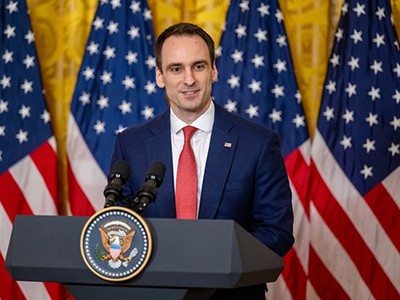
Last month, Michael Kratsios, head of the US Office of Science and Technology Policy (OSTP), released a report called Science: A New Golden Age. The 123-page document is a response to a letter from US President Donald Trump tasking Kratsios with ushering in “a new golden age of American innovation” (see go.nature.com/8tyfk4k). But how likely is it that the report will help the country to achieve this aim?
White House rolls out AI funding — and signals a new era for US science
Such a letter from the president to the OSTP head is not uncommon. It is a signal of the government’s interests and priorities. However, Trump’s letter and the response come amid a systematic effort to reshape US research.
There’s a lot to take in. The report asks hard questions about the future of US science, including about how to support the research that provides the foundations for technological advances and how to enhance crucial scientific infrastructure. There are timely questions about the role of artificial intelligence in science and around the process of issuing research grants. The report proposes changes, too, to how the US federal research-funding portfolio is balanced, for instance. It addresses the persistent concern that grant managers and reviewers are too cautious, and proposes fresh ways to fund people who are willing to take risks and to individuals outside universities. The details need time for reflection and we plan to return to some of the report’s themes in greater depth in future articles.
Before diving deeper into the report’s content, it’s important to consider its precedents and the context in which it was produced. A key predecessor is a 1945 report called Science: The Endless Frontier, which was submitted to then-president Harry Truman by Vannevar Bush, director of the Office of Scientific Research and Development at the time (see go.nature.com/4g7nufa). Produced in the aftermath of the Second World War, this fundamental document in US science policy led to the establishment of a new public funding agency for basic research: the National Science Foundation. The report and its implementation took several years and was a highly inclusive exercise with inputs from academia, industry and policymakers.

White House proposes vast overhaul of US science funding: what you need to know
Science: A New Golden Age has also been written during a tumultuous period, but of a different kind. It was released after 18 months of executive orders, rule changes, abrupt funding cuts, delays to grants being awarded and political interference in many scientific matters that should be the domain of experts, ranging from vaccine safety to climate change. However, unlike the 1945 report, the current one does not name the members of scientific and technical communities who were consulted. This follows a pattern: Trump’s administration has substantially reduced the flow of advice from independent specialists to the federal government, as we documented in an April News Feature (Nature 652, 1106–1109; 2026).
Science: A New Golden Age, at its core, is a set of priorities from Trump’s administration for scientific leaders to focus on. The fields named include “AI, quantum information science, semiconductors, advanced communications, robotics, advanced manufacturing, nuclear fission and fusion, and space systems”. Such large-scale instructions to the research community, without transparent consultation with its stakeholders, is rare for a democratic country — let alone for a powerhouse of research and the home of many globally respected universities and science-based corporations.
But the details of these instructions are not straightforward to find. They are included in an annex in the main document. This part contains a memorandum for the heads of departments and executive agencies co-signed by Kratsios and Russell Vought, the director of the Office of Management and Budget. The annex includes a list of what the document calls “foundational research to drive scientific breakthroughs for emerging technologies”.
Yes minister
The priorities focus mainly on research in physics, materials science, chemistry, computer science, engineering, space science and mathematics, and especially on “national security-relevant research portfolios”. Federal agencies with annual research budgets of at least US$3 billion have 90 days to tell the White House how they will “prioritize both the absolute level and the relative share of funding”. Furthermore, to support the administration’s priorities in biotechnology and biomanufacturing, agencies are being asked to “prioritize foundational research in the biological sciences over the life sciences, a broader category not focused on foundational research”. Details on which fields will be prioritized for funding extend over several pages.

Key US science panels are being axed — and others are becoming less open
But the people who can assess foundational science accurately are those closest to it: the researchers and their representative societies. The report says that parties “across the country’s scientific enterprise” have been consulted, but doesn’t specify who has provided input. Which scientists or organizations in fields such as physics, computer science, space science and chemistry were asked for feedback? Who is saying that life sciences does not focus on foundational research?
One glaring omission in this proposal for overhauling science is direct evidence of input from the National Academies of Sciences, Engineering, and Medicine and from scholarly societies representing individual disciplines. These communities are the modern equivalents of professional guilds. They organize conferences and publish research in their fields; they act as stewards for their disciplines, by setting quality standards, for instance. They represent the field’s interests to policymakers, and protect and defend scholarly integrity.
Missing in action
Entire NSF science advisory board fired by Trump administration
The report’s outlook for the future of science also does not mention some key research areas, such as climate change and public health. Neither is research in social sciences included, although metascience is mentioned. These are surprising omissions, considering that national security is an objective. Climate change and emerging infectious diseases will have huge consequences, for both the United States and the world. Studies in the social sciences and humanities are just as important as those in science and engineering, and will be necessary to help societies to navigate the transformational impacts of AI.
Other surprising omissions from the report’s annex are phrases such as world, global and international cooperation. This is in keeping with Trump’s decision to withdraw funding for, and the country’s participation in, international scientific networks such as the Intergovernmental Panel on Climate Change and the World Health Organization. There is an assumption that US science will achieve its golden age all by itself — cut off from researchers in other countries. That idea goes against the evidence of the past 75 years or so. Moreover, the broader literature of the history of science shows what can be achieved by civilizations that welcome people from all parts of the world. Science is not restricted to national borders, nor should it be.
Time machine
The latest report seeks to establish itself as a successor to Science: An Endless Frontier — and mentions the words frontier or frontiers more than 50 times. But the two documents are very different. The 1945 report provided a clear path for the United States to make groundbreaking discoveries and inventions — continuing on from the global flurry of advances, such as radar, nuclear weapons and the mass production of penicillin, that emerged during the Second World War. In the process of producing the report, Bush formed four scientific committees, representing medicine, science and public welfare, scientific talent development and the publication of scientific information. Their advice was included in the final report. Science: An Endless Frontier was an inclusive discussion that offered hope for a better future.
The current White House plan could have spoken to the moment: the world is dealing with both planetary and societal challenges, including ones posed by AI. The report could have been inclusive, spanning borders and disciplines, not to complete a box-ticking exercise, but because a consultative approach provides the best chance for the world to emerge out of crisis. It could have said, let’s learn from the best, regardless of who they are; let’s learn what works, regardless of where the ideas come from; let’s ensure that scientists are valued partners in those conversations. But it doesn’t say any of these things and that’s a missed opportunity.

