


Kröger, B., Vinther, J. & Fuchs, D. Cephalopod origin and evolution: a congruent picture emerging from fossils, development and molecules. Bioessays 33, 602–613 (2011).
Walcott, C. D. Cambrian faunas of China. Proc. US Natl Mus. 29, 1–106 (1905).
Kocot, K. M., Poustka, A. J., Stöger, I., Halanych, K. M. & Schrödl, M. New data from Monoplacophora and a carefully-curated dataset resolve molluscan relationships. Sci. Rep. 10, 101 (2020).
Song, H. et al. Scaphopoda is the sister taxon to Bivalvia: evidence of ancient incomplete lineage sorting. Proc. Natl Acad. Sci. USA 120, e2302361120 (2023).
Brusca, R. C., Moore, W. & Shuster, S. M. Invertebrates 3rd edn (Sinauer Associates, 2016).
Kobayashi, T. The Ancestory of the Cephalopoda from Helcionella to Plectronoceras. Proc. Jpn Acad. 63, 135–138 (1987).
Mutvei, H. Restudy of some plectronocerid nautiloids (Cephalopoda) from the late Cambrian of China; discussion on nautiloid evolution and origin of the siphuncle. GFF 142, 115–124 (2020).
Chen, J.-Y. & Teichert, C. Cambrian cephalopods from China. Palaeontogr. Abt. A 181, 1–102 (1983).
Kröger, B. Cambrian-Ordovician cephalopod palaeogeography and diversity. Geol. Soc. Lond. Mem. 38, 429–448 (2013).
Fang, X., Kröger, B., Zhang, Y.-D., Zhang, Y.-B. & Chen, T.-E. Palaeogeographic distribution and diversity of cephalopods during the Cambrian–Ordovician transition. Palaeoworld 28, 51–57 (2019).
Pohle, A. et al. Early cephalopod evolution clarified through Bayesian phylogenetic inference. BMC Biol. 20, 88 (2022).
Shigeno, S. et al. Evolution of the cephalopod head complex by assembly of multiple molluscan body parts: evidence from Nautilus embryonic development. J. Morphol. 269, 1–17 (2008).
Yochelson, E. L., Flower, R. H. & Webers, G. F. The bearing of the new Late Cambrian monoplacophoran genus Knightoconus upon the origin of the Cephalopoda. Lethaia 6, 275–309 (1973).
Webers, G. F. & Yochelson, E. L. Late Cambrian molluscan faunas and the origin of the Cephalopoda. Geol. Soc. Lond. Spec. Pub. 47, 29–42 (1989).
Peel, J. S. The classes Tergomya and Helcionelloida, and early molluscan evolution. Grønl. Geol. Unders. Bull. 161, 11–65 (1991).
Pojeta, J. & Runnegar, B. The paleontology of rostroconch molluscs and the early history of the phylum Mollusca. US Geol. Surv. Prof. Pap. 968, 1–88 (1976).
Brock, G. A. & Paterson, J. R. A new species of Tannuella (Helcionellida, Mollusca) from the Early Cambrian of South Australia. Mem. Ass. Aust. Palaeont. 30, 133–143 (2004).
Dzik, J. Brachiopod identity of the alleged monoplacophoran ancestors of cephalopods. Malacologia 52, 97–113 (2010).
Dzik, J. Origin of the Cephalopoda. Acta Palaeontol. Pol. 26, 161–191 (1981).
Moysiuk, J., Smith, M. R. & Caron, J.-B. Hyoliths are Palaeozoic lophophorates. Nature 541, 394–397 (2017).
Sun, H.-J. et al. Hyoliths with pedicles illuminate the origin of the brachiopod body plan. Proc. R. Soc. B 285, 20181780 (2018).
Liu, F., Skovsted, C. B., Topper, T. P., Zhang, Z.-F. & Shu, D.-G. Are hyoliths Palaeozoic lophophorates? Natl Sci. Rev. 7, 453–469 (2020).
Li, L.-Y., Skovsted, C. B., Yun, H., Betts, M. J. & Zhang, X.-L. New insight into the soft anatomy and shell microstructures of early Cambrian orthothecids (Hyolitha). Proc. R. Soc. B 287, 20201467 (2020).
Erwin, D. H. et al. The Cambrian conundrum: early divergence and later ecological success in the early history of animals. Science 334, 1091–1097 (2011).
Kocot, K. M. et al. Phylogenomics reveals deep molluscan relationships. Nature 477, 452–456 (2011).
Vinther, J. The origins of molluscs. Palaeontology 58, 19–34 (2015).
Peterman, D. J., Landman, N. & Ciampaglio, C. Exploring the influence of cameral deposits on the stability, orientation, and maneuverability of orthocone cephalopods. Paleobiology 1, 21 (2026).
Flower, R. H. The Nautiloid Order Ellesmeroceratida (Cephalopoda) (Socorro, 1964).
Teichert, C. Main Features of Cephalopod Evolution (Academic Press, 1988).
Hildenbrand, A., Austermann, G., Fuchs, D., Bengtson, P. & Stinnesbeck, W. A potential cephalopod from the early Cambrian of eastern Newfoundland, Canada. Commun. Biol. 4, 388 (2021).
Landing, E., Kröger, B., Westrop, S. R. & Geyer, G. Proposed Early Cambrian cephalopods are chimaeras, the oldest known cephalopods are 30 m.y. younger. Commun. Biol. 6, 32 (2023).
Smith, M. R. & Caron, J. B. Primitive soft-bodied cephalopods from the Cambrian. Nature 465, 469–472 (2010).
Vinther, J. et al. A fossilized ventral ganglion reveals a chaetognath affinity for Cambrian nectocaridids. Sci. Adv. 11, eadu6990 (2025).
Flower, R. H. Cambrian Cephalopods (New Mexico Bureau of Mines and Mineral Resources, 1954).
Kröger, B. The cephalopods of the Boda Limestone, Late Ordovician, of Dalarna, Sweden. Eur. J. Taxon. 41, 1–110 (2013).
Sasaki, T., Shigeno, S. & Tanabe, K. Anatomy of Living Nautilus: Reevaluation of Primitiveness and Comparison with Coleoidea (Tokai Univ. Press, 2010).
Greenwald, L., Ward, P. & Greenwald, O. Cameral liquid transport and buoyancy control in chambered nautilus (Nautilus macromphalus). Nature 286, 55–56 (1980).
Mutvei, H., Dunca, E. & Weitschat, W. Siphuncular structure in the Recent Nautilus, compared with that in Mesozoic nautilids and ammonoids from Madagascar. GFF 132, 161–166 (2010).
Tanabe, K., Fukuda, Y. & Obata, I. Formation and function of the siphuncle-septal neck structures in two Mesozoic ammonites. Trans. Proc. Paleontol. Soc. Jpn 128, 433–443 (1982).
Devaere, L. et al. Early Cambrian small shelly fossils from northwest Mexico: biostratigraphic implications for Laurentia. Palaeontol. Electron. 22, 41A (2019).
Kouchisky, A. V. Skeletal microstructures of hyoliths from the Early Cambrian of Siberia. Alcheringa 24, 65–81 (2000).
Sun, H.-J. et al. Periodic shell decollation as an ecology-driven strategy in the early Cambrian Cupitheca. Palaeontology 63, 431–442 (2020).
Landing, E. & Kröger, B. Cephalopod ancestry and ecology of the hyolith “Allatheca” degeeri s.l. in the Cambrian Evolutionary Radiation. Paleogeogr. Paleoclimatol. Paleoecol. 353, 21–30 (2012).
Martí Mus, M., Palacios, T. & Jensen, S. Size of the earliest mollusks: Did small helcionellids grow to become large adults? Geology 36, 175–178 (2008).
Li, G.-X. et al. Early Cambrian metazoan fossil record of South China: generic diversity and radiation patterns. Paleogeogr. Paleoclimatol. Paleoecol. 254, 229–249 (2007).
Budd, G. E. & Jackson, I. S. Ecological innovations in the Cambrian and the origins of the crown group phyla. Phil. Trans. R. Soc. B 371, 20150287 (2016).
Skovsted, C. B. et al. The operculum and mode of life of the lower Cambrian hyolith Cupitheca from South Australia and North China. Paleogeogr. Paleoclimatol. Paleoecol. 443, 123–130 (2016).
Liu, F. et al. Morphological disparity and evolutionary patterns of Cambrian hyoliths. Pap. Palaeontol. 10, e1554 (2024).
Li, L.-Y. et al. Homologous shell microstructures in Cambrian hyoliths and molluscs. Palaeontology 62, 515–532 (2019).
Qian, Y. Hyolitha and some problematica from the Lower Cambrian Meishucun stage in central and S. W. China. Acta Palaeontol. Sin. 16, 255–275 (1977).
Parkhaev, P. Y. & Demidenko, Y. E. Zooproblematica and Mollusca from the Lower Cambrian Meishucun Section (Yunnan, China) and taxonomy and systematics of the Cambrian small shelly fossils of China. Paleontol. J. 44, 883–1161 (2010).
Qian, Y., Xie, Y.-S. & He, T.-G. Hyoliths of the lower Cambrian Chiungchussuan Stage in south Shaanxi province. Acta Palaeontol. Sin. 40, 31–43 (2001).
Yang, B., Steiner, M. & Keupp, H. Early Cambrian palaeobiogeography of the Zhenba–Fangxian Block (South China): independent terrane or part of the Yangtze Platform? Gondwana Res. 28, 1543–1565 (2015).
Liu, F., Skovsted, C. B., Topper, T. P. & Zhang, Z.-F. A fresh look at the Hyolithid Doliutheca from the Early Cambrian (Stage 4) Shipai Formation of the Three Gorges Area, Hubei, South China. Biology 11, 875 (2022).
Luo, J.-Z. et al. Resurgence of cloudinomorph fossils with possible cnidarian affinity at the peak of the Cambrian Explosion (Cambrian Series 2, Stage 3) in southern Shaanxi, China. Pap. Palaeontol. 10, e1596 (2024).
Teichert, C. et al. Treatise on Invertebrate Paleontology, Part K (Geological Society of America and Univ. of Kansas Press, 1964).
Li, Z.-C. et al. Petrogenesis and tectonic setting of the early middle Triassic subduction-related granite in the eastern segment of East Kunlun: evidences from petrology, geochemistry, and zircon U-Pb-Hf isotopes. Int. Geol. Rev. 64, 698–721 (2022).
Zhao, L.-M. et al. Geochemical and zircon U-Pb-Hf isotopic study of volcanic rocks from the Yaolinghe Group, South Qinling orogenic belt, China: constraints on the assembly and breakup of Rodinia. Precambrian Res. 371, 106603 (2022).
Ma, S.-J. et al. Provenance analysis of the Nanhua System in the Zhenba Xiaoyangba area, southern Shaanxi: evidence from detrital zircon U-Pb ages, clastic composition analysis and geochemistry. Miner. Explor. 15, 165–189 (2024).
Dai, T., Zhang, X.-L. & Peng, S.-C. Morphology and development of the eodiscoid trilobite Tsunyidiscus yanjiazhaiensis from the Cambrian (Stage 3, Series 2) of South China. J. Syst. Palaeontol. 14, 75–89 (2016).
Zhang, X.-G. & Clarkson, E. N. K. Phosphatized eodiscoid trilobites from the Cambrian of China. Palaeontogr. Abt. A 297, 1–121 (2012).
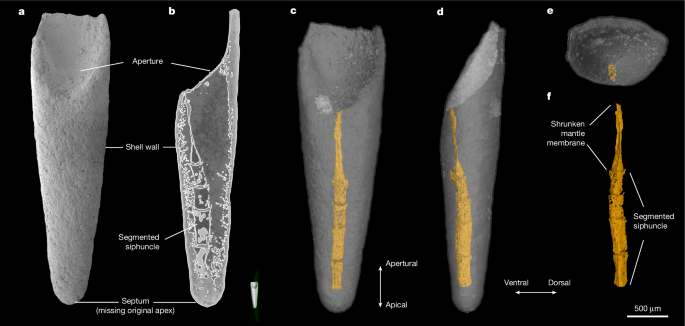
Song, Z.-C. et al. Eoceras supplemental data from: Earliest siphuncle-bearing cephalopod from the early Cambrian. Dryad https://doi.org/10.5061/dryad.qbzkh18zk (2026).

