


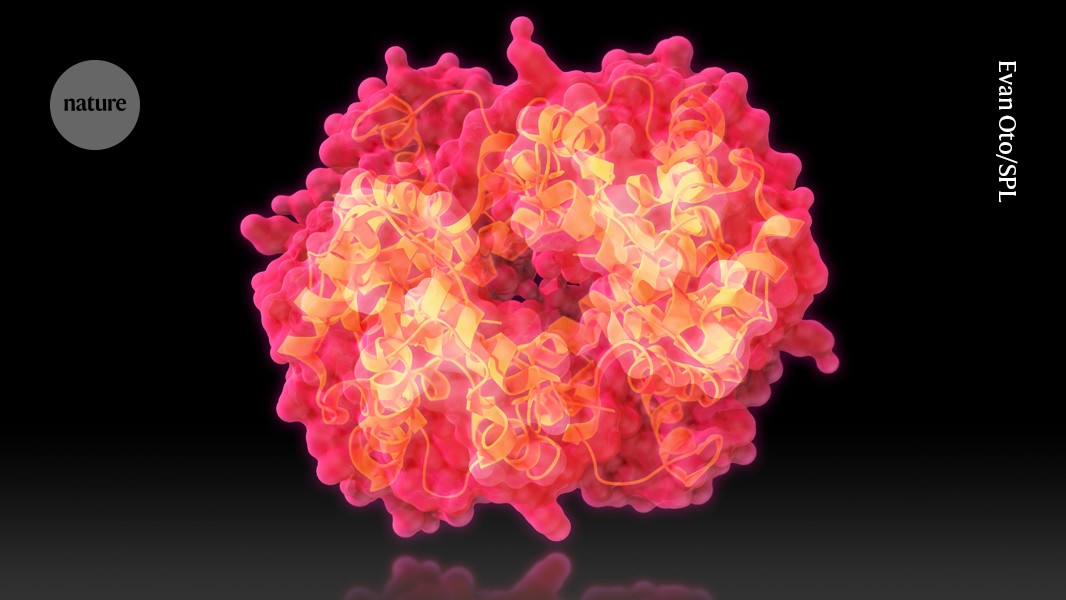

The protein haemoglobin (artist’s illustration) can be miniaturized by an AI tool called Raygun.Credit: Evan Oto/SPL
A sci-fi weapon has entered the AI age. A artificial-intelligence tool dubbed Raygun can miniaturize or supersize a natural protein without disrupting the protein’s shape or ability to function1.
Scientist have developed a host of AI ‘protein language models’ that can create proteins from scratch. But Raygun can modify existing proteins, using some of the same steps as natural evolution: adding or deleting single protein subunits or substituting one protein subunit for another.
Raygun is a “meaningful and creative” first step towards editing existing proteins, says Fajie Yuan, a computational biologist who works on protein language models at Westlake University in Hangzhou, China, and is not involved in the work. “For many real applications, that is exactly what researchers want — not a completely new protein, but a better, smaller, larger or more adaptable version of one they already trust,” he says.
The study is published today in Nature.
Protein revolution
Protein-building models are now so advanced that they can design antibodies with clinical potential. But scientists would also like to resize natural proteins — a tantalizing prospect for biotechnology applications, says study co-author Rohit Singh, a computational biologist at Duke University in Durham, North Carolina. “Sometimes a smaller protein can do things or fit into places where a larger protein cannot,” he says.
But efforts to use AI systems to modify existing proteins have been limited, because they tend to change the structure or function.
I told AI to make me a protein. Here’s what it came up with
Singh and his colleagues turned to ESM-2, a large language model for protein design. Instead of text, ESM-2 and other AI-based protein models are trained on millions of protein sequences. After learning the evolutionary ‘grammar’ or patterns of these sequences, these models can generate new proteins.
Most protein language models create representations of proteins as amino acid sequences of various lengths. But this system makes it is difficult to create proteins that keep their overall structure and functions at different sizes. So Raygun, which is based on ESM-2, takes a more mathematical approach: it divides each protein into pieces and translates the information in each piece into numerical patterns. The tool then uses these patterns to create a standardized version of the protein that follows certain rules. The model learns those rules, allowing it to generate the protein at various sizes without compromising its structural integrity.

