


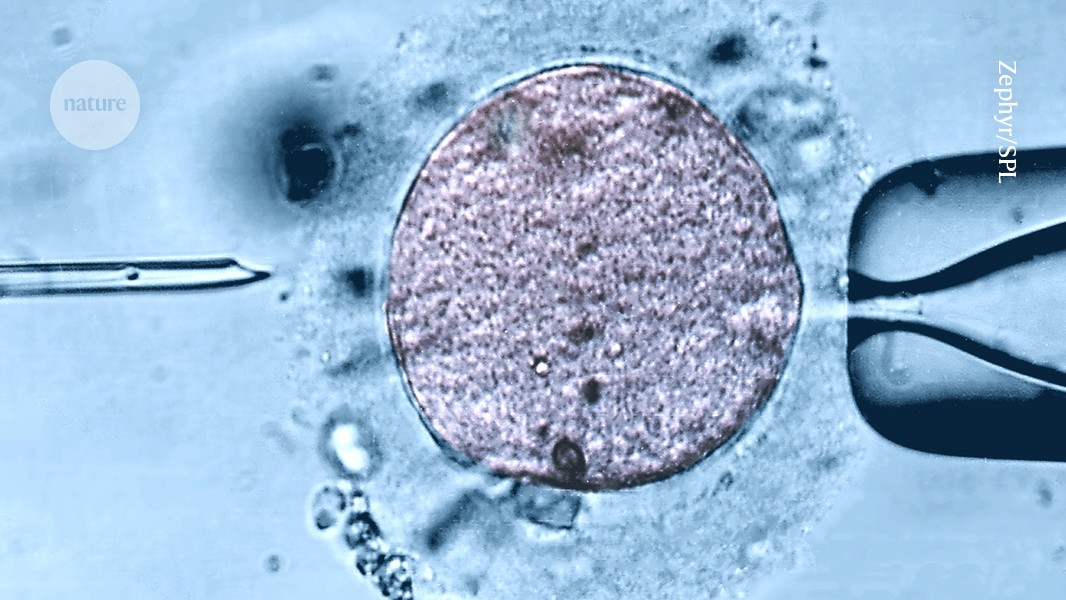

A needle approaches an egg cell (purple) during in vitro fertilization, which some clinics are offering in combination with a procedure called mitochondrial replacement therapy. Credit: Zephyr/Science Photo Library
A small number of fertility clinics around the world are offering a controversial treatment: a procedure to furnish clients’ embryos with donated mitochondria as a way to increase the chances of taking home a baby.
The method, called mitochondrial replacement therapy (MRT), involves removing the nucleus from a person’s egg or a couple’s single-cell embryo and transplanting it into an egg from a young donor. The theory — which remains unproven in rigorous clinical trials — is that the donor’s mitochondria might help the egg, after it is fertilized, or embryo to mature. Any resulting babies would have nuclear DNA from their biological mothers and fathers and mitochondrial DNA from the egg donor.
Scientists have already shown in a clinical trial that MRT can produce healthy children for parents whose mitochondria carry disease-causing mutations. But Nature has identified clinics in Asia, Europe and the Americas that advertise MRT to increase the success rate of in vitro fertilization (IVF) for a broader range of clients who do not have such mutations. “MRT can transform your fertility journey,” says the website of an agency called the International Fertility Group as of the time of this article’s publication. The agency helps people find and receive services from fertility clinics around the world. (A spokesperson for the agency said that MRT is performed not by the agency itself but by partner clinics.)
It is difficult to confirm that all of these clinics are genuinely performing the procedure. But they are advertising it on their websites and social media channels. Clinicians and scientists — including some who think that MRT holds promise — broadly agree that this therapy is experimental and that, at present, it should be offered only as part of a clinical trial.
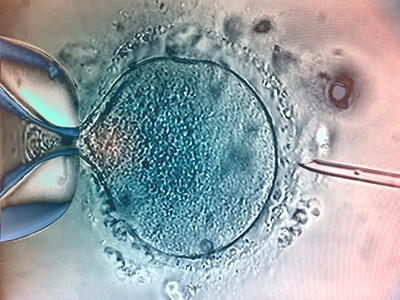
First UK children born using three-person IVF: what scientists want to know
“I’m pretty horrified,” says Richard Anderson, a fertility doctor at the University of Edinburgh, UK, after reviewing the MRT offering of one of the clinics identified by Nature. He says that the technique is difficult, the risks are high and the benefits are uncertain.
“They’re offering the treatment — generally very expensive treatment — to people who are desperate to have their own baby,” despite the absence of published evidence from controlled trials to support its use for infertility, says Mary Herbert, a reproductive biologist at Monash University in Melbourne, Australia, who has led a clinical trial involving MRT. “It’s fundamentally wrong.”
Uliana Dorofeyeva, the advisory clinical director for the International Fertility Group, defends the practice. “This is the patient[’s] right to choose the method, and to choose the way how they would like to solve their fertility problems,” she says.
With MRT added to standard IVF, “someone that’s 40 years old is now getting results similar to as if they were 25,” says Kent McQueen, chief executive of IVF Asia Group in Makati City, Philippines. “It’s like miracle results.”
Improving the odds
The first baby conceived with MRT was born in 2016, to a woman who had lost two children to a mitochondrial disease1. Last year, in the first clinical trial of MRT to prevent the inheritance of mitochondrial diseases, a separate research group reported the birth of eight healthy babies2.
Mitochondria provide energy for cells, leading to theories that mitochondria from young donors could also increase the success rate of IVF. That rate falls quickly with age. According to 2024 statistics from the US Society for Assisted Reproductive Technology, transferring a first embryo to the womb of a woman aged 35–37 resulted in a live birth 26% of the time. But for women aged 41–42, the rate was 8%.
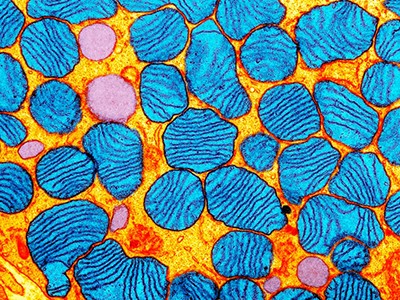
Scientists make precise gene edits to mitochondrial DNA for first time
Some fertility clinics‘ websites assert that replacing the mitochondria in older egg cells will improve those odds. The clinics point to a study suggesting that MRT might help egg cells from subfertile mice to develop into healthy pups3. “While [a] cell ages, we are losing the capacity and the performance of the mitochondria,” says Dorofeyeva. There is, she adds, “a mitochondrial disorder associated with ageing. We can say for sure that this is a secondary mitochondrial disorder.”
But Nature found only a few published studies that investigate using MRT as a treatment for infertility in humans.
A 2023 study4 examined MRT for 25 people without mitochondrial disease and reported that 3 of the 6 participants who were under the age of 36 gave birth to a baby. Of the 19 other participants, who were aged 36-39, only 3 did so. The study’s lead author, Nuno Costa-Borges, chief executive of Embryotools in Barcelona, Spain, says that it’s not possible to draw conclusions about MRT’s efficacy from the study because of its small sample size. The study also lacked a control arm.
A 2019 study reported a single birth out of 30 participants. It also lacked a control arm and did not recommend the procedure5.
Hopes and doubts
It is not clear how many clinics worldwide offer the procedure.
Nature identified clinics in the Bahamas, the Philippines, Albania and Ukraine that are advertising MRT online, sometimes simply calling it ‘oocyte rejuvenation’. A clinic called BioTexCom, based in Kyiv, offers packages starting at €6,500 (US$7,400) for a single transfer of an embryo created through MRT to a parent’s womb.
BioTexCom did not respond to Nature’s request for comment on scientists’ view that charging patients for MRT is premature given the experimental state of the evidence.
Is IVF at risk in the US? Scientists fear for the fertility treatment’s future
Some researchers think that MRT holds promise. The intervention could improve an egg’s ability to develop, says Costa-Borges, “leading to a higher proportion of embryos reaching the blastocyst stage”, the early phase of development when embryos are implanted into the uterine wall.
But other scientists interviewed by Nature are deeply sceptical that MRT can be helpful. Robin Lovell-Badge, a developmental biologist at the Francis Crick Institute in London, says there is “no rationale” for using MRT to treat infertility. “There is little to no evidence” that eggs from women seeking infertility treatment have too few or low-quality mitochondria, he says. Lovell-Badge says that it is “possible” that older women may have ‘secondary mitochondrial disorders’ affecting cells in the ovary, which might lead to infertility. But he is sceptical that MRT can treat the condition.
Data from clinics
Clinic physicians say that their figures show good results. IVF Asia Group sent Nature an unpublished abstract without data tables saying that after MRT, 50% of fertilized eggs developed into blastocysts. McQueen said that “pregnancy rates are pretty good” and said he could not share more specifics.
Another source of information is a 2025 conference abstract6 by Dorofeyeva and co-authors whose listed affiliations include the International Fertility Group and other clinics. The abstract reports pregnancy rates of 55% or higher for IVF plus MRT, but the study was based on a “selected group of patients” chosen “based on their uterine capacity, on their previous outcomes, how many cycles they had,” says Dorofeyeva. “It needs to be specified that this is not the general statistics,” she says. She declined to provide a more representative success rate, saying it is “very complicated.”

