


The Art and Science of Ernst Haeckel Julia Voss & Rainer Willmann Taschen (2026)
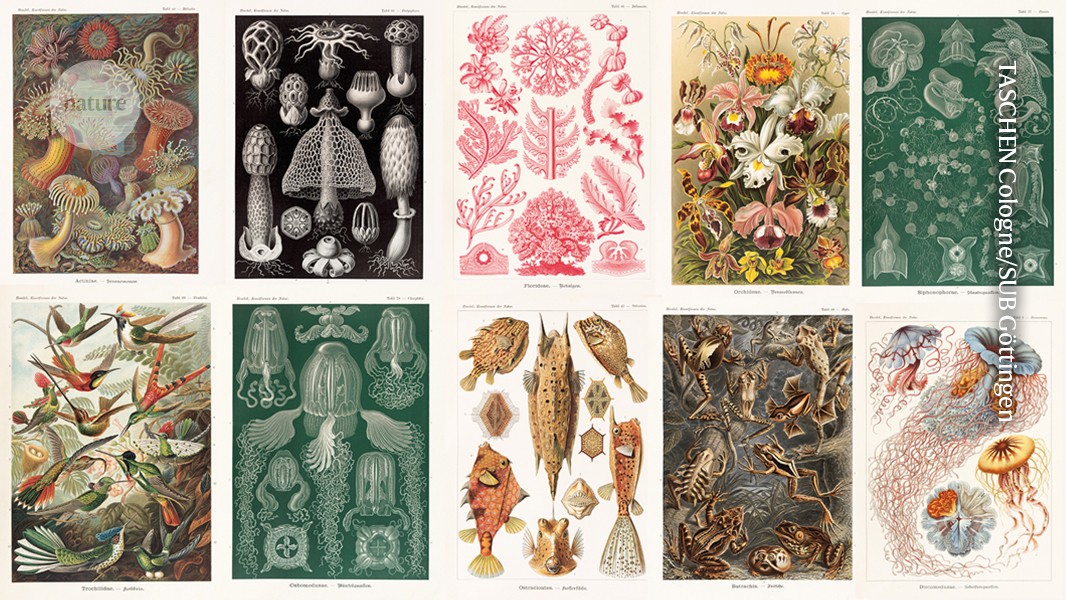
To immerse yourself in the world of naturalist Ernst Haeckel is to fall into a kaleidoscope of vibrant sea slugs, coiling octopuses, looping larvae and bulbous bodies. These tantalizing creatures float and wriggle before your eyes, mesmerizing in their curious contortion.
Nature at its weirdest: what metamorphosis reveals about science and ourselves
The Art and Science of Ernst Haeckel brings together 450 detailed drawings, watercolours and sketches created by this nineteenth-century German polymath. Inside its pages, umbrella-shaped medusae, or jellyfish, trail their tentacles like ethereal bridal veils. Spiky radiolarians — microscopic zooplankton found throughout the ocean — take strange forms, calling to mind beehives and Buddhist temples. Nudibranchs, a group of sea slugs, sprout fronds and tubules, and some Siphonophorae — swimming colonies composed of thousands of organisms called zooids — resemble coiled intestines.
Born in 1834 in Potsdam (then part of the Kingdom of Prussia), Haeckel was a biologist, evolutionist, artist, philosopher and physician. Among other achievements, he was known for defending Charles Darwin’s theory of evolution in an 1863 lecture in Stettin (now Szczecin, Poland).
His ideas ranged from eccentric to eugenic. He thought that the simplest unicellular organisms possess an early form of the soul — the same was supposedly true for atoms and crystals. He was also a racist who ranked “the diverse types of mankind” according to their relative “value”, horrifyingly describing “woolly haired” people, whom Haeckel saw as the lowest-value group, as “incapable of a true inner culture and a higher intellectual development”.

Ernst Haeckel categorized and depicted thousands of species.Credit: TASCHEN Cologne/Göttingen State and University Library
Haeckel accumulated his ideas, both the intriguing and the odious, over the course of his extraordinarily varied career, which began in 1852 with a stint at medical school. While he was a student at the University of Würzburg in the Kingdom of Bavaria, his professors remarked on his gift for “recording at astounding speed precisely what he had seen”. One noted that Haeckel “was able to look through a microscope with his left eye while simultaneously attending to the drawing in progress with his right”.
But his tenure as a physician was brief. He confined his office hours to one hour a day, starting at 5 a.m., and took on no more than half a dozen patients ever. Haeckel switched his focus to marine biology and, in 1862, published a beautifully illustrated monograph on the radiolarians. These single-celled protists (most less than one millimetre in diameter) absorb silica from seawater, forming ‘skeletons’ with “interlacing spirals, spherical lattices, and minute pyramids with radiating struts”. His later publications included atlases and monographs on sponges, corals and jellyfish.
How the idea of human superiority over nature was invented
Across his 85-year lifespan, Haeckel identified thousands of species, including two that he named after “my unforgettable dear wife, Anna Sethe”, who died of a burst appendix in 1864, 18 months after they married. The grief-stricken widower fled to Nice on France’s Côte d’Azur, where he chanced on a jellyfish lying in a pool left by the ebbing tide. Its delicate yellow tentacles reminded him of his deceased wife’s blonde hair, so he named it Mitrocomae annae (‘Anna’s headband’). The second species named after Anna was Desmonema annasethe — another jellyfish, which Haeckel considered even more beautiful.
“Try to imagine the graceful, slim stalk of a flower, its leaves and colourful blossoms as transparent as glass”, Haeckel wrote to his parents of Siphonophorae in 1867. Some of his sketches were recreated in glass. When Prince Albert I of Monaco opened a museum in 1910 at the Oceanographic Institute, a ceiling lamp was modelled on Haeckel’s drawings of medusae.
Likewise, a chandelier designed by Dutch architect Hendrik Petrus Berlage at the Amsterdam Stock Exchange was based on Haeckel’s drawing of Rhopilema frida, a jellyfish named after his muse and lover Frida von Uslar-Gleichen (with whom he exchanged more than 900 love letters during his second, unhappy marriage to Agnes Huschke).

