


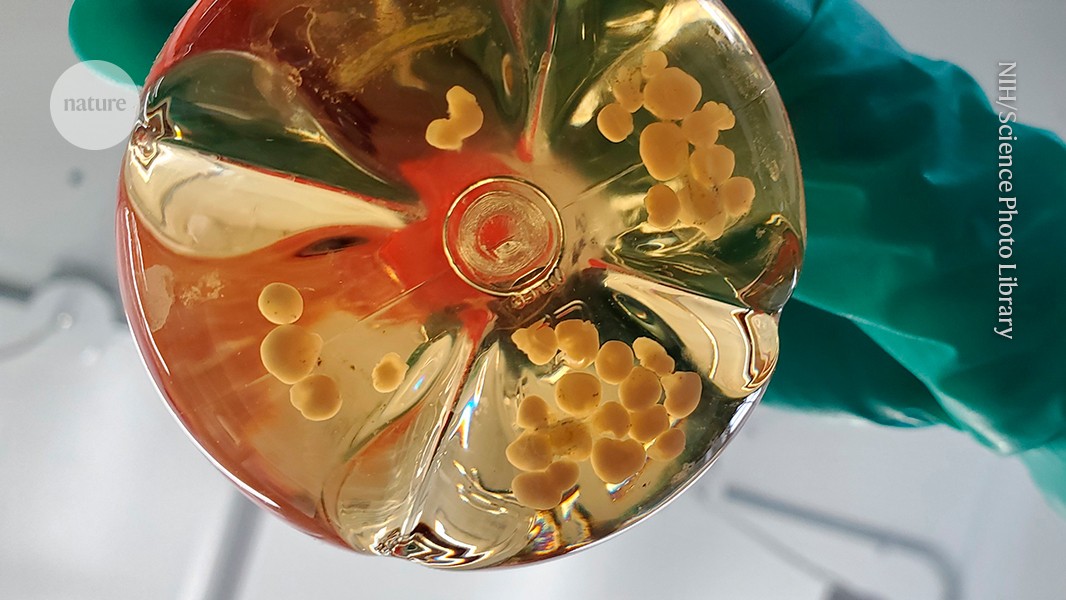
The workings of the brain are often compared to those of a computer. Some researchers are testing this analogy to its limits, attempting to build computers containing laboratory-grown cultures of brain cells. In doing so, they hope to circumvent the physical limitations of the silicon-based computing hardware used for today’s artificial intelligence1,2.
The promise is there. Brain tissue combines memory and computation in the same substrate, requiring fewer components than conventional computers do. Theories of neural networks, based on neurons and synapses, have inspired AI algorithms. Brains consume much less energy than AI machines do3 and don’t require vast cooling systems.
Human neuroscience is entering a new era — it mustn’t forget its human dimension
Such biocomputing does have distinct ethical challenges. Discussions have raged over the morality of using lab-grown brain tissue and the potential for consciousness4. Yet one key issue has been absent from debates so far: the lack of explicit consent for the use of human neural tissue in biocomputing.
Research in biocomputing relies on voluntary donations of cells, often from people undergoing medical procedures who give them altruistically to aid biomedical and basic biological research. Yet, consent forms don’t ask donors what sort of research they would like their cells to be used for in the future — or, more importantly, all the possible ways that they wouldn’t like them to be used. Donors who want to support the development of cancer treatments might not imagine that their tissues could be used to create biocomputers, possibly with commercial uses.
A more explicit and nuanced approach to donor consent is needed for biocomputing research that uses lab-grown brain tissue. In our view, researchers should avoid using cell lines for which consent was given only for biomedical research. A system must be established for seeking consent retrospectively, or for reviewing the ethics of projects when obtaining consent again (known as re-consent) is not possible.
Using brain cells to compute
Brain-based biocomputing relies on human cortical neurons because they are larger and form more complex circuits than do those from rodents or other primates. These features are thought to contribute to the remarkable information-processing capabilities of the human brain5,6, from recognizing a face to performing abstract reasoning.
Biocomputers are built using ‘pluripotent’ stem cells, which have the potential to develop into most of the body’s other cell types. Such cells can come either from donated embryos left over after in vitro fertilization or from engineered adult cells gifted by volunteers, including people undergoing medical treatment.
In the lab, pluripotent stem cells can be coaxed into becoming brain organoids — small 3D clusters that mimic the structure, function and organization of various regions of the brain. Information can be encoded in neural stimulation, providing ‘computational inputs’ that are processed by the neurons in the organoid, leading to neural outputs that can be recorded through microelectronic array systems (see ‘Brain-based biocomputing’). It has already been shown that this set-up can be used for some simple computational processes that are the basis by which hardware-based AI models identify patterns and make predictions7.

A need for ethical solutions
Once generated, a line of pluripotent stem cells can be cultured indefinitely and used for a variety of experiments. But after many years, especially if the donor has died and science has moved on, it’s hard to know whether the original donor would have approved of the experiments that their cells are now contributing to.
People who volunteer their tissue for biomedical research typically consent to a specific research study. At the same time, they might be asked whether they agree to any remaining biospecimens being stored and used by others for future biomedical research. Donors who agree to the latter — known as open-ended consent — are informed that it might be hard to predict how other researchers will use their specimens. Most donors have no idea, for example, that their cells might be used to create a stem-cell line that can be used in future work by many other scientists. But they are assured that any uses will be reviewed by oversight committees to ensure that studies are scientifically meritorious.
Typically, such donations are sent to a biobank, which distributes them to researchers in accordance with strict data protection policies. Donors trust researchers to follow those rules, protect their privacy and handle their specimens with care and respect.
Why researchers should use human embryo models with caution
Some researchers and ethicists might dismiss the ethical concerns highlighted in this article, given that it would be expected that the cell lines used for biocomputing would be derived from donors who have given open-ended consent8. This process, some would argue, strikes a balance between donor autonomy and flexibility for researchers. It’s impossible to obtain permission in advance for every potential future use, because science advances in ways that cannot always be predicted.
But open-ended consent can lead to harm if used carelessly. When about 100 members of the Havasupai tribe in Arizona donated samples in the 1990s to researchers studying the high prevalence of diabetes in the tribe, they initially provided a type of open-ended consent called broad consent. Two decades later, 41 donors and their families sued researchers after learning that their blood had been used in studies on mental illness and their ancestral backgrounds that might stigmatize and harm their community. The tribe’s members did not anticipate this type of research and felt that their cultural autonomy had been violated.
The argument that open-ended consent allows researchers to use donor cells ethically might be reasonable when donated materials are used for altruistic purposes related to biomedicine. But a person donating tissues for a medical study would have no reason to consider that their cells might be used for engineering or computer science.

Generative AI’s environmental costs are soaring — and mostly secret
Some donors have registered concerns about the use of their samples for commercial purposes9. What’s more, a pan-European study found that many people view organoids as complicated entities: neither a living organism nor just an object, but something in-between. Brain organoids specifically were seen as a more sensitive issue than other organoids10.
Research has also shown that some donors want to know about the purposes of research involving brain organoids created with their cells11,12. And some want the chance to revoke their consent if they disagree with future research that would use their donations11.
Brain-based biocomputers need strong ethical oversight because they could result in such donor concerns being realized. Biocomputers might soon be used for commercial tasks unrelated to biomedicine, such as voice or face recognition. An open-ended consent approach is not a good ethical solution here.
The following changes are proposed to ensure that biocomputing research involving lab-grown brain tissue proceeds responsibly. These recommendations could also extend to other emerging fields, such as biohybrid robotics, in which human cells are used to pursue engineering applications such as environmental monitoring13.
Path to proper consent
Biocomputing research should be overseen by independent review committees that can assess both the ethical risks posed by the technology and the appropriate use of human cell lines for computing applications. Existing oversight committees for stem-cell research generally do not review non-biomedical research conducted in computer science and mechanical-engineering departments, and don’t usually have the technical expertise needed to oversee the ethics of biocomputing.
New review boards could be established as needed at institutes that are undertaking biocomputing. Alternatively, boards could be reconfigured from existing stem-cell-research oversight committees, supplemented by neuroscience and computer-engineering scholars.
These review committees should instruct researchers to follow one of three pathways, in a strict order of preference: establish new cell lines; obtain fresh consent from existing donors; or undergo independent review of research plans.

