


You have full access to this article via your institution.

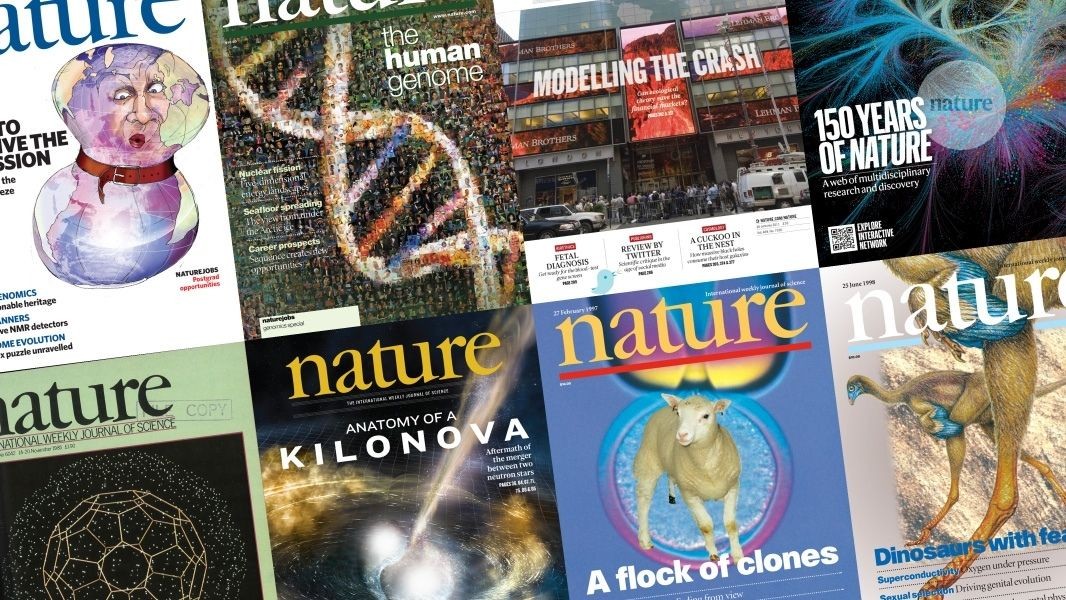
Iconic Nature covers from the 1980s, 1990s, 2000s and 2010s.
Covers of Nature can be found hanging on home and office walls; they are regularly mentioned at conferences and even the subject of academic study1. Equally, they are an opportunity for scientists, science-writers and editors to work with some of the world’s most creative and inventive artists, designers, illustrators and photographers — those whose work we’re celebrating in this special issue on the human art of scientific illustration in the age of artificial intelligence.
Three tips to avoid AI image mistakes in science
Illustrations and photography in Nature go back to the first issue, published on 4 November 1869. The masthead included the strapline “A weekly illustrated journal of science”. This was not an accident: there are images throughout the first issue, ranging from intricate drawings of moths in a book review of An Illustrated Natural History of British Moths, to simple sketches — notably one on the construction of the Suez Canal in Egypt, a project that some were concerned would fail. There are photographs, too, accompanying an essay by founding editor Norman Lockyer on that year’s solar eclipse. At a time when ‘print’ implied printing words, the new journal broke fresh ground with images.
Over subsequent months, however, readers would have noticed fewer illustrations and photographs. At some point the word ‘illustrated’ disappeared from the strapline altogether. A century would elapse before we started publishing full-page cover images, although initially without accompanying words.
From around the mid-1970s, Nature’s front pages illustrated landmark studies and journalism, including covering important world events, such as the 2008 global financial crisis2 and how science could survive the coming recession. We aim for covers that are a blend of art, science, beauty, creativity and novelty. They can be specific or abstract, telling a story that represents the research as accurately as possible in its context — they don’t need to tell the entire research story, but they must not be misleading.
Many of our early covers relied heavily or exclusively on black-and-white photographs snapped with film cameras. In those pre-digital times, images would have been physically cut and pasted in preparation for printing.
‘Good design takes mastery’: scientific illustrators sketch out AI’s future
Long before social media, Nature’s cover images started to take on a life of their own, entering the broader public consciousness in their own right. One of the best examples of a cover image that caught the public’s attention is a computer-generated image from the mid-1980s, accompanying a report of a new form of carbon, C60, shaped like a football3. This research was partly inspired by art and design — the scientists named their discovery ‘Buckminsterfullerene’ after Richard Buckminster Fuller, architect and designer of the geodesic dome.
Digital photography and software used to design magazines and manipulate images caught on from the 1990s, and they greatly enhanced cover designs. Some of Nature’s best-known covers from that period onwards include Dolly the sheep — the first mammal to be cloned from an adult somatic cell — who also made the cover of other magazines and newspapers around the world4. The first draft human genome sequence5 was illustrated on the cover with a visual representation of the DNA double helix made up of an eye-catching mosaic of images of people from all around the world. Illustrations were also used to depict the discovery of a dinosaur with feathers in China6 and γ-ray bursts reported from the merging of two neutron stars7.
The art of data
Nature appointed a creative director in 2011, leading to new partnerships between scientific illustrators, journalists and data scientists. One standout example of this is the cover of Nature’s 150th anniversary issue which was produced in collaboration with researchers at IBM Research in Yorktown Heights, New York, and the Center for Complex Network Research based at Northeastern University in Boston, Massachusetts. The cover depicted the citation networks of 88,000 papers published in Nature since 1900. The principle behind this network was co-citation — two papers were linked if another scientific publication had cited them both. This project featured an animation and a video, along with the cover illustration of the network.

Why Nature will not allow the use of generative AI in images and video
As in other spheres of human endeavour, AI is now knocking on the doors of illustrators and designers, looking for a way in. In an article this week, five scientific illustrators make the case for why humans must always be the beating heart of the creative process, a message echoed on in a Technology Feature.
Although scientific literature is increasingly read, collated and synthesized by machines, researchers continue to be drawn to covers and appreciate their significance. Although the word ‘illustrated’ is no longer part of Nature’s strapline, arguably it doesn’t need to be. Along with words, data, graphics, photography and illustrations, the covers of the journal will continue to be an essential part of our publication.

