


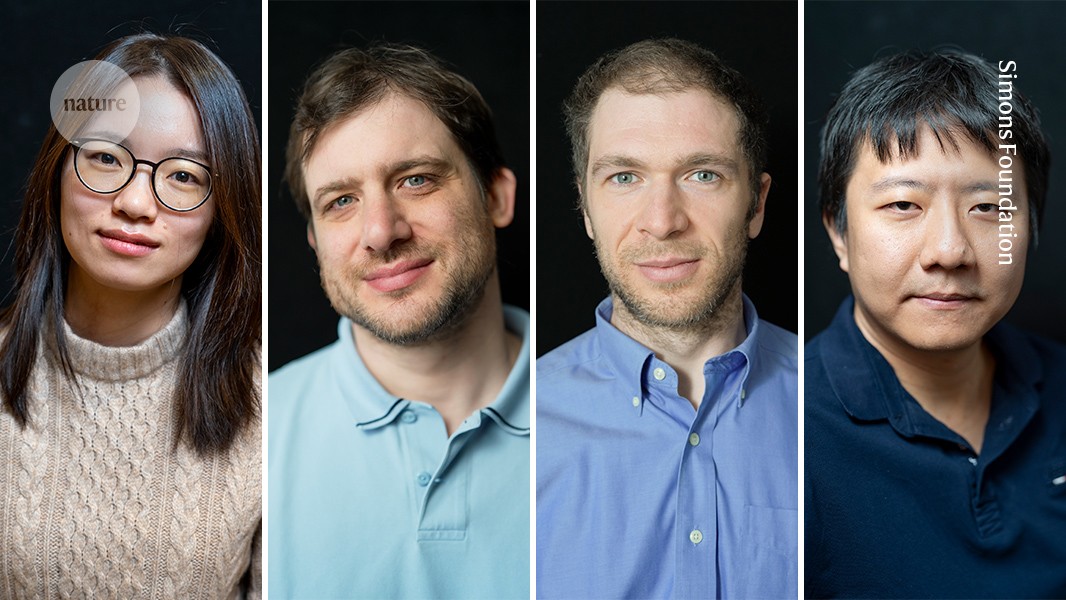

The four Fields Medal recipients are, from left to right, Hong Wang, Jacob Tsimerman, John Pardon and Yu Deng.Credit: Simons Foundation
Mathematicians Yu Deng, John Pardon, Jacob Tsimerman and Hong Wang have won the 2026 Fields Medal — one of the most coveted awards in their discipline. Their names were revealed at the International Congress of Mathematicians (ICM) today in Philadelphia, Pennsylvania.
The four winners represent a range of subfields of maths, from number theory to mathematical physics. They had all been rumoured as favourites to win the medal, which is awarded every four years to up to four mathematicians under the age of 40.
The winners all work in North America, but two — Deng and Wang — were born and raised in China. They are only the second and third Chinese nationals to have earned a Fields Medal: Shing-Tung Yau, who is now at Tsinghua University in Beijing, won his in 1982, before either Deng or Wang were born. Wang is also only the third woman to win in the award’s 90-year history, after the late Maryam Mirzakhani in 2014 and Maryna Viazovska in 2022.
Irreversible fluids
Deng, who is 37 and grew up in Shenzhen, did his PhD at Princeton University in New Jersey. He is now at the University of Chicago in Illinois, where he specializes in differential equations, which are often used to describe physical phenomena. He says that hearing he had won the medal made him “really happy, not just for myself, but for the field I’m representing”.
Deng’s most celebrated achievement was a breakthrough on one of the problems posed by German mathematician David Hilbert in a historic talk at the ICM in 1900: he challenged mathematicians to reconcile the behaviour and smooth appearance of fluids with the idea (still not broadly accepted at that time) that they were made of multitudes of atoms or molecules.
Together with two collaborators1, Deng found a rigorous proof that the microscopic jostling of many constituent particles — acting like tiny billiard balls continuously bouncing off one another — produces as a necessary consequence a differential equation formulated in the late 1800s to describe fluids.
‘Mathematics is an unknown land’: meet Fields Medal winner Maryna Viazovska
This helped to reconcile an apparent conundrum. Microscopic physics works just as well when time is reversed — meaning that it might be impossible to tell if a movie of two molecules bouncing off each other is being played forwards or backwards. But when many molecules form a fluid, they have an unavoidably irreversible behaviour: if you mix a cold gas with a hot one, say, the mixture will never spontaneously separate back into hot and cold.
String contact
Pardon, who is at Stony Brook University on Long Island, New York, was born in Chapel Hill, North Carolina, and is also 37. He made his first original contribution to mathematics — on a deceptively simple problem about the geometry of loops on a flat surface2 — during secondary school. He went on to publish several research papers during his undergraduate degree at Princeton, where he also studied Chinese and performed as a cellist in a university orchestra.
During his PhD at Stanford University in California, Pardon partially solved another of Hilbert’s problems3, but mostly switched to symplectic and contact geometry, fields that arose from the mathematical description of physical systems, such as the motion of planets. Symplectic ‘spaces’ always have an even number of dimensions, and contact spaces are their odd-dimensional counterparts that often sit inside a symplectic space.
Ukrainian mathematician becomes second woman to win prestigious Fields Medal
Pardon’s PhD thesis was a technical tour-de-force in which he developed techniques for telling two contact spaces apart. Later, he applied those tools to cracking major problems in symplectic and contact geometry, including some that arose from string-theory physics4 — a speculative framework to interpret all elementary particles and fundamental forces as vibrations of loops called ‘strings’. Mathematicians often model such strings as loops moving from one contact space to another within a symplectic space.
Resonating with equations
Tsimerman’s passion for solving mathematical puzzles began to show as early as age three, he says. “I had an interest in math as early as I can remember,” says Tsimerman, who is 38 and a Russian-born Canadian at the University of Toronto, Canada.
His main focus is on the theory of numbers, in particular whether, and how, certain equations — ‘Diophantine equations’ — can have whole numbers as solutions. Such equations are intimately connected to algebraic geometry, including to the structure of objects with more than three dimensions, called Shimura varieties. (These also play an essential part in the proof of Fermat’s last theorem, one of the most celebrated maths breakthroughs of the late twentieth century.)
One of Tsimerman’s favourite facts is that if Shimura varieties could vibrate like physical objects, each of their resonant frequencies would correspond to a specific Diophantine equation. Tsimerman and his collaborators proved one of the central statements in the theory of Shimura varieties in 20215, called the André–Oort conjecture after the two mathematicians who formulated it, and another major conjecture stated by Phillip Griffiths at the Institute for Advanced Study in Princeton6.

