


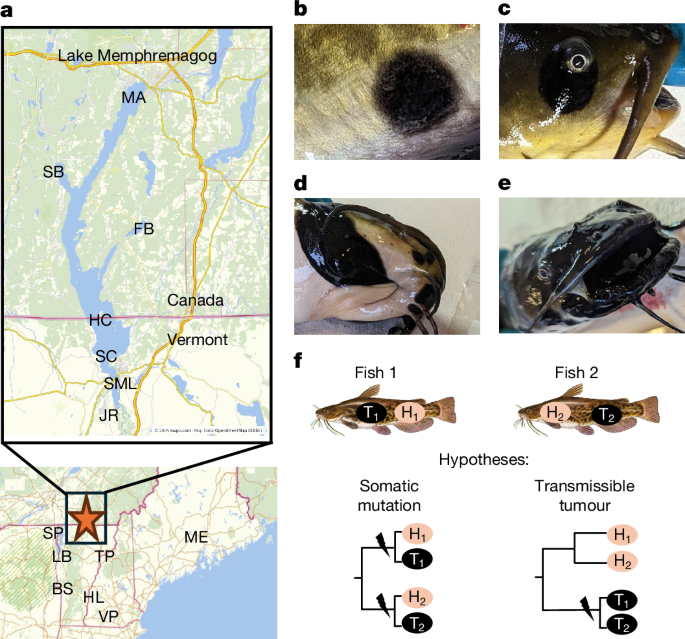
Blazer, V. S., Shaw, C. H., Smith, C. R., Emerson, P. & Jones, T. Malignant melanoma of brown bullhead (Ameiurus nebulosus) in Lake Memphremagog, Vermont/Quebec. J. Fish Dis. 43, 91–100 (2020).
Metzger, M. J. & Goff, S. P. A sixth modality of infectious disease: contagious cancer from devils to clams and beyond. PLoS Pathog. 12, e1005904 (2016).
The Cancer Genome Atlas Research Network. The Cancer Genome Atlas Pan-Cancer analysis project. Nat. Genet. 45, 1113–1120 (2013).
Murgia, C., Pritchard, J. K., Kim, S. Y., Fassati, A. & Weiss, R. A. Clonal origin and evolution of a transmissible cancer. Cell 126, 477–487 (2006).
Pearse, A.-M. & Swift, K. Transmission of devil facial-tumour disease. Nature 439, 549 (2006).
Metzger, M. J., Reinisch, C., Sherry, J. & Goff, S. P. Horizontal transmission of clonal cancer cells causes leukemia in soft-shell clams. Cell 161, 255–263 (2015).
Metzger, M. J. et al. Widespread transmission of independent cancer lineages within multiple bivalve species. Nature 534, 705–709 (2016).
Yonemitsu, M. A. et al. A single clonal lineage of transmissible cancer identified in two marine mussel species in South America and Europe. eLife 8, e47788 (2019).
Skazina, M. et al. First description of a widespread Mytilus trossulus-derived bivalve transmissible cancer lineage in M. trossulus itself. Sci Rep. 11, 5809 (2021).
Hammel, M. et al. Prevalence and polymorphism of a mussel transmissible cancer in Europe. Mol. Ecol. 31, 736–751 (2022).
Michnowska, A., Hart, S. F. M., Smolarz, K., Hallmann, A. & Metzger, M. J. Horizontal transmission of disseminated neoplasia in the widespread clam Macoma balthica from the Southern Baltic Sea. Mol. Ecol. 31, 3128–3136 (2022).
Garcia-Souto, D. et al. Mitochondrial genome sequencing of marine leukaemias reveals cancer contagion between clam species in the Seas of Southern Europe. eLife 11, e66946 (2022).
Yonemitsu, M. A. et al. Multiple lineages of transmissible neoplasia in the basket cockle (C. nuttallii) with repeated horizontal transfer of mitochondrial DNA. Mol. Ecol. 34, e17682 (2025).
Sakaris, Jesien, P. C., Roman, V. & & Pinkney, A. E. Brown bullhead as an indicator species: seasonal movement patterns and home ranges within the Anacostia River, Washington, D.C. Trans. Am. Fish. Soc. 134, 1262–1270 (2005).
Agency of Natural Resources, Department of Environmental Conservation. Lake Memphremagog. https://dec.vermont.gov/watershed/restoring/memphremagog (2026).
Ní Leathlobhair, M. & Lenski, R. E. Population genetics of clonally transmissible cancers. Nat. Ecol. Evol. 6, 1077–1089 (2022).
Baez-Ortega, A. et al. Somatic evolution and global expansion of an ancient transmissible cancer lineage. Science 365, eaau9923 (2019).
Pye, R. J. et al. A second transmissible cancer in Tasmanian devils. Proc. Natl Acad. Sci. USA 113, 374–379 (2016).
Stammnitz, M. R. et al. The evolution of two transmissible cancers in Tasmanian devils. Science 380, 283–293 (2023).
Osburn, R. C. Black tumor of the catfish. Bull. Bur. Fish. 41, 9–13 (1925).
Riquet, F., Simon, A. & Bierne, N. Weird genotypes? Don’t discard them, transmissible cancer could be an explanation. Evol. Appl. 10, 140–145 (2017).
Martincorena, I. et al. Universal patterns of selection in cancer and somatic tissues. Cell 171, 1029–1041 (2017).
Alexandrov, L. B. et al. Signatures of mutational processes in human cancer. Nature 500, 415–421 (2013).
Ellrott, K. et al. Scalable open science approach for mutation calling of tumor exomes using multiple genomic pipelines. Cell Syst. 6, 271–281 (2018).
Burioli, E. A. V. et al. Traits of a mussel transmissible cancer are reminiscent of a parasitic life style. Sci Rep. 11, 24110 (2021).
Giersch, R. M. et al. Survival and detection of bivalve transmissible neoplasia from the soft-shell clam Mya arenaria (MarBTN) in seawater. Pathogens 11, 283 (2022).
Hart, S. F. M., Garrett, F. E. S., Kerr, J. S. & Metzger, M. J. Gene expression in soft-shell clam (Mya arenaria) transmissible cancer reveals survival mechanisms during host infection and seawater transfer. PLoS Genet. 21, e1011629 (2025).
Blumer, L. S. Reproductive natural history of the brown bullhead Ictalurus nebulosus in Michigan. Am. Midl. Nat. 114, 318–330 (1985).
Harris, J. & Bird, D. J. Modulation of the fish immune system by hormones. Vet. Immunol. Immunopathol. 77, 163–176 (2000).
McCallum, H. et al. Distribution and impacts of Tasmanian devil facial tumor disease. EcoHealth 4, 318–325 (2007).
Frampton, D. et al. Molecular signatures of regression of the canine transmissible venereal tumor. Cancer Cell 33, 620–633 (2018).
Farley, C. A., Plutschak, D. L. & Scott, R. F. Epizootiology and distribution of transmissible sarcoma in Maryland softshell clams, Mya arenaria, 1984-1988. Environ. Health Perspect. 90, 35–41 (1991).
Muttray, A. et al. Haemocytic leukemia in Prince Edward Island (PEI) soft shell clam (Mya arenaria): spatial distribution in agriculturally impacted estuaries. Sci. Total Environ. 424, 130–142 (2012).
Hart, S. F. M. et al. Centuries of genome instability and evolution in soft-shell clam, Mya arenaria, bivalve transmissible neoplasia. Nat. Cancer https://doi.org/10.1038/s43018-023-00643-7 (2023).
Weinandt, S.A. et al. Atlantic to Pacific: outbreak of bivalve transmissible neoplasia detected in hybridizing soft-shell clams and eDNA in Puget Sound. Proc. Natl Acad. Sci. USA 123, e2611852123 (2026).
Siciliano, M. J., Perlmutter, A. & Clark, E. Effect of sex on the development of melanoma in hybrid fish of the genus Xiphophorus. Cancer Res. 31, 725–729 (1971).
Sweet, M. et al. Evidence of melanoma in wild marine fish populations. PLoS ONE 7, e41989 (2012).
Schall, M. K., Smith, G. D., Blazer, V. S., Walsh, H. L. & Wagner, T. Factors influencing the prevalence of hyperpigmented melanistic lesions in smallmouth bass Micropterus dolomieu in the Susquehanna River Basin, Pennsylvania. J. Fish. Dis. 48, e14033 (2025).
Blazer, V. S. et al. Melanoma and other melanistic lesions in brown bullhead Ameiurus nebulosus from waterbodies in the northeastern United States and Canada: identification of risk factors. J. Fish Dis. https://doi.org/10.1111/jfd.70207 (2026).
Jin, J.-J. et al. GetOrganelle: a fast and versatile toolkit for accurate de novo assembly of organelle genomes. Genome Biol. 21, 241 (2020).
Chen, S., Zhou, Y., Chen, Y. & Gu, J. fastp: an ultra-fast all-in-one FASTQ preprocessor. Bioinformatics 34, i884–i890 (2018).
Lopez, M. L. D. et al. mtGrasp: streamlined reference-grade mitochondrial genome assembly and standardization to enhance metazoan mitogenome resources. Methods Ecol. Evol. 16, 668–677 (2025).
Li, H. Minimap2: pairwise alignment for nucleotide sequences. Bioinformatics 34, 3094–3100 (2018).
Danecek, P. et al. Twelve years of SAMtools and BCFtools. GigaScience 10, giab008 (2021).
Lubkowitz, J., Curd, E., Dragon, J. & Harcourt, E. PEGASUS: a comprehensive hybrid genome assembly pipeline. Zenodo https://doi.org/10.5281/zenodo.11397779 (2024).
De Coster, W. & Rademakers, R. NanoPack2: population-scale evaluation of long-read sequencing data. Bioinformatics 39, btad311 (2023).
Andrews, S. FastQC: a quality control tool for high throughput sequence data. Babraham Bioinformatics https://www.bioinformatics.babraham.ac.uk/projects/fastqc/ (2010).
Kim, D., Song, L., Breitwieser, F. P. & Salzberg, S. L. Centrifuge: rapid and sensitive classification of metagenomic sequences. Genome Res. 26, 1721–1729 (2016).
Lin, Y. et al. Assembly of long error-prone reads using de Bruijn graphs. Proc. Natl Acad. Sci. USA 113, E8396–E8405 (2016).
Aury, J.-M. & Istace, B. Hapo-G, haplotype-aware polishing of genome assemblies with accurate reads. NAR Genom. Bioinform. 3, lqab034 (2021).
Vaser, R., Sović, I., Nagarajan, N. & Šikić, M. Fast and accurate de novo genome assembly from long uncorrected reads. Genome Res. 27, 737–746 (2017).
Coombe, L. et al. LongStitch: high-quality genome assembly correction and scaffolding using long reads. BMC Bioinform. 22, 534 (2021).
Manni, M., Berkeley, M. R., Seppey, M. & Zdobnov, E. M. BUSCO: assessing genomic data quality and beyond. Curr. Protoc. 1, e323 (2021).
Gurevich, A., Saveliev, V., Vyahhi, N. & Tesler, G. QUAST: quality assessment tool for genome assemblies. Bioinformatics 29, 1072–1075 (2013).
Pedersen, B. S. & Quinlan, A. R. Mosdepth: quick coverage calculation for genomes and exomes. Bioinformatics 34, 867–868 (2018).
Cantalapiedra, C. P., Hernández-Plaza, A., Letunic, I., Bork, P. & Huerta-Cepas, J. eggNOG-mapper v2: functional annotation, orthology assignments, and domain prediction at the metagenomic scale. Mol. Biol. Evol. 38, 5825–5829 (2021).
Seemann, T. Barrnap. GitHub https://gitbhub.com/tseemann/barrnap (2025).
Auwera, G. van der. Genomics in the Cloud: Using Docker, GATK, and WDL in Terra (O’Reilly Media, 2020).
Robinson, J. T. et al. Integrative Genomics Viewer. Nat. Biotechnol. 29, 24–26 (2011).
R Core Team. R: a language and environment for statistical computing. R https://www.R-project.org/ (2025).
Benjamin, D. et al. Calling somatic SNVs and indels with Mutect2. Preprint at bioRxiv https://doi.org/10.1101/861054 (2019).
Rausch, T. et al. DELLY: structural variant discovery by integrated paired-end and split-read analysis. Bioinformatics 28, i333–i339 (2012).
Smolka, M. et al. Detection of mosaic and population-level structural variants with Sniffles2. Nat. Biotechnol. 42, 1571–1580 (2024).
Gkanogiannis, A. & Bruls, T. A scalable assembly-free variable selection algorithm for biomarker discovery from metagenomes. BMC Bioinformatics 17, 311 (2016).
Paradis, E. & Schliep, K. ape 5.0: an environment for modern phylogenetics and evolutionary analyses in R. Bioinformatics 35, 526–528 (2019).
Katoh, K., Misawa, K., Kuma, K. & Miyata, T. MAFFT: a novel method for rapid multiple sequence alignment based on fast Fourier transform. Nucleic Acids Res. 30, 3059–3066 (2002).
Minh, B. Q. et al. IQ-TREE 2: new models and efficient methods for phylogenetic inference in the genomic era. Mol. Biol. Evol. 37, 1530–1534 (2020).
Page, A. J. et al. SNP-sites: rapid efficient extraction of SNPs from multi-FASTA alignments. Microb. Genom. 2, e000056 (2016).
Yu, G. Data Integration, Manipulation and Visualization of Phylogenetic Trees (Chapman and Hall/CRC, 2022); https://doi.org/10.1201/9781003279242.
Wang, L.-G. et al. Treeio: an R package for phylogenetic tree input and output with richly annotated and associated data. Mol. Biol. Evol. 37, 599–603 (2020).
Ewels, P. A. et al. The nf-core framework for community-curated bioinformatics pipelines. Nat. Biotechnol. 38, 276–278 (2020).
Krakau, S., Straub, D., Gourlé, H., Gabernet, G. & Nahnsen, S. nf-core/mag: a best-practice pipeline for metagenome hybrid assembly and binning. NAR Genom. Bioinform. 4, lqac007 (2022).
Nurk, S., Meleshko, D., Korobeynikov, A. & Pevzner, P. A. metaSPAdes: a new versatile metagenomic assembler. Genome Res. 27, 824–834 (2017).
Camargo, A. P. et al. Identification of mobile genetic elements with geNomad. Nat. Biotechnol. 42, 1303–1312 (2024).
Wood, D. E., Lu, J. & Langmead, B. Improved metagenomic analysis with Kraken 2. Genome Biol. 20, 257 (2019).
McMurdie, P. J. & Holmes, S. Phyloseq: an R package for reproducible interactive analysis and graphics of microbiome census data. PLoS ONE 8, e61217 (2013).
Love, M. I., Huber, W. & Anders, S. Moderated estimation of fold change and dispersion for RNA-seq data with DESeq2. Genome Biol. 15, 550 (2014).

