


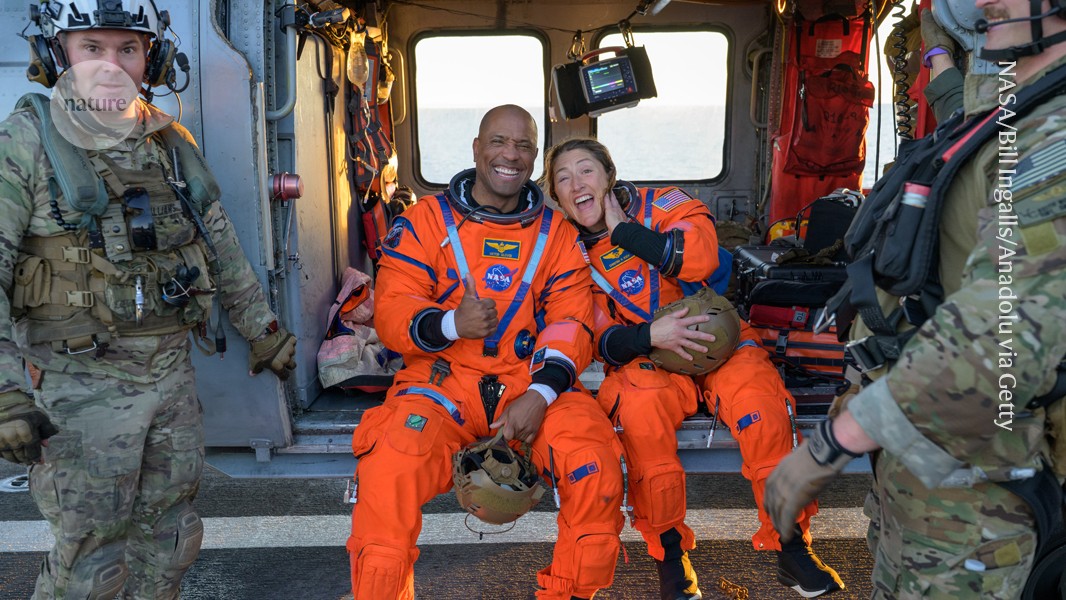
What do you do after you’ve been to the Moon and back? If you’re the astronauts of NASA’s Artemis II mission, you get to meet the US president and the Canadian prime minister — and even talk-show host Oprah Winfrey.
The Artemis II flight in April captured the world’s attention as four astronauts whizzed around the far side of the Moon, travelling farther from Earth than humans had ever gone before. On board were Reid Wiseman, Victor Glover, Christina Koch and Jeremy Hansen, a close-knit and accomplished group of explorers. Now, back on Earth, the Artemis II astronauts are basking in the after-effects of ‘Moon joy’, the feeling of elation from visiting another world. What could they possibly do next?
Flying in space is a hard act to follow. But many astronauts have forged thriving post-space careers by redirecting their immense talent and drive into fresh projects.
“The ones that are really successful in a post-flight career are the ones where being an astronaut didn’t define them,” says Susan Kilrain, a former astronaut who is one of the only women, and the youngest person ever at age 35, to fly a space shuttle. In 1997, she piloted NASA’s STS-83 and STS-94 missions. Since leaving NASA in 2002, Kilrain has worked for the US Navy, raised a family, served on the board of fitness-equipment company TRX Training, worked at venture-capital firm New North Ventures and written two books, including her just-published memoir Slaying Snakes in the Cockpit (2026).

I was with Artemis II’s scientists during the Moon fly-by. Here’s what I saw
More than 780 people have gone to space. Some were space tourists, but most were professionals who had trained for years. It’s been more than half a century since the Apollo 11 astronauts walked on the Moon, so today’s astronauts are more familiar with the modern age than the space age — closer to Chappell Roan than to Yuri Gagarin.
Since Koch got back from space, for instance, her two million Instagram followers have heard about her adventures surfing the waves on the coast of southern California and playing pickleball in North Carolina. Hansen threw the first pitch at a Toronto Blue Jays baseball game, and Wiseman and Glover delivered the match ball to a World Cup football game in Houston, Texas. Astronauts just can’t escape their role as public inspirations, says Libby Jackson, head of space for the Science Museum in London. “Astronauts are humans, and we can relate to them,” she says. “Every sector has its celebrities.”

The Artemis II crew spent nine days travelling to the Moon and back to test the Orion spacecraft’s capabilities.Credit: Adam Gray/AFP via Getty
As a result, many astronauts move into public-facing roles after they stop going on missions. For example, Liu Yang, China’s first female astronaut, occasionally makes high-profile appearances, such as speaking to the United Nations Human Rights Council on gender equality. Others become educators at universities, often in aerospace-focused programmes. Canadian astronaut Chris Hadfield, who is known for playing the guitar in space, is an adviser at the University of Waterloo in Canada. Some ex-astronauts work in the commercial space industry, joining companies such as Axiom Space, which runs private astronaut missions to the International Space Station, or organizations that have contracts with NASA to build hardware for future Moon missions.

