



Danish airspace deconfliction company eyes U.S. market
By DRONELIFE Features Editor Jim Magill
As the FAA wrestles with the best way to manage the low-altitude airspace to accommodate the anticipated explosive growth of traffic from UAVs and advanced-aviation vehicles, a European technology innovation company is offering a solution, based on mathematical algorithms, instead of artificial intelligence (AI) models.
Working with some of the largest aerospace and logistics companies in Europe, Copenhagen-based Skypuzzler has developed an air traffic management system that combines strategic (pre-departure) and tactical (during flight) deconfliction, to prevent airspace conflicts before they arise and allow for the management of air traffic in real time.
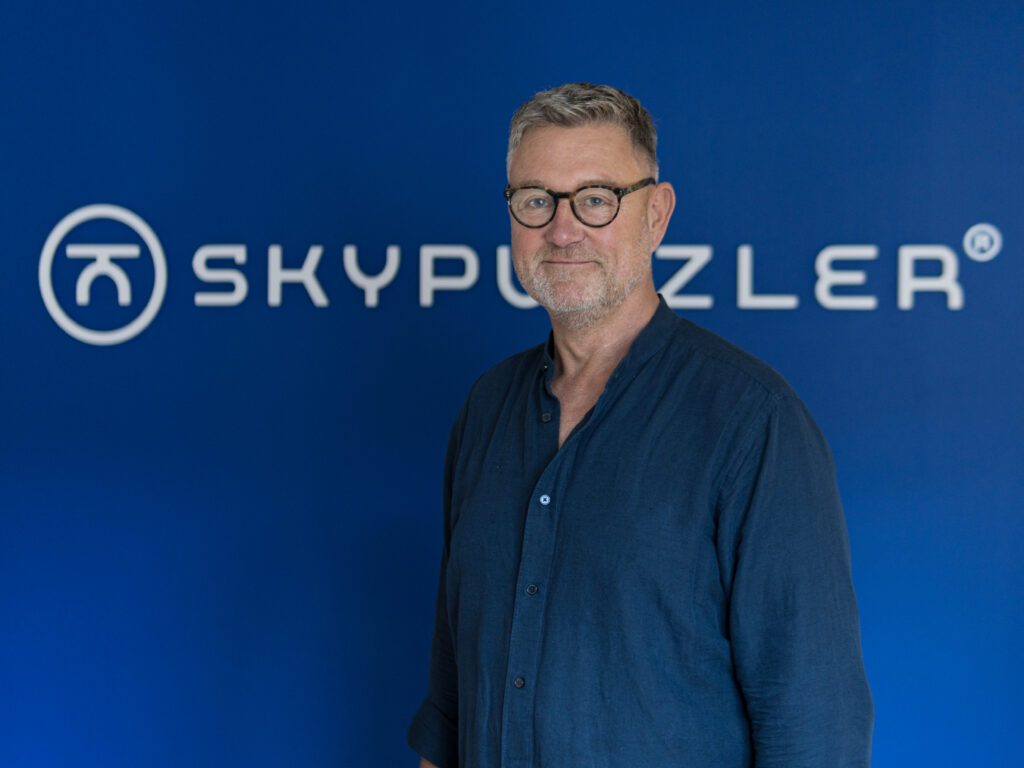
“The beauty with our solution is that you don’t need to install additional hardware on the drones. It’s based on the required data that the drones are sending to the UTM [UAS traffic management] systems or to the infrastructure,” Skypuzzler CEO Jesper Skou said in an interview.
Skou, a former air traffic controller who formerly was responsible for controlling all the air traffic in Denmark and Sweden, founded the company about 15 years ago with another air traffic controller and a computer scientist.
On its European home continent, Skypuzzler is integrating its deconfliction platform with major players, such as Thales Group, a France-based multinational aerospace and defense company, and with DSV, the world’s largest logistics company, which flies an extensive fleet of commercial drones.
Skypuzzler’s platform currently is being used to deconflict UAV operations in Europe’s largest port, the Port of Rotterdam in the Netherlands. Skou said there are almost 100 different drone operators working in the harbor and in the associated port facilities, performing a variety of jobs, from cargo transport to conducting survey inspections to detect oil leaks.
“It’s quite a logistic puzzle to make sure that all these different drone operators with different types of drones and different missions can be coordinated and can fly in the same airspace,” he said.

Recently, Skypuzzler announced that United Airlines Ventures, the corporate venture capital arm of United Airlines Holdings, had made an investment in the Danish Company. As a result of this relationship, Skypuzzler in hoping to establish a foothold in the growing U.S. airspace-management market, Skou said.
The company is particularly interested expanding into the Dallas-Fort Worth region, one of the most active areas in the country in terms of drone delivery operations and the establishment of UTM systems. The FAA already has issued approvals for drone deliveries by UAV operators such as Wing, Zipline and Flytrex. And last year, in the first of its kind agreement in the United States, Flytrex and Wing announced their shared implementation of the U.S. UTM Strategic Coordination standard.
However, Skou said the DFW model for airspace deconfliction, which involves only a handful of UAV operators, is not sustainable over the longer term as more aviation vehicles, both manned and unmanned, begin to crowd the skies.
“They are coordinating pre-departure, which means it’s strategic, it’s before they are launching their drones,” he said. “But if you have an airspace with many drone operators, helicopters and other manned aviation, then this concept will not survive over time. So, the drone industry cannot scale based on that.”
Skou said Skypuzzler’s software can be integrated into existing UTM systems, to provide both strategic and tactical deconfliction protections.
“That could be OneSky or ANRA Technologies if we’re talking about the U.S.,” he said. “It’s a plug and play basically.”
Digital system allows fully autonomous operations
Because Skypuzzler’s system is 100 percent digital, it can be operated fully autonomously as well as under the direction of human air traffic controllers, Skou said.
“For example, DSV, they are requesting that they still want a human in the loop,” he said. Under such a hybrid system, the human controllers can be alerted by a pop-up that will flag a potential conflict, between the operator’s drone and another drone or a manned aerial vehicle.
“We detect the conflict, and then we are also providing them with a conflict resolution. And then the pilot will accept or reject the solution. It’s exactly the same as the controller saying to United Airlines, ‘Turn left to a heading of…’ And then the captain will respond saying, ‘Okay, I will turn left,’” he said.
Skou said the Skypuzzler solution allows a single drone pilot to direct the operation of many UAVs. This allows companies such as DSV to dramatically improve the efficiency of their operations, such as in the drone transport of parts and equipment from northwestern Germany to wind farms in the North Sea.
“Now, instead of hiring 10 pilots to 10 drones, they can have one pilot supervising or monitoring the airspace where they are launching five or 10 drones,” he said. “It’s quite a lucrative business to fly with spare parts because they can deliver them within minutes to one hour. And they are basically replacing vessels and very expensive helicopters to provide these spare parts.”
System based on deterministic model
Unlike those airspace deconfliction systems devised by many of its competitors, which are based on AI technology, Skypuzzler’s platform is based on a mathematic model.
“It’s what you call a deterministic model, which means that we know exactly what the algorithm is doing. When you’re providing a mathematical model or algorithm with a question, you will always get the same answer, and we can trace it back to see if there’s an error,” Skou said.
“Some of our competitors, they have built a solution, that’s more or less similar, but it’s based on AI and machine learning (ML), which means that when you’re asking something, you cannot make sure that it’s the same answer that the algorithms provide. It can be different answers, which means that when you’re working with AI and ML, it is a black box.”
Skou said that while AI can be used in a lot of different areas, it has not been developed sufficiently to enable reliance on it for aviation safety. “It’s brilliant, but when you’re talking safety, flight safety, aviation safety, maybe in five or 10 years,” he said.
Yet, with all the buzz surrounding AI, Skou said he sometimes has a hard time convincing potential customers and investors of its limitations.
“I’m talking to investors right now, and, some investors are saying, ‘Oh, if your algorithm is not built on AI, we are not interested.’ And then I’m trying to explain that, ‘Yeah but it’s not going to work with AI in this solution.’
Read more:

Jim Magill is a Houston-based writer with almost a quarter-century of experience covering technical and economic developments in the oil and gas industry. After retiring in December 2019 as a senior editor with S&P Global Platts, Jim began writing about emerging technologies, such as artificial intelligence, robots and drones, and the ways in which they’re contributing to our society. In addition to DroneLife, Jim is a contributor to Forbes.com and his work has appeared in the Houston Chronicle, U.S. News & World Report, and Unmanned Systems, a publication of the Association for Unmanned Vehicle Systems International

