


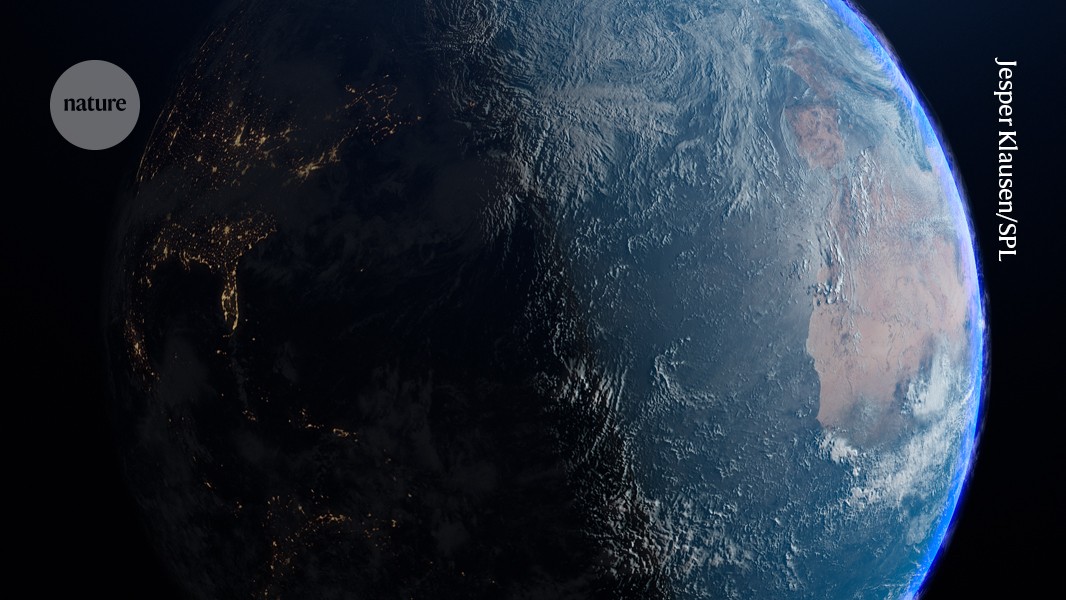

Reflect Orbital aims to redirect sunlight into Earth’s night-time zones.Credit: Jesper Klausen/Science Photo Library
A risky plan to turn night into day is one step closer to reality. Last week, US officials approved a mission to launch a giant mirror into space, where the device will reflect sunlight onto shadowed parts of the Earth. The start-up company behind the mission aims to place 50,000 mirrors in orbit by 2035, allowing for “full noon” brightness in select spots.
The start-up, Reflect Orbital in Hawthorne, California, says it intends to make “clean, abundant energy available on demand”. The company says that its pockets of manufactured “daytime” could increase agricultural productivity, aid natural-disaster relief efforts and allow solar panels to make electricity at night.

AI data hubs in space: when will they take flight?
But many astronomers worry that beams from the orbiting mirrors will interfere with sensitive telescope equipment and increase light pollution. “With 50,000 satellites, that would probably mean the end of ground-based astronomy, or optical astronomy, at least,” says Roohi Dalal, deputy director of public policy at the American Astronomical Society in Washington DC.
A spokesperson for the company says that this claim “demonstrates a lack of understanding of our technology”, and that Reflect Orbital has guard rails in place to ensure that its technology doesn’t interfere with astronomers’ work. The company has held discussions with scientists and will continue to do so, the spokesperson says. “Feedback from the astronomical community has already materially informed the design of our spacecraft and operational plans.”
Here’s what Reflect Orbital aspires to do and what scientists and engineers think.
How does the technology work and what is the test mission’s goal?
After receiving approval from the US Federal Communications Commission on 9 July, Reflect Orbital plans to launch its first satellite, Eärendil-1, later this year, into an orbit 625 kilometres above Earth’s surface. From there, the mini-fridge-sized spacecraft will deploy a mirror that’s the size of a tennis court, yet 28 times thinner than a human hair. The mirror will be angled to direct sunlight at multiple test locations, and the Reflect Orbital team will evaluate the deployment and pointing mechanisms. The first mirror will illuminate a patch of roughly 24 square kilometres on Earth’s surface. The light can be turned off on demand.
“This first satellite is going to be a proving ground, and we’re really going to get a chance to show how we can create good in the world without shining a light where people don’t want it,” says Reflect Orbital co-founder and chief executive Ben Nowack. His team has created hundreds of prototype mirrors, he says. The company plans to launch more test missions and is asking independent researchers to study the effects of its devices.
What are the challenges facing this technology?
As with any satellite, one small error in a piece of hardware or software could result in faulty mirror deployment. “It’s the simple stuff that gets you,” says Darren McKnight, a senior technical fellow at LeoLabs, a spacecraft- and debris-tracking company based in Menlo Park, California.
And once the mirror is deployed, Reflect Orbital will need to carefully monitor the effects of debris from other spacecraft orbiting Earth, says McKnight. Millimetre- and centimetre-sized pieces of artificial debris are common at the altitude where the satellite will orbit, and could hit it; repeated strikes on the ultra-sensitive mirror could reduce its effectiveness. Furthermore, this altitude has a high concentration of atomic oxygen, a highly reactive substance that erodes spacecraft surfaces and could damage the mirror.

Space debris is falling from the skies. We need to tackle this growing danger

