


You have full access to this article via your institution.
Hello Nature readers, would you like to get this Briefing in your inbox free every day? Sign up here.

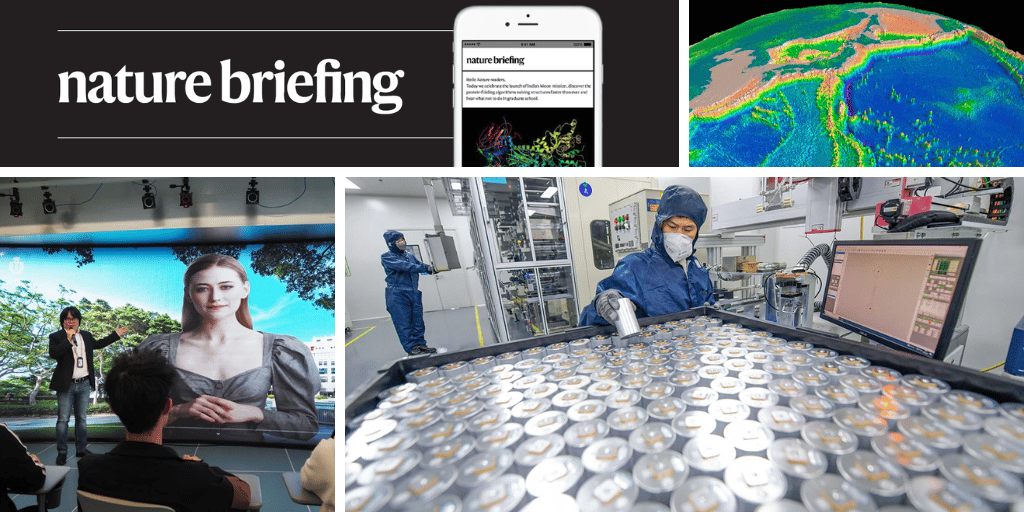
Computer scientist Pan Hui with a digital teaching avatar used at the Hong Kong University of Science and Technology in Guangzhou.Credit: Yawei Zhao
From assisting with health care to lecturing in universities, AI avatars are increasingly filling roles across China — so much so that the Cyberspace Administration of China, the country’s cyberspace regulator, has released new rules for the virtual digital humans. They require that people consent to the use of their personal information, appearance or voice. And companies are banned from providing children and young people with virtual relatives or virtual intimate relationships, and from creating services that could lead to children becoming addicted to virtual human services. In response, some tech companies have begun disabling features that allow users to create their own customized AI avatars.
Reference: Administrative Measures for Digital Virtual Human Information Services (Draft for Public Comment) (in Chinese)
Around 550 million years ago, a flat, segmented, worm-like creature called Spriggina floundersi wiggled its way through the seafloor mud of the Ediacaran period. And when it wiggled, it tended to wiggle to the right, say researchers. A study of more than 100 Spriggina specimens from South Australia — where it’s the state fossil — found that about twice as many were bending in a right-turning direction when they died compared to the opposite direction. “The presence of handedness in any kind of functional asymmetry, really deep into the fossil record, gives us important and interesting information,” says evolutionary biologist Russell Bicknell.
Smithsonian Magazine | 5 min read
Reference: Scientific Reports paper
Infographic of the week

Many countries can’t maintain their own regulatory drug approval processes, and so rely on reviews from others — especially the US Food and Drug Administration. “Since the 1980s, this model has been a win-win proposition for the countries, their citizens and the pharmaceutical companies,” writes pharmacy-practice researcher C. Michael White. However, changes under the administration of US President Donald Trump, such as staff cuts and a new programme that offers accelerated approval to some drugs, “could hurt international confidence in [the FDA’s] objectivity and rigor”, White argues. (The Conversation | 8 min read) (The Conversation (CC-BY-ND))
Features & opinion
Sodium-ion batteries promise to be cheaper, safer and more environmentally friendly than the lithium-ion cells that currently dominate technologies such as electric cars. And the sea-change could finally be here: CATL — the world’s largest battery producer — has announced that it will start mass-producing sodium-ion batteries by the end of the year. A swell of interest from battery makers and researchers has helped to solve longstanding challenges, such as a lack of durability.

Advanced technologies are poised to reveal the mysteries of the deep ocean floor — and deeper. Data from hydrophones can detect tsunamis faster than the destructive megawaves can travel, and a system that piggybacks on the optical cables that carry our data can detect seismic events over thousands of kilometres. Meanwhile, scientists are planning to drill through the crust’s lower boundary — called the Mohorovičić discontinuity — and take the first-ever pristine samples of the underlying mantle.
Can I borrow US$1.2 million? That’s the top estimate for a very special pen that helped get Neil Armstrong and Buzz Aldrin home from the Moon. It’s being auctioned off as I write — along with the broken switch that it served to replace for long enough to restore a circuit that they needed to lift off.
This firmly justifies my dedication to always carrying a pen, despite rarely writing by hand anymore. I’d love to hear what item you’ll never leave home without (I’ll allow you the watch, wallet and keys as a given) — plus any other feedback on this newsletter — at [email protected].
Thanks for reading,
Flora Graham, chief editor, Nature Briefing
With contributions by Jacob Smith
• Nature Briefing: Careers — insights, advice and award-winning journalism to help you optimize your working life
• Nature Briefing: Microbiology — the most abundant living entities on our planet — microorganisms — and the role they play in health, the environment and food systems
• Nature Briefing: Anthropocene — climate change, biodiversity, sustainability and geoengineering
• Nature Briefing: AI & Robotics — 100% written by humans, of course
• Nature Briefing: Cancer — a weekly newsletter written with cancer researchers in mind
• Nature Briefing: Translational Research — covers biotechnology, drug discovery and pharma

