


The modern world has been shaped by semiconductor technologies, grounded in the intrinsic band structures of materials and in our ability to engineer those structures with precision6,7. Similarly, the emergence of photonic crystals four decades ago not only transformed the field of optics but also laid the groundwork for compact quantum technologies8,9. The possibility of replacing bulky optical set-ups with two-dimensional nanostructures, typically referred to as metasurfaces, has stimulated widespread interest in exploring their potential for the preparation, manipulation and detection of quantum light fields3,10. However, most implementations so far have focused on integrating single-photon emitters with metasurfaces and manipulating several degrees of freedom, such as frequency, polarization and orbital angular momentum2,11,12,13,14,15. Similar efforts have also been reported for entangled photon pairs14,16,17. Yet, given the enormous implications that controlling larger multiparticle systems on metasurfaces would have for scalable quantum technologies, numerous continuing efforts aim to demonstrate this capability2,3,18. Nevertheless, this goal has remained elusive so far.
Interest in multiphoton quantum systems originates from the complex interference phenomena they can host19,20,21,22, which are particularly valuable for quantum information technologies14,23,24,25. The nature of these interference processes depends on the quantum coherence properties of the multiphoton system, which are, in turn, determined by the quantum statistical characteristics of the corresponding light fields19,21,26,27. These fundamental properties define different kinds of light, such as single photon sources, coherent light and thermal light21,28,29. Unlike other degrees of freedom, such as polarization or frequency, which can be investigated and filtered using photonic metasurfaces2,3, the statistical properties of multiphoton systems cannot be directly accessed. So far, their identification has required characterizing the collective behaviour of the entire multiphoton system21,25,29. Consequently, no material has yet been shown to exhibit sensitivity to the statistical fluctuations or coherence properties of multiphoton systems. As a result, the implementation of operations based on the quantum coherence of multiphoton systems has remained unattainable so far.
Here we introduce, to our knowledge, the first class of room-temperature quantum materials that are intrinsically sensitive to the quantum statistical properties defining all forms of light. In close analogy with the emergence of allowed and forbidden bands in semiconductors and photonic crystals, the meta-atoms composing quantum statistical plasmonic metacrystals result in quantum statistical bands that enable selective transmission of light according to its quantum coherence28. We show that the response of these plasmonic metacrystals is governed by the geometry of the constituent meta-atoms and by their collective arrangement within the crystal lattice30. As a result, many-particle interactions mediated by the plasmonic metacrystal suppress forbidden quantum statistical fluctuations, which cannot propagate through the metasurface, whereas multiphoton fields supported by allowed statistical bands propagate robustly and without distortion. These statistical bands therefore enable the controlled transport of otherwise fragile multiphoton quantum states. The demonstration of the first room-temperature quantum material intrinsically sensitive to the quantum coherence of many-body systems has direct implications for improving the efficiency of energy-harvesting processes, which are fundamentally influenced by the coherence properties of light31,32,33,34. The ability to control these properties using a coherence-sensitive materials platform operating under ambient conditions opens transformative opportunities for solar energy conversion and the development of next-generation optoelectronic devices5,31,32. More broadly, our approach lays the groundwork for robust many-body quantum technologies operating beyond cryogenic environments1,3,5,18,22,23,30,35.
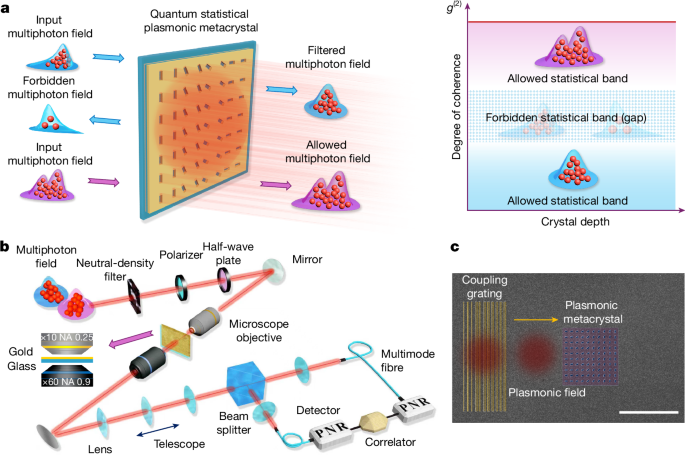
Sharing similarities with the formation of allowed and forbidden bands in semiconductors and photonic crystals, the repeating arrangement of meta-atoms in our plasmonic metacrystal results in multiparticle interference processes that are sensitive to the statistical fluctuations defining different kinds of light22,26,27. As illustrated in Fig. 1a, these processes establish allowed and forbidden quantum statistical bands whose emergence depends on the geometry of the plasmonic metacrystal. This response enables the first kind of optical materials that are sensitive to the quantum statistical properties of light. We characterize the quantum statistical fluctuations of multiphoton fields using the degree of second-order coherence, \(g^(2)(0)=1+(\langle (\Delta \hatn)^2\rangle -\langle \hatn\rangle )/\langle \hatn\rangle ^2\), in which \(\hatn\) is the photon-number operator and \(\Delta \hatn=\hatn-\langle \hatn\rangle \) denotes the photon-number fluctuation operator21,28,29. Notably, our plasmonic metacrystal transmits multiphoton fields whose degrees of coherence fall within the allowed statistical bands, whereas fields lying in forbidden bands are filtered and thermalized until their statistics converge to the nearest allowed band. In general, this transmitted multiphoton field can be described as an average over transverse spatial configurations Σ as
$$\hat\rho _\rmout=\int \rmd\varSigma \bigotimes _i,j|\alpha _\rangle _\theta _ij,\varSigma _ij.$$
(1)
Here \(_\theta _ij,\varSigma _ij\) denotes the coherent state of amplitude α0 associated with the meta-atom at position (i, j), with its linear polarization specified by the angle θij (refs. 36,37). In particular, θij = 0 corresponds to vertical polarization and θij = π/2 corresponds to horizontal polarization. The transverse spatial distribution of these photons is given by \(\varSigma _ij(\bfx)=\sin (\theta _ij)S_ij(\bfx)\varSigma (\bfx)\), in which x denotes the transverse position and Sij(x) describes the masking function of the meta-atoms. The factor sin(θij) accounts for the coupling efficiency of that meta-atom to the horizontal polarization component of the input field. Further details on the functional integral ∫dΣ and the form of Sij(x) are provided in the Supplementary Information. The description of the plasmonic metacrystal response presented below applies to all forms of input light fields29,31,32,33,34,38,39. Specifically, taking Σ(x) to be complex corresponds to sub-thermal input fields, with degree of second-order coherence 1 < g(2)(0) < 2, whereas restricting Σ(x) to be real yields superthermal multiphoton fields, with degree of second-order coherence 2 < g(2)(0) < 3.

a, Operation of a quantum statistical plasmonic metacrystal composed of 100 nanoantennas that act as meta-atoms. The plasmonic field propagating along the gold surface of the structure mediates coupling between neighbouring meta-atoms, resulting in multimodal quantum multiparticle interference. These interactions lead to the formation of allowed and forbidden statistical bands that respectively transport or filter multiphoton fields according to their quantum statistics. b, Experimental verification of the phenomenon, in which multiphoton fields with varying degrees of second-order coherence are prepared to illuminate coupling gratings. These gratings generate propagating surface plasmons, which subsequently excite the meta-atoms of the plasmonic metacrystal. The transmitted multiphoton field, propagating perpendicular to the metacrystal surface, is collected by a microscope objective and imaged using a tunable telescope, enabling the examination of different propagation planes within the paraxial near-field region of the metacrystal, in which the formation of quantum statistical bands is confined. We refer to this region as the crystal depth (Supplementary Information). The selected plane is directed through a beam splitter and analysed using two PNR detectors. c, The plasmonic metacrystal consists of coupling input gratings and 100 nanoantennas measuring 200 × 400 nm with varying orientations, patterned on a 110-nm-thick gold film deposited on a 175-μm-thick glass substrate, with adjacent nanoantennas separated by 1 μm. The roughness of the gold film is measured to be approximately 0.5 nm. The red spots in this figure depict the surface plasmon mode and the yellow arrow marks the propagation direction towards the plasmonic metacrystal. Further information about the coupling gratings and plasmonic metacrystal is provided in Methods and the Supplementary Information. Scale bar, 10 μm.
To characterize the second-order coherence at the output of the metacrystal, we first evaluate the corresponding first-order and second-order intensity moments \(G_\rmout^(1)(0)=\langle \hatn\rangle \) and \(G_\rmout^(2)(0)=\langle :\hatn^2:\rangle \) (ref. 37). The notation :⋅: is used to indicate normal ordering. Moreover, the photon number operator \(\hatn\) is given by \(\hatn=\int \frac\rmd^2x(2\pi )^2[\hata_\rmH^\dagger (\bfx)\hata_\rmH(\bfx)+\hata_\rmV^\dagger (\bfx)\hata_\rmV(\bfx)]\). Here \(\hata_s(\bfx)\) annihilates photon density at position x, with s = H, V denoting horizontal and vertical polarizations. The coherent states \(\otimes _ij_\theta _ij,\varSigma _ij\) from equation (1) are eigenstates of these annihilation operators (Supplementary Information). In particular, the eigenvalue of \(\hata_\rmH(\bfx)\) is given by \(\sum _ij\alpha _(2\pi )\sin (\theta _ij)\sin (\theta _ij)S_ij(\bfx)\varSigma (\bfx)\), whereas that associated with \(\hata_\rmV(\bfx)\) becomes \(\sum _ij\alpha _(2\pi )\sin (\theta _ij)\cos (\theta _ij)S_ij(\bfx)\varSigma (\bfx)\). These eigenvalue relations directly yield \(g_\rmout^(2)(0)=G_\rmout^(2)(0)/[G_\rmout^(1)(0)]^2\) with
$$\beginarraycG_\rmout^(1)(0)=|\alpha _^2\int \rmd\varSigma \int \rmd^2x\varSigma ^\ast (\bfx)\varSigma (\bfx)\sum _i,j\sin ^2(\theta _ij)S_ij(\bfx),\\ G_\rmout^(2)(0)=|\alpha _^4\int \rmd\varSigma \int \rmd^2x_1\rmd^2x_2\varSigma ^\ast (\bfx_1)\varSigma ^\ast (\bfx_2)\varSigma (\bfx_2)\varSigma (\bfx_1)\\ \,\times \sum _i_1,j_1,i_2,j_2\sin ^2(\theta _i_1j_1)\sin ^2(\theta _i_2j_2)S_i_1j_1(\bfx_1)S_i_2j_2(\bfx_2).\endarray$$
(2)
The response of each individual meta-atom is captured by Sij(x). By contrast, the array that forms the plasmonic metacrystal is specified by the set of polarization angles θij, which encodes the collective multipolar response arising from the arrangement of meta-atoms. Numerical evaluation of the multiphoton field transmitted through a statistical plasmonic metacrystal reveals clear design principles for quantum statistical control. We report numerical calculations in the Supplementary Information, showing that the size of each meta-atom sets the allowed values of the second-order coherence, whereas the number of meta-atoms and their relative orientations fine-tune the statistical bandwidth of the crystal. As a result, quantum statistical bands do not necessarily arise in arbitrary plasmonic structures2,3,17,19,30. When a plasmonic aperture becomes sub-wavelength, higher-order multipolar oscillations are suppressed40, producing a localized oscillating meta-atom with a uniform phase and enabling the selection of specific values of the second-order coherence. As described by equation (2), near-field coupling between meta-atoms further induces distinguishable and indistinguishable multiparticle interactions that govern the width of the statistical bands36,37. Meta-atoms aligned along the same direction lead to indistinguishable multiparticle interference, whereas differently oriented meta-atoms produce distinguishable multipolar effects.
We test this predicted functionality of our quantum statistical plasmonic metacrystal using the experimental set-up shown in Fig. 1b. To test its response, we prepared 13 multiphoton sources ranging from coherent to thermal and superthermal light, with degrees of coherence spanning values from one to three21,39 (see Methods and the Supplementary Information for details). The metacrystal dynamics described by equation (2) are preserved within the paraxial near-field regime. Consequently, the formation of quantum statistical bands is confined to this region, which we define as the crystal depth (see Supplementary Information for a full characterization of this region). Our platform provides access to the multiphoton dynamics at different propagation planes within the crystal depth, enabling direct examination of the multiparticle interactions that lead to the formation of quantum statistical bands. These interactions among paraxial photons are fundamentally distinct from those associated with evanescent near-field photons, which require dedicated near-field investigation techniques (for example, nanotip-based methods)40,41. The resulting multiphoton dynamics and coherence properties are measured using a pair of photon-number-resolving (PNR) detectors in the far field in a direction perpendicular to the sample plane22,25. The scanning electron microscopy (SEM) image of our plasmonic metacrystal is shown in Fig. 1c. The plasmonic sample comprises a grating coupler and a nanoantenna array forming the metacrystal. The grating excites a propagating plasmonic field that couples into the metacrystal region. Each meta-atom corresponds to a single nanoantenna with dimensions 200 × 400 nm. The metacrystal comprises 100 such meta-atoms with distinct orientations, coupled by means of plasmonic near-field interactions.
The sensitivity of our plasmonic metacrystal to the quantum statistical properties of light is shown in Fig. 2. As predicted by equation (2), the metacrystal exhibits an allowed statistical band for superthermal light, enabling the transmission of multiphoton fields with a degree of second-order coherence of g(2)(0) = 3 without any modification of their statistical properties. As described below, this mechanism mediates efficient transport of light with these quantum statistical fluctuations33,34. By contrast, the forbidden statistical band for superthermal fields filters photons characterized by g(2)(0) = 2.15. Specifically, this kind of light is superthermalized by the plasmonic crystal to reach an allowed degree of second-order coherence of g(2)(0) = 2.58. Furthermore, this quantum statistical metacrystal enables the efficient transmission of thermal light without any statistical modification. Notably, the injection of a sub-thermal multiphoton field with g(2)(0) = 1.25 falls within a forbidden statistical band of the metacrystal, which thermalizes the field to achieve g(2)(0) = 1.50. As indicated in Fig. 2, there is also an allowed statistical level for coherent light, which we examine using a field with g(2)(0) = 1. This field is transmitted without any statistical distortions by the metacrystal. The experimental joint photon-number distribution for this case can be found in the Supplementary Information.

Our plasmonic metacrystal exhibits a notable sensitivity to the quantum statistical properties of light, revealing well-defined allowed and forbidden bands for multiphoton fields, which are described in equation (2). We investigate these properties using multiphoton light sources with different statistical characteristics. The injection of a superthermal multiphoton system with a degree of second-order coherence g(2)(0) = 3 remains unaffected by the metacrystal, as its coherence matches one of the allowed statistical bands of the plasmonic crystal. Notably, a multiphoton field with g(2)(0) = 2.15 falls within a forbidden statistical band, leading to enhanced thermalization of the field and an increased g(2)(0) = 2.58. Thermal light with g(2)(0) = 2 lies within an allowed statistical band, resulting in its transmission without any statistical modification. By contrast, an injected multiphoton field with g(2)(0) = 1.25 lies within a forbidden statistical band, resulting in a modification of its coherence to g(2)(0) = 1.50. The yellow arrow indicates the transformation induced by the plasmonic metacrystal. Finally, coherent light, characterized by g(2)(0) = 1, propagates through the allowed statistical level of the metacrystal, as reported in the Supplementary Information. This unexpected form of statistical transport demonstrates the functionality of quantum statistical plasmonic metacrystals.
The observation of statistical bands in a plasmonic metacrystal establishes a route to room-temperature quantum materials sensitive to the quantum coherence of light. As predicted by equation (2), plasmonic metacrystals can be designed to control their sensitivity to multiparticle optical fields29,31,32,33,34,38,39. As summarized in Fig. 3a, the size of each meta-atom determines the magnitude of the second-order coherence, whereas the number of meta-atoms and their relative orientation set the statistical bandwidth. Consequently, quantum statistical bands do not arise in arbitrary plasmonic structures2,3,17,19,30. This is illustrated by illuminating the plasmonic structures with 19 input sources with distinct degrees of second-order coherence, spanning coherent, thermal and superthermal statistics. This is illustrated in the first panel of Fig. 3b for two configurations of plasmonic beam splitters, among the most basic and widely used plasmonic architectures2,17,19,30, which remain insensitive to the coherence properties of multiphoton fields. All multislit structures in Fig. 3 use a coupling grating (not shown), similar to that in Fig. 1c, to excite plasmonic fields that propagate towards the purple region. In the bottom-right structure in Fig. 3b, the two slits combine the plasmonic fields within this region. In this case, both coherence-insensitive plasmonic structures produce nearly identical responses. We report the response of the two-slit structure here; the response of the first beam splitter is provided in the Supplementary Information. The quantum coherence of the input fields is transmitted by these structures without modification. By contrast, when plasmonic apertures exhibit meta-atom behaviour, their collective arrangement shows the characteristic sensitivity of plasmonic metacrystals to quantum optical coherence. This sensitivity is reflected in the emergence of statistical bands: the first panel of Fig. 3c shows a narrow gap, making the metacrystal sensitive to a reduced number of light sources. In this regime, each aperture still exhibits multipolar plasmonic resonances40. Reducing the aperture size suppresses these multipolar dynamics and yields a metacrystal composed of localized plasmonic meta-atoms. As shown in the second panel of Fig. 3c, this results in wider forbidden statistical bands and sensitivity to a broader range of light sources. Nevertheless, in accordance with equation (2), this metacrystal contains fewer meta-atoms and a simpler configuration than that in Figs. 1 and 2 and therefore supports narrower statistical gaps. Together, these results establish a mechanistic pathway for the design of statistical bands in plasmonic metacrystals.

a, The design parameters governing statistical-band formation. Meta-atom size sets the accessible values of the second-order coherence, whereas the number of meta-atoms and their relative orientations control the statistical bandwidth. b, Arbitrary plasmonic structures, such as beam splitters, are insensitive to input-field coherence and do not modify multiphoton quantum statistics, reflecting the absence of meta-atom behaviour at the level of individual apertures. These two plasmonic structures represent common configurations in which two plasmonic fields are combined to produce interference. The plasmonic fields are scattered out of plane by the large apertures, visible as black rectangles in the purple-shaded regions in the SEM images. The input grating for the beam-splitter structure on the left is shown in yellow. On the other hand, the two-slit structure on the right includes a grating (not shown) that excites a plasmonic field propagating towards the purple-shaded region (similar to Fig. 1c)—each slit can reflect, transmit or scatter surface plasmons into photons. The splitting and recombination of the fields in both plasmonic structures (left and right) can be described by a multiport beam-splitter transformation46. These structures were investigated using sources with varying degrees of second-order coherence, ranging from one to three. c, The controlled engineering of statistical bands is experimentally verified using two distinct plasmonic metacrystals, with the input gratings omitted for clarity. The first panel of c shows narrow forbidden statistical bands associated with multipolar plasmonic resonances supported by the aperture geometry. Reducing the aperture size suppresses these dynamics and, in the second panel, yields localized plasmonic meta-atoms that collectively form a plasmonic metacrystal with wider forbidden statistical bands. This response is associated with enhanced sensitivity to a broader range of light sources. Scale bars, 10 μm (b, left); 5 μm (b, right, c).
We investigate the robustness of the statistical bands by examining multiparticle systems as they propagate through the depth of the plasmonic metacrystal. Using a Green’s function approach, we capture the inherent multiparticle near-field dynamics surrounding the metacrystal and explain their role in shaping its statistical bands. To this end, we recall that the (i, j)th meta-atom’s masking function was given by Sij(x). As such, the spatial distribution of the outgoing photons for each meta-atom is given by Σij(x) = Sij(x)Σ(x), in which Σ(x) is once again the stochastically random transverse spatial profile of the input source. As detailed in the Supplementary Information, the spatial distribution evolves in time as \(\varSigma _ij^\ast (\bfx,t)=\int \rmd^2x^\prime K(\bfx,\bfx^\prime ,t)\varSigma _ij^\ast (\bfx^\prime )\) (refs. 41,42), in which
$$K(\bfx,\bfx^\prime ,t)=\frac\omega _\rmi2\pi t\rme^\bfx-\bfx^\prime ^2$$
(3)
is the Fresnel kernel41. Here ω0 denotes the frequency of the light source and t describes the propagation time. In this expression, x denotes the transverse spatial coordinate in the measurement plane and x′ denotes the transverse spatial coordinate in the preceding plane, in which no photon detector is present. This indicates that the photon density at the output of each meta-atom spreads gradually on propagation40,41. Within the paraxial near field of the metacrystal, no reduction in indistinguishability is observed, so that the quantum statistics are preserved. In the paraxial far field, in which the photon densities associated with different meta-atoms begin to overlap, further coherence terms emerge, leading to an increase in the second-order coherence. A more in-depth discussion of this phenomenon, by which statistically incoherent light fields become statistically coherent on propagation, can be found in the Supplementary Information. As such, the statistical bands generated by our metacrystal are stable within the paraxial near-field region. Expressions for the time-evolved first-order and second-order coherence functions are provided in the Supplementary Information.
In Fig. 4a, we experimentally demonstrate that the plasmonic near-field dynamics of the metacrystal robustly preserve its quantum statistical bands on propagation through the crystal depth. In this case, we use the metacrystal discussed in Figs. 1 and 2, which exhibits wider statistical bands. The robustness of the statistical bands is verified using 13 multiphoton input fields. Notably, these statistical bands are preserved for multiphoton fields with arbitrary statistical properties. Our theoretical description attributes this behaviour to the collective nonclassical dynamics of the underlying multiparticle systems that define different forms of light. This can be directly examined using projective PNR measurements on the transmitted field26, which enable the extraction of multiparticle Fock systems. In Fig. 4b, we show that an extracted four-particle subsystem preserves the statistical-band behaviour of the classical system. The colours of statistical bands encode the coherence properties of the input light fields. As shown in the Supplementary Information, the multiphoton coherence can be described through the multiparticle-field coherence function
$$\tildeg^(2)(N)=\frac\mathrmTr[\hat\rho _\mathrmout(t):\hatn^2N\exp [-2\hatn]:](\mathrmTr[\hat\rho _\mathrmout(t):\hatn^N\exp [-\hatn]:])^2,$$
(4)
in which \(\hat\rho _\rmout(t)\) is the quantum state from equation (1) but where the spatial distributions of each photon are propagated forward in time. Notably, the presence of stable statistical bands is also observed for multiphoton quantum systems throughout the crystal depth43. Despite the inherent losses of plasmonic platforms44,45, this behaviour suggests robust mechanisms for efficient transport of multiparticle quantum states33,34. We further confirm this possibility in Fig. 4c, in which multiparticle systems distilled from the allowed superthermal band exhibit probabilities that remain essentially constant during propagation through the crystal depth, despite the strong intensity fluctuations of superthermal light and the losses in the crystal27,30. This robustness highlights the capability of the allowed statistical bands to transport quantum photonic states in an efficient fashion43.

a, The collective response of the plasmonic metacrystal to multiparticle systems exhibiting statistical properties that range from coherent to thermal and superthermal light fields. We report the quantum statistical near-field dynamics of multiparticle systems propagating through the depth of the plasmonic crystal, experimentally verified using 13 sources with distinct degrees of second-order coherence ranging from one to three. These dynamics reveal that the propagating paraxial near-field components from the metacrystal robustly preserve its allowed and forbidden statistical bands. Notably, this band structure is maintained for the nonclassical multiphoton fields that constitute different light fields. We investigate this using PNR measurements on the transmitted field, which enable the extraction of multiparticle states. b, The band structure of the extracted four-particle subsystem, with statistical-band colours encoding the coherence properties of the input light fields. The preservation of statistical bands for multiparticle systems suggests the possibility of using plasmonic metacrystals for applications in many-body quantum systems. c, Demonstration of the robust propagation of quantum systems with well-defined Fock particle numbers in a synthetic lattice43, in which the input probabilities for different multiparticle states are preserved despite the inherent losses of the plasmonic crystal30,44,45,47. These probability lattices were extracted from one of the superthermal output fields of our plasmonic metacrystal structure. These effects demonstrate the robust statistical response of the plasmonic metacrystal across a broad range of multiparticle systems.
The emergence of a new class of room-temperature quantum materials has broad and profound consequences6,7,8,9, spanning energy science and quantum technologies3,5. In energy-harvesting architectures, the partial coherence of realistic light sources mediates interference effects that induce localization of light in photovoltaic absorbers, thereby suppressing long-range transport5,31,32,33. These effects, which are unavoidable in disordered media, convert optical energy into heat and reduce conversion efficiency5,31,32,34. Notably, our plasmonic metacrystals enable the deterministic engineering of quantum statistical bands, providing a route to optimizing quantum coherence for efficient solar-energy conversion. Beyond energy science, this functionality establishes a platform for robust many-body quantum technologies operating at room temperature. These include high-fidelity constant-time transformations of many-body quantum systems that are independent of system size, defined by the number of particles. Such transformations are essential for scalable quantum computing2,14,35. As demonstrated here, the emergence of allowed quantum statistical bands enables controlled transport of multiparticle quantum states, providing a key ingredient for robust many-body quantum technologies2,14,30,35.
In conclusion, we demonstrated quantum statistical plasmonic metacrystals, a new class of materials in which the multiparticle dynamics they host lead to allowed and forbidden bands that select light according to its quantum coherence properties. Sharing similarities with the filtering functionalities of semiconductors and photonic crystals7,8,9, the gaps in our plasmonic metacrystal selectively transmit or block multiphoton fields based on their quantum statistical properties. This behaviour is governed by the geometry of the constituent meta-atoms and their collective arrangement within the crystal. The size of each meta-atom determines the quantum coherence associated with the allowed and forbidden bands, whereas the number of meta-atoms and their relative orientation control the statistical bandwidth of the metacrystal. Consequently, forbidden quantum statistical fluctuations cannot propagate through the metasurface, whereas fields supported by the statistical bands propagate robustly and without distortion. Notably, these allowed statistical bands enable robust transport of fragile multiphoton quantum systems34,43. The advent of a room-temperature quantum material intrinsically sensitive to the quantum coherence of light has direct implications for energy harvesting, as the efficiency of solar energy conversion is fundamentally influenced by the coherence properties of sunlight31,32,33,34. In this context, quantum plasmonic metacrystals provide a route for selectively filtering the quantum statistical properties of light, opening transformative opportunities for efficient solar energy conversion and the development of next-generation optoelectronic devices31,32. Beyond energy applications, this platform establishes a materials system capable of manipulating many-body quantum systems at ambient conditions, laying the groundwork for robust many-body quantum technologies operating beyond cryogenic environments2,3,4,5,30,31,32.

