


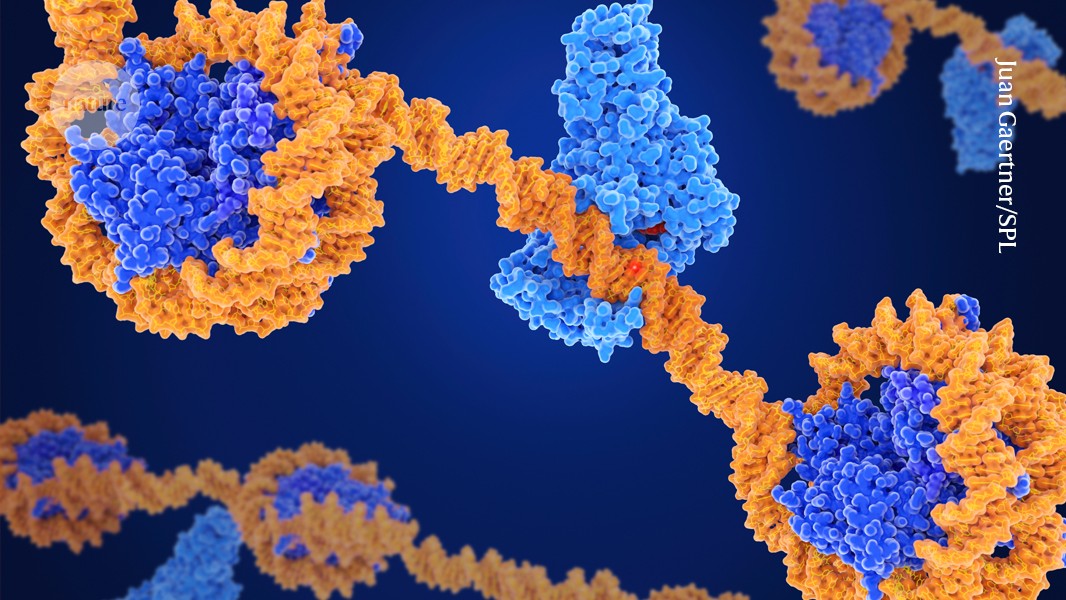

Epigenetic modifications to DNA (yellow), such as those catalysed by DNA methyltransferase enzymes (blue, centre) control gene expression.Credit: Juan Gaertner/Science Photo Library
Marianne Rots first started talking about epigenome editing on the conference circuit about two decades ago. If natural epigenetic marks such as DNA methylation and histone acetylation control gene expression, she reasoned, then artificially modifying those marks should allow scientists to adjust that expression. But many of her peers scoffed, assuming that epigenetic tags could not trigger such changes. “We really had to fight dogmas, that people thought, this will never, ever work,” says Rots, an epigeneticist at the University Medical Center Groningen in the Netherlands.
Then came the CRISPR–Cas system. Although the technology first made a splash in gene editing, scientists such as Rots now use it to precisely target epigenetic editors to any DNA sequence. Suddenly, epigenetics researchers could not only silence or activate genes, but also dial gene expression up or down. More than a dozen companies are now exploring epigenetic-editing technology, and a handful of early-stage clinical trials are under way.
Tunable and flexible, epigenetic editing stands in elegant contrast to gene editing. CRISPR’s Cas enzyme slashes genetic material apart, then relies on cellular systems to repair it, hopefully incorporating the desired edit. Epigenetic editing is gentler, leaving the DNA strands and code unchanged, and can induce either temporary or permanent changes.
‘Epigenome editor’ silences gene that causes deadly brain disorders
“I find epigenome editing to be much more sophisticated, much more complex,” says Charles Gersbach, a biomedical engineer at Duke University in Durham, North Carolina. “There are just so many more things that you can do with epigenome editing that aren’t necessarily doable with genome editing.”
For example, in epigenetic editing, adding a handful of guide RNAs — the nucleic acids that target the Cas enzyme to a specific genomic location — to the machinery allows scientists to alter several sites at once. By contrast, because gene editing requires creating a double-stranded DNA break, editing several gene sequences at once risks the pieces reconnecting in unnatural, dangerous configurations.
Researchers are using epigenetic editing to explore the intricacies of gene expression and to develop therapies. Plant scientists are fiddling with epigenomes, too, to create crop variants that differ not in DNA sequence, but in gene activity. But the epigenome is complex, and many projects require trial and error.
“We really don’t understand the rules,” says Rots. “We cannot predict the final outcome of our biological experiments.”
From the bench …
It’s no wonder the rules are unclear: “The epigenetic modifications are numerous,” says Elizabeth Heller, a neuroscientist at the University of Pennsylvania Perelman School of Medicine in Philadelphia. The DNA molecule can be modified by methylation — which can silence genes — and its associated histones are subject to dozens of possible chemical decorations, including acetylation, phosphorylation and biotinylation, each of which has its own mode of action. “Even at a given gene, there’s usually many of them, changing all at once,” says Heller. In human cells, gene expression is managed by about 900 chromatin regulators and 1,600 transcription factors, proteins that bind to DNA sequences to control the rate of gene expression.

CRISPR’s next act: the companies editing the epigenome to treat disease
Therefore, one of the first applications for epigenetic editing is in probing the mechanics of epigenetics itself. Heller, for instance, studies the genetic impacts of cocaine use. Preliminary results suggest that when mice are exposed to the drug and later denied it, histone methylation is diminished at a particular genetic locus, and production of the corresponding mRNA transcript increases1. This suggests that the withdrawal of cocaine caused the epigenetic changes, which then altered gene expression. But to dissect precisely what’s happening, she needs to modify epigenetic marks, one at a time or in concert. Epigenetic editors are just the ticket.
The basic editor has two key parts. The first is a targeting mechanism — generally a version of CRISPR’s Cas enzyme that cannot cut DNA, along with a guide RNA to bring it to the locus.
The other is the effector, which makes the edit or otherwise influences gene expression. Some effectors are enzymes that directly modify DNA and histones, such as methyltransferases and demethylases. Other effectors don’t act directly on the DNA itself, but recruit or block transcriptional machinery — artificial transcription factors (ATFs), as Heller and Rots call them2.

Epigenetics researcher Elizabeth Heller.Credit: Daniel Burke
For temporary changes, Heller says, researchers can introduce plasmids that encode the editor or ATF into cells. The plasmids can be delivered in a few ways, for example as DNA or packaged inside short-lived viral vectors such as herpes simplex virus. The expression of the editor or ATF, and any resulting changes, will last for a week or so.
For longer-term changes, researchers might use lentiviral vectors, which integrate their genes into the host-cell genome. Or they can create transgenic cell lines or organisms with genomes that have been modified to express the editor or ATF.
“Having all of those options does make it a little daunting,” says Gersbach. “But also, it’s really powerful, in creating a lot of flexibility.”
Rots recommends starting with a couple of commonly used effectors, many of which are available from the reagent-distribution service Addgene, based in Watertown, Massachusetts. To turn gene expression up, consider VP64 and its related constructs, activators based on a transcription factor from herpes simplex virus 1. To decrease expression, try CRISPRoff, built from the transcriptional repressor KRAB domain and a DNA methyltransferase complex, which catalyses methylation.
Gersbach used KRAB, VP64 and another gene activator called TET1 in a 2025 study to probe gene regulation in Prader–Willi syndrome, which causes ongoing hunger, among other symptoms. The disease occurs when there’s a deletion in the copy of chromosome 15 inherited from the father. All the genes are present on the maternal chromosome 15, but they’re methylated, or turned off. Rather than trying to reactivate each gene across 5–6 megabases of genetic material, Gersbach is seeking a “master switch” to control them all — a strategy he hopes could one day lead to a therapeutic.
To investigate how the region is regulated, the researchers paired more than 11,000 guide RNAs with either VP64 to activate expression of the silenced maternal allele or KRAB to repress the normal paternal version. Hits from the screen and further work with the TET1 activator identified a single genomic location at which targeted demethylation activated silenced genes, even after the editor had dissipated3.
To the clinic …
At the San Raffaele Hospitalization and Treatment Institute for Gene Therapy in Milan, Italy, molecular biologist Angelo Lombardo also has therapeutic ambitions for epigenetic editing. In 2016, Lombardo described a method that he calls “hit and run” editing to achieve long-term changes from transiently expressed effectors4. Like CRISPRoff, the system relies on KRAB and a methyltransferase enzyme, as well as customizable DNA-targeting molecules. Short-term expression of these constructs in cultured cells placed repressive marks on the DNA and histones of target genes, shutting them off for good. The effects last for months, across several rounds of cell division, Lombardo says.
Lombardo’s team used the same system to deactivate the Pcsk9 gene in mice5. Expressed in liver cells, Pcsk9 regulates cholesterol levels; small-molecule PCSK9 inhibitors can treat high cholesterol, and gene-editing strategies to disable the gene are in trials. Lombardo’s group used lipid nanoparticles to deliver messenger RNA encoding their epigenetic editor to mouse livers, which almost halved PCSK9 levels. A single treatment created effects lasting nearly a year. The researchers removed part of the liver in four mice, forcing the organ to regenerate — and the new tissue maintained the epigenetic repression, showing that it can be passed from mother cell to daughter.
‘Epigenetic’ editing cuts cholesterol in mice
Lombardo co-founded nChroma Bio in Boston, Massachusetts, to further develop epigenetic treatments such as this one, and the company is taking the PCSK9 programme through its next steps. In mice, nChroma researchers silenced expression of a human PCSK9 transgene, leading to a reduction of more than 98% in protein levels for at least a year — and they could reactivate the gene, too, by removing the silencing methyl marks6. In the same study, cynomolgus monkeys were given the treatment, which slashed PCSK9 levels by about 90%, and levels of low-density lipoprotein, or ‘bad’, cholesterol dropped by about 70%.
Both nChroma and Tune Therapeutics, co-founded by Gersbach and based in Seattle, Washington, are trialling epigenomic treatments for hepatitis B. Infected liver cells contain many copies of the viral genome: some are integrated into the host chromosome, and others exist outside it. The idea behind these treatments, Gersbach explains, is to silence the viral genomes and prevent production of viral particles, thus leading to a “functional cure”. At the European Association for the Study of the Liver conference in Barcelona, Spain, in May, Tune reported that, in an ongoing, early-stage trial, the higher doses of the treatment eliminated several viral protein and RNA biomarkers for up to 17 months.
Back in the laboratory, Lombardo is now combining epigenetic editing with gene editing in what he calls an all-in-one “crazy platform” for cancer therapeutics. In CAR-T therapy, immune cells are reprogrammed with chimeric antigen receptors (CARs) that target cancer cells. But it’s also helpful to inactivate other genes that could inhibit the CAR T cells’ immune actions or cause them to attack the wrong targets. Lombardo reasoned that only the addition of the CAR requires actual genetic editing; silencing other genes can be accomplished through the gentler epigenetic approach.
The trick was to design a system that could cleave a single target site to insert the CAR gene while targeting epigenetic editors to other genomic locations. Lombardo’s solution was to use guide RNAs of varying lengths and an active Cas9 enzyme that could slice DNA. He used a full-length guide RNA to target the desired CAR locus, which Cas9 cleaved during full-on genetic editing. Truncated guide RNAs targeting other sites were sufficient to recruit the epigenetic effectors — again, KRAB and methyltransferases — without cutting DNA. In May, the scientists reported that they had successfully expressed CARs and epigenetically silenced two other genes in 80% of cells in culture7.
To the greenhouse
Epigenome editing is also making inroads in the agricultural sciences. Many plant traits, such as height and yield, are controlled by epigenetics, explains Jian-Kang Zhu, a molecular geneticist and president of Macau University of Science and Technology in China. Editing plant epigenomes could create valuable breeds without having to alter the DNA sequence.

