


Opinions expressed by Entrepreneur contributors are their own.
Key Takeaways
- From FOX One’s Times Square “Cube” to Seattle’s floating soccer barge, brands are winning attention by creating memorable moments that turn casual viewers into engaged fans.
- Watch parties, personalities and interactive fan experiences make the sport more accessible, helping the 2026 World Cup become a cultural event that extends far beyond the action on the field.
Soccer may not be “America’s Game”, but the 2026 World Cup could become its biggest event. That’s because the tournament’s real product isn’t the action on the pitch; it’s the experience around it.
NFL legend Chad “Ochocinco” Johnson, a longtime soccer fan and co-host of The Late Run, sees community and creativity as the key to the sport’s growth in the U.S.
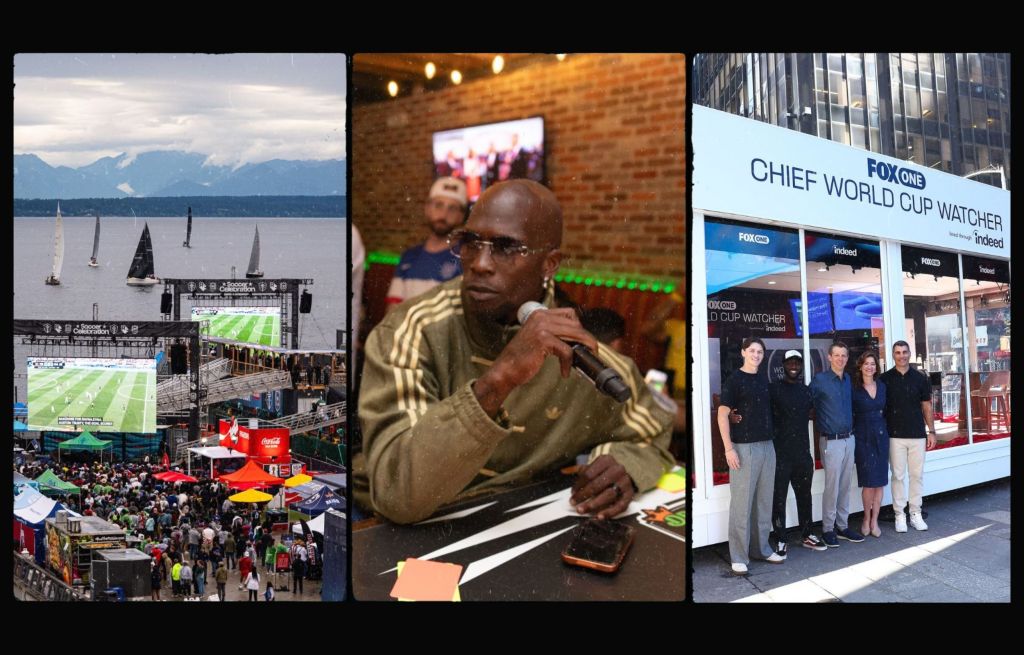
“It’s gonna catch on, and for things to catch on, you need other avenues to expose the game to people,” Johnson said while hosting a DraftKings World Cup watch party at The Shepherd & The Knucklehead in Hoboken. “You’ve got to be in the mix. If you’re not going to a game, you’ve got to go somewhere where there are a lot of people watching.”
“I think it’s all about that cultural connection,” added fellow The Late Run co-host Raheem Taylor-Parkes. “In America, not everybody’s just going to wake up and watch a 90-minute soccer game. You need something that keeps people attached to it. That’s where personalities like Ocho, or what you see on Fox Sports with Thierry Henry and Zlatan, come in. They’re characters people can connect with. What happens off the field is just as important.”
So, while nations battle for supremacy on the pitch, brands are waging a war of their own behind the scenes, racing to create the most memorable World Cup experiences.
The tournament permits companies to think far beyond the traditional sports bar, inspiring brands to get creative as they build destinations around the game. Here are a few of the companies reimagining what it means to watch the World Cup.
FOX One: Thinking Inside The Box
This World Cup, FOX One knew it needed to make a statement for the tournament’s long-awaited return to the U.S. But instead of thinking outside the box, they decided to put someone in one.
“One of our agencies had a crazy idea and said, ‘What if we put someone in a glass cube in Times Square and had them watch every minute of the World Cup?’” says FOX Sports’ Brian Borkowski, CMO, Direct to Consumer at FOX.
And with that, The Cube was born. A pop-up living room built from scratch in the heart of Times Square, encased in glass and putting its occupants on display for thousands of passing tourists and fans. The only thing left was finding someone willing to spend a month inside it, which wasn’t too difficult.
Thousands of diehard soccer fans flocked to Indeed, submitting custom videos and polished resumes in hopes of landing the coveted title of Chief World Cup Watcher — and the $50,000 payday that came with it.
The competition was so fierce that what began as a search for one fan quickly expanded to two, with FOX ultimately selecting Austin Franklin and Kevin Akoto.
“I was going to watch all the matches anyway, so I figured I might as well do it from Times Square and make content around it,” Franklin says, laughing from the couch inside The Cube, which he’s called home for the last 21 days.
Akoto was so committed to the opportunity that he quit his day job to take it.
“It’s always going to be a conversation starter when somebody sees that on your resume,” he says. Once the tournament began, the World Cup Watchers became attractions in their own right. Tourists snapped photos, fans, celebrity and civilians alike stopped by to talk soccer, and the pair quickly became an integral part of the Times Square experience.
The Cube isn’t selling tickets or pouring drinks; it was never designed to drive immediate revenue. Instead, it’s meant to capture attention, generate earned media, and help FOX One capitalize on a once-in-a-generation cultural moment.
“It’s about the PR and social content that comes out of it,” says Borkowski. A big part of the country still doesn’t know what FOX One is — or even that it exists. We saw this as an opportunity to launch the brand again and make the entire country aware of us overnight.”
So far, it’s been a resounding success. While he couldn’t share exact figures, Borkowski claims that FOX could’ve spent 5x as much as they did on the Cube and it still would’ve been worth it.
Though unconventional, The Cube is a testament to the power of creativity in a crowded media landscape. Countless influencers and creators are streaming World Cup matches from bars and watch parties, but only two can say they’re watching every game from a glass box in the middle of Times Square.
In the experience economy, the product isn’t always the game itself — sometimes it’s the chance to be part of the spectacle surrounding it. And ironically, occasionally being a square actually does make you stand out.
The Sounders: Anchoring The World Cup in Seattle
Most World Cup host cities don’t have the luxury of a Times Square-sized stage, so they’ve had to get creative by leaning into what makes their cities unique.
Seattle’s answer is to turn its waterfront into a soccer destination. The city’s two professional clubs, Seattle Sounders FC and Seattle Reign FC, alongside The RAVE Foundation, are spearheading the Seattle Soccer Celebration, a first-of-its-kind fan experience at Pier 62 on Elliott Bay.
At the center of it all is “The Barge,” a floating soccer pitch framed by Elliott Bay, the Seattle skyline, and Waterfront Park. The premium ticketed venue serves as the celebration’s signature gathering place, hosting watch parties, community events, and brand activations while helping subsidize the free fan experience on the pier.
“When we started thinking about what this could look like, we immediately went to the water,” Sounders CMO Ro Vega says. “If there’s one thing that’s uniquely Seattle, it’s our waterfront.”
At first, there were preliminary talks about creating a fully functional floating soccer stadium. But as organizers got realistic about timing and logistics, the idea evolved into a floating fan destination—one designed to be photographed, shared, and remembered as one of the tournament’s defining images.
For the Sounders and Reign, the celebration isn’t just a watch party. It’s a fan acquisition and brand-building exercise, an opportunity to introduce new supporters to both clubs, re-engage lapsed fans, and reinforce Seattle’s identity as one of North America’s premier soccer markets. So far, the strategy appears to be working: the Pier 62 and Barge fan site has already welcomed more than 650,000 visitors since the start of the World Cup, with more expected before the tournament concludes.
The project also carries a deeper meaning. Ahead of the 2026 World Cup, RAVE pledged to build 52 free mini-pitches in underserved communities across Washington state. The floating field serves as the symbolic 52nd pitch—a highly visible fulfillment of that promise and a reminder that the clubs hope their legacy will extend long after the final whistle.
What happens to The Barge after the World Cup remains an open question. It could be decommissioned and returned to its previous life hauling cargo between Alaska and Seattle, or it could become a permanent fixture on the city’s waterfront. According to Vega, other Seattle sports organizations have already expressed interest in the floating venue.
Whatever its physical future, The Barge has already secured its place as a symbol of Seattle’s deep connection to the game—and as a testament to the role the Sounders and Reign have played in putting the city at the center of American soccer.
“I want people to look at Seattle and say, ‘That’s the best soccer city in North America,’” Vega says. “I want Seattle to be seen as the premier market for world-class soccer.”
Key Takeaways
- From FOX One’s Times Square “Cube” to Seattle’s floating soccer barge, brands are winning attention by creating memorable moments that turn casual viewers into engaged fans.
- Watch parties, personalities and interactive fan experiences make the sport more accessible, helping the 2026 World Cup become a cultural event that extends far beyond the action on the field.
Soccer may not be “America’s Game”, but the 2026 World Cup could become its biggest event. That’s because the tournament’s real product isn’t the action on the pitch; it’s the experience around it.
NFL legend Chad “Ochocinco” Johnson, a longtime soccer fan and co-host of The Late Run, sees community and creativity as the key to the sport’s growth in the U.S.
“It’s gonna catch on, and for things to catch on, you need other avenues to expose the game to people,” Johnson said while hosting a DraftKings World Cup watch party at The Shepherd & The Knucklehead in Hoboken. “You’ve got to be in the mix. If you’re not going to a game, you’ve got to go somewhere where there are a lot of people watching.”

