


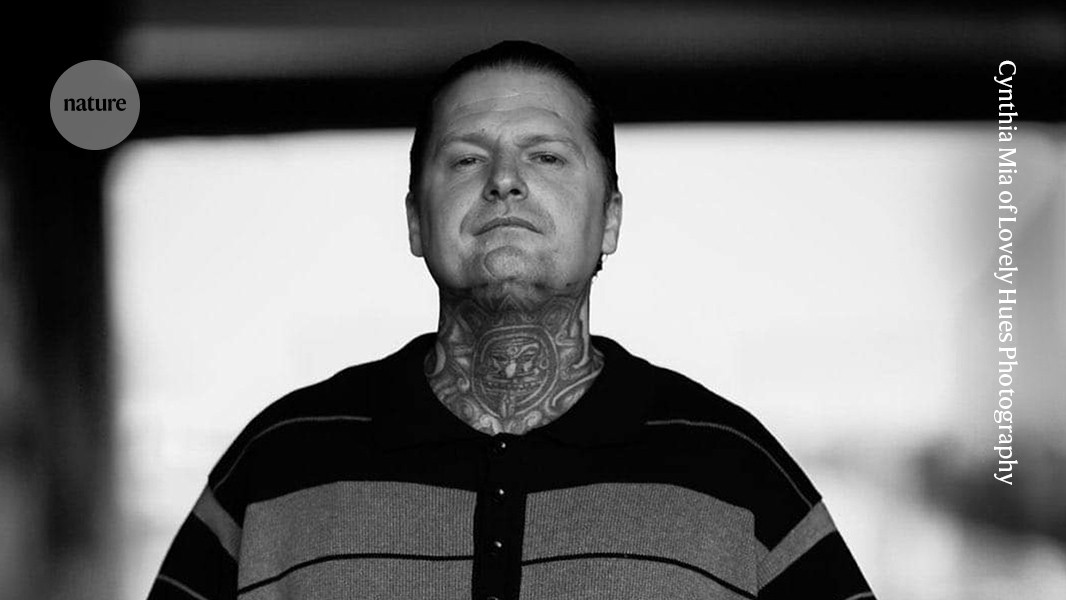

Ryan Rising started taking university courses while in prison and is now pursuing a PhD focused on how best to help formerly incarcerated individuals to reintegrate with society.Credit: Courtesy of Cynthia Mia of Lovely Hues Photography
Ryan Rising was first incarcerated when he was 12 years old, and was characterized as a troublemaker. The label followed him in and out of prison over the next two decades. During that time, he replaced his addiction to drugs with one for gaining knowledge. Rising is now pursuing a PhD in criminology at the University of California, Irvine, studying strategies that prevent recidivism, or repeated criminal behaviour. He is also helping to create a prison-to-university pipeline to assist other formerly incarcerated individuals to earn degrees.
How and when did you start your university journey?
In 2009, I was sentenced to seven years at the California State Prison, Sacramento, in Folsom, where I was handed a secondary-school graduation certificate, but without receiving a proper education. I didn’t start taking university courses until 2013, after incarcerated people in several California prisons took part in a hunger strike to protest against their living conditions. I was one of roughly 30,000 people across more than 30 prisons who participated, refusing to eat for 33 days. My fellow inmates and I concluded that we were willing to put ourselves on the line so that the next generation of families wouldn’t have to experience a continued cycle of criminalization, in which incarcerated individuals continue to be treated and labelled as criminals while in jail and after their release. The United States has built a justice system that often focuses more on punishment than it does on rehabilitation. We were being warehoused in prison with no support services. After that hunger strike, however, we were allowed to take courses by mail through Lassen Community College in nearby Susanville, California.
What was that experience like?
I took two university courses per term. One of my first classes was on the pharmacology of drugs that can be abused, including prescription medications and illegal drugs. I wrote papers on 12 substances, combining my research on their health impacts with the effects that I had personally experienced. I never used drugs again after writing that paper.
But I didn’t know how to write with proper punctuation. For example, I used slashes as sentence breaks. The instructor told me to read books to learn how to write properly. I got two A+ grades that first term. I became addicted to achieving A+ results and I fell in love with knowledge. I left prison with dozens of course credits, but not a completed degree.
How did you continue your higher education after leaving prison?
I left prison in 2015 with US$200 in my pocket and travelled to San Diego in California by bus, arriving at two in the morning. There were people sleeping in tents or high on drugs everywhere. I thought, “What the heck is going on out here?”. I was offered drugs, and in that moment, I had a choice. I kept walking. I ended up falling asleep on a bench. I woke up outside San Diego City College, and decided that I wanted to go there. It changed the whole trajectory of my life. Once enrolled, I met other students who had been incarcerated, and we created a student-led initiative called the Urban Scholars Union. We lobbied for institutional recognition, support and resources for students at the university who had been incarcerated. That initiative led to the Rising Scholars Network, and it is currently in place at more than 90 community colleges in California. After I completed my two-year associate’s degree with honours, I received a three-year scholarship that allowed me to pursue a bachelor’s degree in sociology at the University of California, Santa Barbara, an institution with a long history of activism. The US county of Santa Barbara has one of the highest recidivism rates in California.

Ryan Rising has worked with initiatives such as the Rising Scholars Network and the Gaucho Underground Scholars programme to help formerly incarcerated individuals to access educational opportunities.Credit: Reyes Melendez/Saint John’s Community Health
At the University of California, Santa Barbara, I created the Gaucho Underground Scholars programme and secured $4 million in funding to expand it. The programme is similar to the Rising Scholars Network, but in place across the University of California system. For my efforts to support formerly incarcerated individuals, I received the Michael D. Young Engaged Scholar Award, which recognizes students who have used their scholarly knowledge to take action to create positive change.
What drives your community-service work?
I’ve been criminalized all my life, so I decided to become a criminologist. My work has been all about erasing the stigma attached to people who have been incarcerated. We’re not monsters; we’re credible messengers and can be agents for change in our communities. A credible messenger is someone with lived experience — often including facing injustices or incarceration — who has transformed that experience into trusted leadership, using it to mentor others and create pathways away from violence and towards education, employment, healing and community leadership. Under our circumstances, access to guns and drugs is easy. What’s hard is going to university.
What is your PhD research focused on?
I’m trying to identify ideal, successful models for initiatives to prevent recidivism and help formerly incarcerated people to rejoin society. Strategies can include providing housing, mentorship and career-development opportunities. I’m using a mixed-methods qualitative study, including interviews with and surveys of previously incarcerated individuals who have taken part in a variety of support programmes while attending university. I will document their career paths, the barriers that they have experienced, the financial aid that they have received and how much student debt they have incurred to identify what is and is not working, so that funding can be directed appropriately. My advocacy work is also about more than simply increasing access to education; it’s about changing who produces knowledge about incarceration and justice.
How do you combine your research with community work?
For me, academic research and community work are not separate. They are in constant conversation with each other. My community work keeps my research accountable. I don’t want to just describe the world, but change it. At the University of California, Irvine, where I’m doing my PhD, I founded the West Coast Credible Messengers programme, which frames re-entry into society as a community-health matter. My colleagues and I work at juvenile detention centres in Orange County, California, to mentor incarcerated adolescents on how to be of service to their communities. We use art and creative writing to teach emotional intelligence, critical thinking and how adolescents can grow from their experiences. Our efforts aim to address the well-documented school-to-prison pipeline — in which young people from low-income neighbourhoods and under-represented groups are disproportionately likely to be incarcerated — and redirect people towards a prison-to-university pipeline.

