


 This article published in collaboration with JUIDA, the Japan UAS Industrial Development Association.
Researchers at the University of Tokyo say drone imagery, machine learning, and a growth curve model can estimate underground potato yield before harvest.
Researchers at the University of Tokyo Graduate School of Agricultural and Life Sciences and Kubota Corporation have developed a drone potato yield prediction method that estimates underground tuber biomass before harvest. According to the university, the approach combines drone-based remote sensing, machine learning, and an underground growth model to predict yield in unharvested plots.
The announcement follows recent Dronelife coverage of Japan’s agriculture drone market, which Tokyo-based Market Research Center forecasts will reach $357.8 million by 2034. The University of Tokyo says its new method reflects the kind of precision agriculture use case driving that growth.
How the drone potato yield prediction works
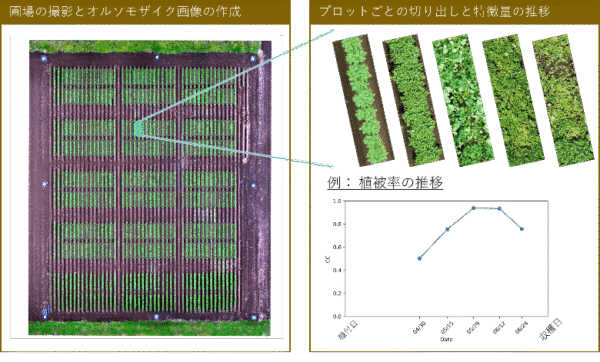
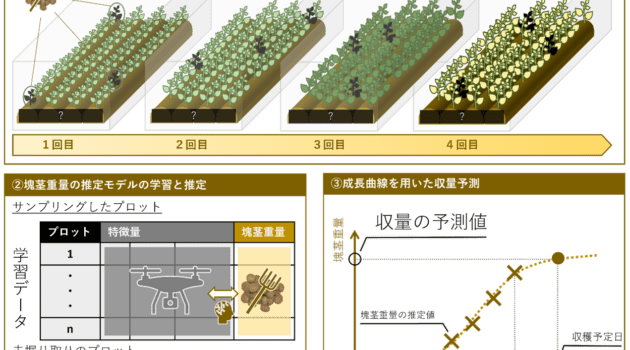
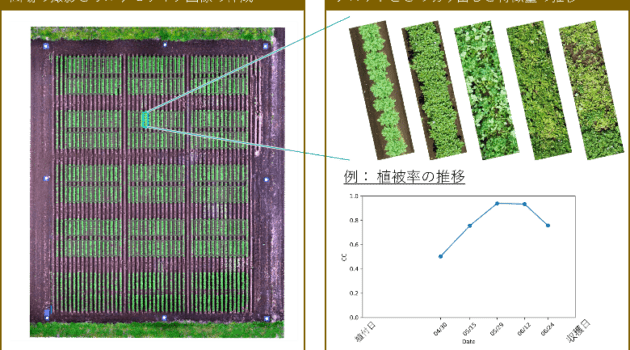
According to the university, fields were periodically photographed with drones equipped with RGB and multispectral cameras. The team extracted image features on a plot basis, including plant cover ratio, canopy height, color indices, and vegetation indices. A machine-learning model was trained on the relationship between these features and measured underground biomass obtained through sampling.
For unharvested plots, the researchers estimated tuber biomass by feeding image features into the machine-learning model. The team then applied the time-series data to a Gompertz growth curve, an S-shaped mathematical model of biological growth, to predict yield at harvest.
The study was led by doctoral student Yuto Imachi, Professor Hiroyoshi Iwata, and Associate Professor Wei Guo, alongside researchers from Kubota’s Next-Generation Research Department and Masahiro Okada of Sarabetsu Prediction Co., Ltd. Pieter M. Blok, then a project assistant professor at the university and now at Eindhoven University of Technology, also contributed.
Two-year field trial results
According to the university, the team conducted the experiment in 2023 and 2024 in fields at the University of Tokyo Field Science Center in Nishi-Tokyo City. Trials covered multiple treatment plots with varying planting density and seed tuber conditions.
The team achieved a correlation coefficient of 0.8 or higher for tuber biomass estimation and 0.7 or higher for yield prediction using the growth curve. According to the university, the results confirm that yield can be predicted from the pre-harvest stage using above-ground drone data.
Applications for smart agriculture
The university says potatoes are an important food crop worldwide, but assessing yield during the growing period has traditionally relied on destructive sampling. According to the research team, the new method offers a non-destructive alternative that captures spatial variation across a field.
The team says the growth-curve approach is expected to support pre-harvest yield forecasting and optimization of cultivation management, including suggesting optimal harvest timing. The research was carried out under the joint Kubota Todai Lab project.
More information is available from the University of Tokyo.
Read more:

Ian McNabb is a journalist focusing on drone technology and lifestyle content at Dronelife. He is based between Boston and NH and, when not writing, enjoys hiking and Boston area sports.

