


Geological context of the samples
The Comoros archipelago is the surface manifestation of a deep plume. The main islands that make up this archipelago are Grande Comore, Mohéli and Anjouan, as well as the islands that constitute Mayotte, namely Grande-Terre and Petite-Terre, from west to east53. Of these, Mayotte corresponds to the oldest volcanic activity, with the first subaerial eruption occurring about 11 million years ago (Ma). However, its volcanic activity has alternated between periods of active and quiescent phases, shaping its two islands of Grande-Terre and Petite-Terre54. The most recent volcanic activity was observed on Petite-Terre and is Holocene54,55 in age. Between June 2018 and January 2021, a new submarine volcano called Fani Maoré erupted approximately 55 km east of Mayotte, representing the most recent volcanic expression of the plume (see Fig. 1 in ref. 56 and Extended Data Fig. 1). The 2018–2021 crisis that led to the formation of Fani Maoré is associated with a volcanic ridge that extends westwards towards Petite-Terre56,57. In this context, we analysed 13 samples from the new submarine volcano Fani Maoré and eight samples from the eastern flank of Petite-Terre, Mayotte (Extended Data Fig. 1). These samples were collected during a series of oceanographic cruises between 2018 and 2021 (MAYOBS1, MAYOBS2, MAYOBS4 and MAYOBS15 (refs. 57,58)) as part of several dredging operations targeting both the Fani Maoré volcanic edifices and the eastern flank of Petite-Terre. All Fani Maoré samples are basanites, whereas Petite-Terre samples include three basanites and five phonolites. Detailed petrological descriptions can be found in ref. 56 and chemical and isotope compositions are reported in ref. 51.
Sample preparation and Nd isotope measurements
All 21 OIB samples were processed in the clean laboratory of the Institut de Physique du Globe de Paris (IPGP) and their Nd isotope compositions were measured on a Nu Instruments TIMS, following procedures described in ref. 22. Depending on the REE concentration and the amount of powder available, aliquots of 50–300 mg of homogenized bulk rock powder were digested in a 3:1 mixture of distilled 28 M HF and 15 M HNO3 at 75 °C for 48 h on a hotplate and then evaporated to incipient dryness. Fluorides were decomposed with repeated dissolution and evaporation cycles using alternating 6 M HCl and a 1:1 mixture of 6 M HCl and 15 M HNO3, until the solution was clear of any precipitate after centrifugation. Neodymium was chemically isolated using a four-step chemical separation procedure. REE were initially separated from the matrix by cation exchange chromatography using AG50W-X8 resin (200–400 mesh; 2 ml for a typical sample of 35–50 mg). Samples with digested mass exceeding 50 mg were divided into several columns to avoid saturation of the resin. The resulting REE fractions were subsequently recombined. In the second step, Ce was separated from the other REE using a redox technique and LN resin (50–100 µm; 0.5 ml). Sodium bromate (NaBrO3) was used to oxidize Ce from Ce3+ to Ce4+, allowing it to be retained in the LN resin while the other REE3+ were eluted. This step was completed twice to ensure complete Ce removal. Residual Na and Br were removed from the Ce-free REE fraction during the third step using AG50W-X8 resin (200–400 mesh; 1 ml). Finally, in the fourth step, Nd was isolated from the other REE using a thin LN resin (25–50 mesh; 0.82 ml). Total procedural Nd yields were ≥90% and the procedural blank for Nd was less than 40 pg (n = 3), which is negligible relative to the 1–9 µg of Nd collected from the samples. Residual Sm and Ce remaining in the final Nd fraction were consistently negligible (<0.5 ng Sm and <0.2 ng Ce) relative to the mass of Nd.
High-precision multi-dynamic Nd isotope analyses were performed on a Nu Instruments TIMS at IPGP following a five-line acquisition method thoroughly detailed in ref. 22 (cup configuration in their Fig. 1). For both standards and samples, about 800 ng of Nd per analysis was loaded onto zone-refined 99.999% Re filaments used in a double-filament configuration. The five-line acquisition method in positive mode allows the simultaneous measurement of all Nd isotopes during all five acquisition lines, each separated by a one-mass-unit jump. This technique allows the combination of two to three acquisition lines to dynamically measure (in the same Faraday cup) three ratios per Nd isotope, the average of which gives a multi-dynamic ratio essentially free from biases owing to the Faraday cups. A typical run consists of 40 blocks of 20 cycles with about 6 V of 142Nd+ measured for 18 h. Mass discrimination was corrected using 146Nd/144Nd = 0.7219 and the exponential law. Time drift was corrected using 11-cycles interpolations. Data were systematically corrected22 for Sm and Ce isobaric interferences in case 147Sm/144Nd was higher than 7 × 10⁻⁷ or 140Ce/144Nd was higher than 9 × 10⁻⁶. This allows reliable correction and prevents overcorrection that might increase errors. The detection threshold to consistently distinguish Sm and Ce signal from the background noise during our analyses is established at 147Sm/144Nd > 5 × 10⁻⁷ and 140Ce/144Nd > 5 × 10⁻⁶ (for I142Nd+ about 5 V; see Fig. 9a,c in ref. 22).
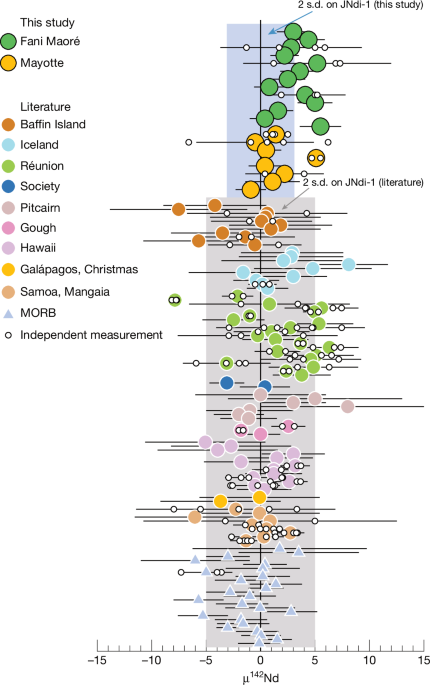
External precision was evaluated using two pure Nd solution standards measured over two analytical sessions, alongside the samples. We analysed AMES Rennes Nd five times during the first session (March 2022 to May 2022) and we analysed AMES Rennes Nd and JNdi-1 15 and 23 times, respectively, during the second session (July 2022 to January 2024). They gave similar isotope ratios within error, with typical reproducibility (2 s.d.) between 1.8 and 3.9 ppm for 142Nd/144Nd, 2.0–3.8 ppm for 143Nd/144Nd, 1.8–3.1 ppm for 145Nd/144Nd, 4.2–5.6 ppm for 148Nd/144Nd and 11.4–11.9 for 150Nd/144Nd. JNdi-1 was the most frequently measured standard during this study and its reproducibility (2 s.d. of 3.1 for 142Nd/144Nd) is taken as representative of the external error for all samples. The short-term reproducibility, which is usually reported in the literature as being equivalent to uninterrupted series of samples and standard measurements, is similar. We identify six series (March–May 2022; July 2022; December 2022 to January 2023; April–June 2023; August–September 2023; November 2023–January 2024), the reproducibility of which on the 142Nd/144Nd ratio ranges from 1.8 to 4.1 ppm (n = 4–9, excluding n ≤ 3), giving an average reproducibility of 3.1 ppm. Details on the individual measurements of AMES Rennes Nd and JNdi-1 are given in Supplementary Data Table 1b and are shown in Extended Data Figs. 2 and 3.
Rock reference materials were measured during the same analytical sessions as our samples. The results were extensively described in ref. 22 and show similar reproducibility.
The 143Nd/144Nd ratios are given in the epsilon notation following the equation ε143Nd = ((143Nd/144Ndsample/143Nd/144NdCHUR) −1) × 104, in which CHUR is the CHondritic Uniform Reservoir with 143Nd/144Nd = 0.512630 (ref. 59). All other Nd isotope ratios are given in the mu notation following the equation µxNd = ((xNd/144Ndsample/xNd/144Ndterrestrial reference) −1) × 106, in which the terrestrial reference composition for this study is the widely used JNdi-1 pure Nd solution standard. All of the samples analysed during session 2 were measured concurrently with JNdi-1 and their mu values were calculated directly. However, three samples were measured during session 1. To ensure proper comparison of these data with the rest of the dataset, their measured isotope ratios were first normalized to session 2 using the AMES Rennes Nd measured during both sessions, following the equation xNd/144Ndcorrected sample = xNd/144Ndmeasured sample × (xNd/144NdAMES,session 2/xNd/144NdAMES,session 1). The mu values for these corrected samples were then calculated similarly to the rest of the dataset. All Nd isotope measurements of samples and pure Nd reference materials acquired during the course of this study are reported in Supplementary Data Table 1 and Extended Data Figs. 2 and 3.
Critical evaluation of the data obtained on natural samples
Under terrestrial conditions, excesses and deficits in 142Nd reflect the decay of 146Sm. They are subtle and therefore more prone to analytical bias and misinterpretation. To detect these, Sm and Ce interferences as well as 145Nd/144Nd, 148Nd/144Nd and 150Nd/144Nd ratios were precisely measured and monitored.
Samarium and Ce interferences were essentially non-existent for most samples. Nevertheless, six measurements were corrected for an approximate 0.5 ppm Sm contribution and DR1402 for a 2.0 ppm contribution on 142Nd/144Nd (Supplementary Data Table 1a). Similarly, Ce interference was negligible during most measurements, with only three requiring corrections, with contributions of 1.6 ppm (DR140401) and 6–8 ppm (both measurements of DR070202) on 142Nd/144Nd. Interference-corrected analyses are unrelated to the extreme 142Nd/144Nd ratios reported in this study (Extended Data Fig. 3).
145Nd/144Nd, 148Nd/144Nd and 150Nd/144Nd ratios are not supposed to show any mass-independent variations in terrestrial conditions. In Extended Data Fig. 4, anomalous variations can be identified, as they may exceed the typical variability of pure standard solutions and can serve as an indicator for potentially biased 142Nd/144Nd data. In particular, Nd isolation during the chemical procedure can induce mass-independent variations affecting all Nd isotopes22,23, called the nuclear field shift (NFS) effect60,61. Higher NFS magnitudes lead to larger deviations from terrestrial values (illustrated in Extended Data Fig. 5c). We monitor these Nd ratios for variations exceeding the JNdi-1 reproducibility, indicating possible and associated ppm-level μ142Nd deviations. DR1802-1 has 148Nd and 150Nd excesses (15.6 and 40.4 ppm) and a 145Nd deficit (2.2 ppm; Extended Data Table 1), mimicking NFS-induced variations (in red in Extended Data Fig. 5b and Extended Data Table 1). This suggests that its measured positive µ142Nd might be underestimated and should be even more positive. However, the lack of convergence in the magnitude of NFS across isotopes prevents us from performing a correction of the measured µ142Nd. Excluding DR1802-1, the average Fani Maoré value remains consistent, as it only changes from 3.2 ± 0.9 (2 s.e., n = 13) to 3.0 ± 0.9 (2 s.e., n = 12). Several other measurements show small excesses or deficits in 148Nd and 150Nd but no 145Nd deviation (in brown in Extended Data Fig. 5a,b and Extended Data Table 1). They do not show a clear pattern resembling fractionation owing to the NFS effect and their 142Nd can be considered reliable.
The significance of the 142Nd isotope anomaly measured in Fani Maoré or Mayotte samples can be assessed by comparing the lavas dataset with the reference material values and distributions. The 2 s.d. of the mean for all Fani Maoré and Mayotte samples are 3.3 and 3.7 ppm, values that are similar to the standard deviation of JNdi-1 measurements (3.1 ppm). This implies that the total variability of Fani Maoré and Mayotte samples is small and almost corresponds to the analytical precision alone. Although slightly positive, the mean µ142Nd of Mayotte of +1.3 ±1.3/±3.6 (2 s.e./2 s.d., n = 8) is clearly within the error of JNdi-1. By contrast, the mean µ142Nd of Fani Maoré of +3.2 ±0.9/±3.3 (2 s.e./2 s.d., n = 13) is at the limit of JNdi-1’s reference value. The statistical distribution of both JNdi-1 and Fani Maoré samples demonstrates that they represent three distinct groups: (1) The 2 s.e. on the mean value for Fani Maoré and JNdi-1 do not overlap, as +3.2 ±0.9 (Fani Maoré; n = 13) is distinct from 0 ± 0.7 (JNdi-1; n = 23). (2) The distinction between the Fani Maoré and JNdi-1 populations is also assessed with a t-test, providing a P-value of 8.9 × 10⁻⁶, in which the two populations are considered statistically distinct whenever the P-value is below 0.05. By contrast, the P-value when comparing Mayotte and JNdi-1 is 0.14, thus showing that they are statistically undistinguishable. (3) The distribution of Fani Maoré samples in histograms also points towards a strict distinction from JNdi-1 (Extended Data Fig. 6), as the maximum of their Gaussian distribution curve is distant by 3.5 ppm from JNdi-1, with 95% of Fani Maoré data located between +2 and +5, whereas 95% of JNdi-1 measurements are located between −2 and +2.
Relationship to other radiogenic isotopes and trace elements
Fani Maoré lavas were previously studied for their radiogenic isotope and trace-element composition51. Their radiogenic isotopes are very uniform (see Extended Data Fig. 7 and Supplementary Fig. 2 in ref. 51) and lie at intermediate compositions between HIMU to EM-I. Although the Nb/Th ratio does not vary much, basanites and phonolites have somewhat different ratios of elements, such as La/Sm, Sm/Yb, Ba/Th or Ce/Pb. Discussing the origin of the exceptionally high Ba/Th and Ce/Pb ratios is beyond the scope of this manuscript and we encourage the reader to look at the interpretation suggested in ref. 51. Here we concentrate on the relationship between these ratios and µ142Nd. Extended Data Fig. 7 shows that no clear relationship exists between the presence of a positive 142Nd anomaly and any of the above-mentioned radiogenic and trace-element ratios, suggesting that the origin of the 142Nd anomaly might not be related to the process that led to the presence of high Ce/Pb and Ba/Th ratios.
Isotope modelling: assumptions about the composition of the mantle
Estimating the present-day µ142Nd and ε143Nd composition of a Hadean reservoir requires assumptions about the composition of the mantle after Earth accretion and today. Several studies suggest that the lithophile part of the Earth after core formation (BSE) has a non-chondritic Sm/Nd ratio owing to depletion events occurring within the first few million years of Earth history. Suggestions include: (1) collisional erosion of the early planetesimals that built the Earth38,62; (2) heterogeneous mineral distribution in the inner Solar System63; and (3) buried ancient crust that left an early depleted reservoir64. Despite these different interpretations, all studies converge on a 2.40–2.65% higher Sm/Nd ratio than in chondrites38,59,63, yielding a Sm/Nd = 0.333 and 147Sm/144Nd = 0.2012 (calculated as 147Sm/144Nd = Sm/Nd × 0.60455923 using Sm and Nd isotope abundances and molar masses65,66) and an initial 146Sm/144Nd calculated at 0.00034703 using an initial Solar System 146Sm/144Sm of 0.00840 (ref. 67), a Solar System age of 4.5674 ± 0.0007 Gyr (ref. 68) and a decay constant for 146Sm of 92 Myr (ref. 9). Following these assumptions, the present-day Nd isotope composition of the BSE is ε143Nd = +3.07 and µ142Nd = 0, values that we will use as reference for a present-day ordinary mantle. All input and output data used in our models are listed in Extended Data Tables 2 and 3.
Samarium and neodymium partition coefficients between bridgmanite and melt
To best investigate the trace-element signature of Hadean bridgmanite crystallizing out of a magma ocean, we conducted laboratory experiments reproducing the solidification process under terrestrial conditions. Specifically, we performed fractional crystallization experiments in a laser-heated DAC, following the protocol established in ref. 36. This protocol, originally conceived for quantitative major-element concentration measurements in the various phases (minerals along the fractional crystallization sequence as well as the residual melt), has recently been extended to include trace-element measurements at the 100-ppm level69. We used it here to determine the partition coefficient of Sm and Nd between bridgmanite and melt under deep-mantle conditions relevant to magma ocean solidification, specifically between 53 GPa at 3,200 K and 97 GPa at 3,700 K (final temperatures). The starting material for our experiments, loaded into the DAC, had a pyrolitic major-element composition (representative of the BSE) and was doped with several trace elements, including 3,000 ppm of Sm and Nd. This material was synthesised by mixing pure oxides and pure trace-element solutions. The mixture was then fused for 60 s at 1,900 °C (above the liquidus) in a gas-mixing aerodynamic levitation laser furnace70 to achieve full chemical equilibration71 before being rapidly quenched into a glass. The resulting glass was polished and analysed using a field emission gun scanning electron microscope to verify its chemical homogeneity and the absence of crystals; its composition is detailed in Supplementary Data Table 2. The glass was subsequently loaded in a DAC, compressed to the target pressure and melted using a double-sided laser heating system. It was then slowly cooled36 (10–30 K s−1) to a low residual melt fraction, yielding a fractional crystallization sequence at a set pressure, before being quenched to freeze in the chemistry and mineralogy. After decompression, a thin section was retrieved in the centre of the heated region using the focused ion beam lift-out technique and thinned down to electron transparency (about 100 nm), allowing for analysis on an analytical transmission electron microscope. An FEI Tecnai Osiris, equipped with four windowless energy-dispersive X-ray spectrometers at École Polytechnique Fédérale de Lausanne (EPFL), was used for quantitative chemical mapping. The concentrations of Sm and Nd were measured across the sample, with a particular focus on the most primitive bridgmanite crystals that were the first to form following pyrolite crystallization and that are of principal interest here. The composition of these primitive bridgmanite crystals is given in Supplementary Data Table 2. The molar partition coefficients were derived from the Sm and Nd bridgmanite-to-melt ratio, with uncertainties calculated through classical propagation of those obtained from the chemical composition measurements. Finally, these molar partition coefficients were converted to mass partition coefficients (Extended Data Table 4) for further geochemical modelling, although the difference is negligible (less than 1%) and falls well within the uncertainty, thus it can be disregarded.
Our data can be compared with the data in ref. 39, which are multi-anvil experiments that have demonstrably achieved equilibrium (long-duration experiments, in contrast to the shorter runs reported elsewhere). Also, the lithology investigated in ref. 39 closely matches ours and, by extension, the BSE (a pyrolite composition doped with trace elements). Our partition coefficients for Sm and Nd are an order of magnitude higher than those measured at 25 GPa and 2,300 °C. This can be expected for several reasons, from thermodynamics and crystal chemistry. Our experiment is at 65 GPa and 4,000 °C. At higher temperature (a natural consequence of increasing liquidus temperature with pressure), element partitioning tends to unity (equipartition principle of statistical physics). At higher pressure, the difference in compressibility and size of the host site for large cations (between crystal and melt) decreases, as expected from lattice strain theory, so that partitioning should also tend towards unity.
Fractional crystallization modelling
The Nd isotopic composition of solids formed at great depth in the mantle during magma ocean solidification is controlled by the minerals/liquid partition coefficients as given in Extended Data Table 4. It also depends on the initial liquid composition chosen here as the non-chondritic REE contents of the BSE estimated using depletion calculations72, non-chondritic Sm/Nd ratio38 and an initially chondritic primitive mantle37. In deep-mantle conditions (>60 GPa; see Fig. 7 in ref. 35), the crystallization sequence35 is as follows: (1) 100 wt% bridgmanite during the first 35% of crystallization; (2) 90 to 84 wt% bridgmanite and 10 to 16 wt% ferropericlase between 35% and 90% of crystallization, following a simplified linear increase of ferropericlase, an approximation with minimal effect on our conclusions; (3) between 90% and 100% of crystallization, we model the solidification of the residual melt as a bulk containing similar proportions of ferropericlase and bridgmanite and about 4 wt% Ca-perovskite. Element concentrations in the evolving liquid phase are calculated using Cliq = Cliq,0 × (1 − X)(D − 1), in which Cliq is the element concentration in the liquid, Cliq,0 is the initial element concentration in the liquid, X is the crystallized fraction and D is the partition coefficient. It is noteworthy that this formulation is not formally correct here, because the previous equation only applies in a system with a constant D. Our system has varying mineral proportions and partition coefficients, which necessitates to iteratively and incrementally integrate the batch crystallization equation with a parameterized D. However, the difference between these two formulations is negligible in the present case. Element concentrations in the cumulative solid are calculated using Ccumulate = (Cliq,0 × (XD)/X, whereas the element concentrations in the instantaneous solids formed at a given crystallization step are calculated using Cinstant. sol. = Cliq × D. Neodymium concentrations and Sm/Nd ratios of liquid and solids are shown in Fig. 2.
Mixing at present day between Hadean bridgmanite and ordinary mantle ± sediments
We evaluate how the incorporation of a Hadean bridgmanite-rich material in modern mantle can reproduce the mean µ142Nd and ε143Nd isotope compositions measured on the lavas. During the first 90% of crystallization of the magma ocean, all solids have increased Sm/Nd ratio that can evolve to positive µ142Nd. We call those solids ‘Hadean bridgmanite’ because it is bridgmanite that predominantly controls the Nd and Sm budget (Fig. 2 and Extended Data Table 4). The last 10% of crystallization produces solids with low Sm/Nd, leading to potentially negative µ142Nd. We calculate the present-day isotopic composition of three different solids formed during magma ocean crystallization, the first one at 10% crystallization and two others at 35% and 75% crystallization (Extended Data Table 3).
The present-day µ142Nd isotope compositions of these three solids are calculated using a two-step evolution model, here from a non-chondritic BSE:
-
1.
The 142Nd/144Nd ratio of the mantle evolves from the Earth initial ratio to its composition at the time of formation of the solid, according to its Sm/Nd ratio and following the decay of 146Sm during that period
with 146Sm/144NdBSE,t = 146Sm/144Ndi × e(−λ(146Sm) × Δt).
-
2.
The 142Nd/144Nd ratio of the Hadean bridgmanite (denoted HB) solid evolves from the isotope composition of the mantle at its time of formation to the present day, according to its Sm/Nd ratio and following the decay of 146Sm during that period
with 146Sm/144NdHB,t = Sm/NdHB × (146Sm/144NdBSE,t × Sm/NdBSE)
and 146Sm/144NdHB,today = 146Sm/144NdHB,t × e(−λ(146Sm) × Δt).
Values are calculated using a crystallization age of 4.46 ± 0.05 Ga. We also choose the instantaneous solid compositions because they better capture the potential heterogeneities present in the solidified magma ocean. The highly radiogenic Nd isotope composition of the Hadean bridgmanite, coupled with its moderately low Nd content, implies that about 10% of such material is sufficient to reproduce Fani Maoré µ142Nd (Extended Data Table 3). However, the same mixture of mantle and Hadean bridgmanite does not reproduce the observed ε143Nd of Fani Maoré lavas. To match their ε143Nd requires a much lower proportion of Hadean bridgmanite in the mixture (Extended Data Table 3). This is because of the highly radiogenic ε143Nd of the Hadean bridgmanite.
Offsetting the high ε143Nd of Hadean bridgmanite requires an extra, geochemically enriched, low-Sm/Nd-ratio material and this material should have no µ142Nd anomaly. Recycling of crustal material in the mantle is often suggested to explain the wide isotopic variability observed in OIB (refs. 1,52,73), making it a plausible source for a further unradiogenic ε143Nd component in the source of Fani Maoré. Here we use GLOSS-II, the average composition of subducted sediments suggested in ref. 50 and assume that the recycled sedimentary material has an age of 2 Gyr, which implies no µ142Nd anomaly. We calculate its present-day Nd isotopic evolution (Extended Data Table 3) using its published 143Nd/144Nd and Sm/Nd ratios50 (Extended Data Table 2) and the recycling model calculations of ref. 52, as shown in Extended Data Fig. 8.
Extended Data Table 3 shows the result of a ternary mixture that includes Hadean bridgmanite, ordinary mantle and recycled sediments. Incorporation of <0.5% of such recycled sediment (GLOSS-II) is sufficient for its low ε143Nd to balance the high ε143Nd of Hadean bridgmanite and reproduce the value measured for Fani Maoré lavas, while not changing the proportions of Hadean bridgmanite and modern mantle components.
What happens in the case of a chondritic scenario?
Although the non-chondritic composition of the Earth is a long-standing debate, a chondritic BSE composition cannot be entirely ruled out. We therefore calculated comparable isotope evolution and mixing models using a chondritic composition (input compositions in Extended Data Table 2 and results in Extended Data Table 3). In such case, the proportions of Hadean bridgmanite calculated using 142Nd and 143Nd are less different from in the non-chondritic BSE scenario when considering a simple mixture of Hadean bridgmanite and ordinary mantle. In this context, no recycled sediments are required in the source (Extended Data Table 3).
What about a Hadean depleted mantle formed through continental crust extraction?
The range of 142Nd/144Nd isotopes in Archaean rocks10,14,25, together with the Hf isotope variability of zircons10,74, indicates the coexistence of both enriched and depleted reservoirs at that time. These anomalies have been attributed either to early crustal extraction producing a depleted mantle residue14,25,26 or to large-scale processes generating heterogeneities11,75,76. However, there is no clear evidence for large volumes of Hadean crust77,78 and only rare evidence of mantle depletion before about 3.8 Ga (ref. 28); most crustal growth models also favour progressive rather than massive early extraction79. Nevertheless, here we test whether the formation of a Hadean crust could create a suitable depleted Hadean mantle reservoir.
Because crust extraction processes could not be very different from today’s processes, it is expected that a Hadean reservoir depleted by crustal extraction would be similar to the present-day DMM. Here we assume that its Sm/Nd ratio is the same as the DMM in ref. 27 (Extended Data Table 2). To observe significantly positive µ142Nd in this reservoir, it must form during the first 300 Myr of the Earth’s history. For a depletion age of 4.46 Gyr, the depleted reservoir has a µ142Nd of +19 and for a depletion age of 4.3 Gyr, it has a µ142Nd of +6 (Extended Data Fig. 9). Using these values and the Nd concentration of DMM27, we can calculate how much material is required to match the Fani Maoré µ142Nd value. If the material is 4.46 Gyr old, it must represent 26% of the plume source, and if it is 4.3 Gyr old, it must represent 70% of the plume source. However, similarly to the Hadean bridgmanite scenario, offsetting the high ε143Nd of a Hadean depleted mantle requires an extra, geochemically enriched, low-Sm/Nd-ratio material devoid of µ142Nd anomaly.
Recycling of a 2-Gyr-old GLOSS-II-like crustal material in the mantle is again a plausible source for a further unradiogenic ε143Nd component in the source of Fani Maoré. Extended Data Fig. 9 shows the result of a ternary mixture that includes Hadean depleted mantle, ordinary mantle and recycled sediments. Incorporation of about 1% of such recycled sediment (GLOSS-II) is sufficient for its low ε143Nd to balance the high ε143Nd of the Hadean depleted mantle and reproduce the value measured for Fani Maoré lavas, but it requires to substantially increase the proportion of Hadean depleted material to 28–90% (for formation ages of 4.46–4.3 Ga). Such scenario requires the depleted mantle owing to crustal extraction to form extremely early after the giant impact. For the source of Fani Maoré to be largely composed of such depleted mantle requires that the Hadean component is large enough to be preserved unaltered for more than 4 Gyr. As it formed in the upper mantle, it needs to be dense enough to sink at the bottom of the lower mantle, where it could potentially escape the efficient stirring owing to convection. The survival of localized Hadean depleted domains originating from the upper mantle thus cannot be ruled out but meeting the conditions for it to have survived up to today in notable amounts makes this option a low-probability scenario.
Involvement of a Hadean felsic material in the source
Early felsic materials such as Isua noritic dykes have been shown to have a positive μ142Nd (ref. 75) (≤+20), but because of their low Sm/Nd ratios, they also have very negative ε143Nd values75 (≈−30). Mass balance calculations demonstrate that the positive μ142Nd and ε143Nd of Fani Maoré cannot be reproduced by incorporating such material.

