


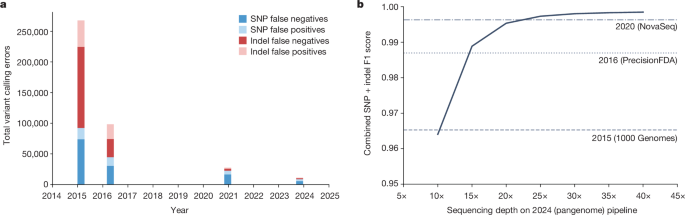
International Human Genome Sequencing Consortium. Initial sequencing and analysis of the human genome. Nature 409, 860–921 (2001).
Venter, J. C. et al. The sequence of the human genome. Science 291, 1304–1351 (2001).
Goodwin, S., McPherson, J. D. & McCombie, W. R. Coming of age: ten years of next-generation sequencing technologies. Nat. Rev. Genet. 17, 333–351 (2016).
Ashley, E. A. Towards precision medicine. Nat. Rev. Genet. 17, 507–522 (2016).
Ashley, E. A. et al. Clinical assessment incorporating a personal genome. Lancet 375, 1525–1535 (2010).
Dewey, F. E. et al. Clinical interpretation and implications of whole-genome sequencing. J. Am. Med. Assoc. 311, 1035–1045 (2014). This study evaluated the performance and findings of clinical whole-genome interpretation in an adult cohort, finding incomplete coverage of medically important disease genes, variable concordance for small indels and medically actionable findings in all participants. It established the need for transparent reporting of technical limitations in clinical genomic sequencing precision.
Martin, A. R. et al. Clinical use of current polygenic risk scores may exacerbate health disparities. Nat. Genet. 51, 584–591 (2019).
US Food and Drug Administration. FDA proposes rule aimed at helping to ensure safety and effectiveness of laboratory developed tests. FDA https://go.nature.com/4uHYYKp (29 September 2023).
Ashley, E. A. The Genome Odyssey (St Martin’s Press, 2023).
Dewey, F. E. et al. Phased whole-genome genetic risk in a family quartet using a major allele reference sequence. PLoS Genet. 7, e1002280 (2011).
Goldfeder, R. L. et al. Medical implications of technical accuracy in genome sequencing. Genome Med. 8, 24 (2016).
Olson, N. D. et al. PrecisionFDA Truth Challenge V2: calling variants from short and long reads in difficult-to-map regions. Cell Genom. 2, 100129 (2022).
Eisfeldt, J., Ek, M., Nordenskjöld, M. & Lindstrand, A. Toward clinical long-read genome sequencing for rare diseases. Nat. Genet. 57, 1334–1343 (2025).
Ewing, B., Hillier, L., Wendl, M. C. & Green, P. Base-calling of automated sequencer traces using phred. I. Accuracy assessment. Genome Res. 8, 175–185 (1998).
Jia, H., Tan, S. & Zhang, Y. E. Chasing sequencing perfection: marching toward higher accuracy and lower costs. Genomics Proteomics Bioinf. 22, qzae024 (2024).
Deng, D. Z. Q. et al. R2C2 + UMI: combining concatemeric and unique molecular identifier-based consensus sequencing enables ultra-accurate sequencing of amplicons on Oxford Nanopore Technologies sequencers. PNAS Nexus 3, pgae336 (2024).
Arslan, S. et al. Sequencing by avidity enables high accuracy with low reagent consumption. Nat. Biotechnol. 42, 132–138 (2024).
Kruglyak, S. et al. Characterizing and addressing error modes to improve sequencing accuracy. Preprint at bioRxiv https://doi.org/10.1101/2024.02.01.578321 (2024).
Allender, C. J. et al. Sequencing by binding rivals SMOR error-corrected sequencing by synthesis technology for accurate detection and quantification of minor (<0.1%) subpopulation variants. BMC Genomics 25, 789 (2024).
Schmitt, M. W. et al. Detection of ultra-rare mutations by next-generation sequencing. Proc. Natl Acad. Sci. USA 109, 14508–14513 (2012).
Smith, T., Heger, A. & Sudbery, I. UMI-tools: modeling sequencing errors in unique molecular identifiers to improve quantification accuracy. Genome Res. 27, 491–499 (2017).
Zook, J. M. et al. Integrating human sequence data sets provides a resource of benchmark SNP and indel genotype calls. Nat. Biotechnol. 32, 246–251 (2014).
Zook, J. M. et al. An open resource for accurately benchmarking small variant and reference calls. Nat. Biotechnol. 37, 561–566 (2019). This study established the gold-standard reference materials and metrics to enable any laboratory to benchmark genome sequencing accuracy, providing the foundation for standardized quality assessment in clinical genomic sequencing applications and for evaluating novel technologies.
Goldfeder, R. L. & Ashley, E. A. A precision metric for clinical genome sequencing. Preprint at bioRxiv https://doi.org/10.1101/051490 (2016).
Wagner, J. et al. Curated variation benchmarks for challenging medically relevant autosomal genes. Nat. Biotechnol. 40, 672–680 (2022).This study characterized 273 medically important genes that are often excluded from benchmark sets and clinical analyses owing to their complexity, creating a standardized benchmark that enables confident clinical interpretation in these regions and establishing a curation standard for characterizing other medically important, complex genes.
Dennis, M. Y. et al. The evolution and population diversity of human-specific segmental duplications. Nat. Ecol. Evol. 1, 0069 (2017).
Morales, J. et al. A joint NCBI and EMBL-EBI transcript set for clinical genomics and research. Nature 604, 310–315 (2022).
Genome Reference Consortium. GRCh38.p14 is now released! GenomeRef https://genomeref.blogspot.com (2022).
Nurk, S. et al. The complete sequence of a human genome. Science 376, 44–53 (2022).This study by the Telomere-to-Telomere Consortium resolved the remaining 8% of the genome around telomeres and centromeres, adding nearly 200 million bases of new sequence, including more than 1,000 predicted new genes (including 99 protein-coding genes) and 50 Mb of segmental duplications, thereby enabling a more complete and accurate human genome reference that enables the analysis of regions previously considered inaccessible.
Liao, W.-W. et al. A draft human pangenome reference. Nature 617, 312–324 (2023). This study by the Human Pangenome Reference Consortium presented the first draft of the human pangenome reference by producing 47 phased, diploid assemblies, demonstrating improved assembly quality and variant calling accuracy in diverse populations and ultimately providing the framework for transitioning from a mosaic haploid reference to a reference model in which many diploid reference genomes are represented in graph format.
Hickey, G. et al. Pangenome graph construction from genome alignments with Minigraph-Cactus. Nat. Biotechnol. 42, 663–673 (2024).
Logsdon, G. A. et al. Complex genetic variation in nearly complete human genomes. Nature 644, 430–441 (2025).
Chaung, K. et al. SPLASH: A statistical, reference-free genomic algorithm unifies biological discovery. Cell 186, 5440–5456 (2023).
Garrison, E. et al. Building pangenome graphs. Nat. Methods 21, 2008–2012 (2024).
Jennings, L. J. et al. Guidelines for validation of next-generation sequencing-based oncology panels: a joint consensus recommendation of the Association for Molecular Pathology and College of American Pathologists. J. Mol. Diagn. 19, 341–365 (2017).
New York State Department of Health. Next generation sequencing (NGS) guidelines for somatic genetic variant detection. New York State Department of Health (2018).
Incorporating whole-genome sequencing into cancer care. Lancet Oncol. 25, 945 (2024)
Chakravarty, D. et al. OncoKB: A precision oncology knowledge base. JCO Precis. Oncol. 1, 1–16 (2017).
Corcoran, R. B. & Chabner, B. A. Application of cell-free DNA analysis to cancer treatment. N. Engl. J. Med. 379, 1754–1765 (2018).
Chabon, J. J. et al. Integrating genomic features for non-invasive early lung cancer detection. Nature 580, 245–251 (2020).
Newman, A. M. et al. An ultrasensitive method for quantitating circulating tumor DNA with broad patient coverage. Nat. Med. 20, 548–554 (2014).
Kurtz, D. M. et al. Enhanced detection of minimal residual disease by targeted sequencing of phased variants in circulating tumor DNA. Nat. Biotechnol. 39, 1537–1547 (2021).
Black, J. R. M. et al. Ultrasensitive ctDNA detection for preoperative disease stratification in early-stage lung adenocarcinoma. Nat. Med. 31, 70–76 (2025).
Deveson, I. W. et al. Evaluating the analytical validity of circulating tumor DNA sequencing assays for precision oncology. Nat. Biotechnol. 39, 1115–1128 (2021). This study evaluated the analytical performance of several circulating tumour DNA assays, demonstrating reliable high sensitivity at VAFs higher than 0.5% but unreliable and variable sensitivity for VAFs lower than 0.5%. It established standards and validation frameworks for circulating tumour DNA sequencing applications.
American College of Obstetricians and Gynecologists. Current ACOG Guidance. ACOG https://www.acog.org/advocacy/policy-priorities/non-invasive-prenatal-testing/current-acog-guidance (2020).
Dungan, J. S. et al. Noninvasive prenatal screening (NIPS) for fetal chromosome abnormalities in a general-risk population: An evidence-based clinical guideline of the American College of Medical Genetics and Genomics (ACMG). Genet. Med. 25, 100336 (2023).
Deans, Z. C. et al. Recommended practice for laboratory reporting of non-invasive prenatal testing of trisomies 13, 18 and 21: a consensus opinion. Prenat. Diagn. 37, 699–704 (2017).
Hui, L. et al. Position statement from the International Society for Prenatal Diagnosis on the use of non-invasive prenatal testing for the detection of fetal chromosomal conditions in singleton pregnancies. Prenat. Diagn. 43, 814–828 (2023).
Wataganara, T., Bui, T.-H., Choy, K. W. & Leung, T. Y. Debates on fetal fraction measurement and DNA-based noninvasive prenatal screening: time for standardisation? BJOG 123, 31–35 (2016).
Becking, E. C. et al. Variability in fetal fraction estimation: comparing fetal fractions reported by noninvasive prenatal testing providers globally. Clin. Chem. 69, 160–167 (2023).
Lo, Y. M. D. et al. Quantitative analysis of fetal DNA in maternal plasma and serum: implications for noninvasive prenatal diagnosis. Am. J. Hum. Genet. 62, 768–775 (1998).
Snyder, T. M., Khush, K. K., Valantine, H. A. & Quake, S. R. Universal noninvasive detection of solid organ transplant rejection. Proc. Natl Acad. Sci. USA 108, 6229–6234 (2011).
De Vlaminck, I. et al. Circulating cell-free DNA enables noninvasive diagnosis of heart transplant rejection. Sci. Transl. Med. 6, 241ra77 (2014).
Rodgers, N. et al. Comparison of two donor-derived cell-free DNA tests and a blood gene-expression profile test in heart transplantation. Clin. Transplant. 37, e14984 (2023).
Melancon, J. K., Khalil, A. & Lerman, M. J. Donor-derived cell free DNA: is it all the same? Kidney360 1, 1118–1123 (2020).
Lum, E. L. et al. Single center experience comparing two clinically available donor derived cell free DNA tests and review of literature. Transplant. Rep. 6, 100079 (2021).
Koyawala, N. et al. Comparing outcomes between antibody induction therapies in kidney transplantation. J. Am. Soc. Nephrol. 28, 2188–2200 (2017).
Khush, K. K. et al. Noninvasive detection of graft injury after heart transplant using donor-derived cell-free DNA: a prospective multicenter study. Am. J. Transplant. 19, 2889–2899 (2019). This study evaluated the performance of donor-derived cell-free DNA testing in a large prospective cohort of heart transplant recipients, demonstrating its sensitivity as a biomarker for both transplant rejection and graft dysfunction, and ultimately establishing clinical utility and detection thresholds for non-invasive allograft monitoring.
Keller, M. et al. Donor-derived cell-free DNA as a composite marker of acute lung allograft dysfunction in clinical care. J. Heart Lung Transplant. 41, 458–466 (2022).
Bromberg, J. S. et al. Biological variation of donor-derived cell-free DNA in renal transplant recipients: clinical implications. J. Appl. Lab. Med. 2, 309–321 (2017).
Keller, M. et al. Biological variation of donor-derived cell-free DNA in stable lung transplant recipients. J. Appl. Lab. Med. 7, 901–909 (2022).
Grskovic, M. et al. Validation of a clinical-grade assay to measure donor-derived cell-free DNA in solid organ transplant recipients. J. Mol. Diagn. 18, 890–902 (2016).
Altuğ, Y. et al. Analytical validation of a single-nucleotide polymorphism-based donor-derived cell-free DNA assay for detecting rejection in kidney transplant patients. Transplantation 103, 2657–2665 (2019).
Lockwood, C. M. et al. Recommendations for cell-free DNA assay validations: a joint consensus recommendation of the Association for Molecular Pathology and College of American Pathologists. J. Mol. Diagn. 25, 876–897 (2023).
US Food and Drug Administration. FDA approves first gene therapies to treat patients with sickle cell disease. FDA https://go.nature.com/4gmaHL3 (8 December 2023).
Musunuru, K. et al. Patient-specific in vivo gene editing to treat a rare genetic disease. N. Engl. J. Med. 392, 2235–2243 (2025).
Hanlon, K. S. et al. High levels of AAV vector integration into CRISPR-induced DNA breaks. Nat. Commun. 10, 4439 (2019).
Guo, C., Ma, X., Gao, F. & Guo, Y. Off-target effects in CRISPR/Cas9 gene editing. Front. Bioeng. Biotechnol. 11, 1143157 (2023).
Park, S. H. et al. Comprehensive analysis and accurate quantification of unintended large gene modifications induced by CRISPR–Cas9 gene editing. Sci. Adv. 8, eabo7676 (2022).
Leibowitz, M. L. et al. Chromothripsis as an on-target consequence of CRISPR–Cas9 genome editing. Nat. Genet. 53, 895–905 (2021).
Cromer, M. K. et al. Ultra-deep sequencing validates safety of CRISPR/Cas9 genome editing in human hematopoietic stem and progenitor cells. Nat. Commun. 13, 4724 (2022).This study established ultra-deep sequencing methodologies capable of detecting off-target editing events at a 0.1% VAF, providing the technical foundation for safety validation in clinical applications of CRISPR-based genome editing.
Saha, K. Accounting for diversity in the design of CRISPR-based therapeutic genome editing. Nat. Genet. 55, 6–7 (2023).
Cancellieri, S. et al. Human genetic diversity alters off-target outcomes of therapeutic gene editing. Nat. Genet. 55, 34–43 (2023).
US Food and Drug Administration. Long Term Follow-Up After Administration of Human Gene Therapy Products: Guidance for Industry https://www.fda.gov/media/113768/download (FDA, 2020).
European Medicines Agency Committee for Advanced Therapies. Guideline on Quality, Non-Clinical and Clinical Requirements for Investigational Advanced Therapy Medicinal Products in Clinical Trials https://go.nature.com/4uG2k0q (EMA, 2025).
Grupp, S. A. et al. Chimeric antigen receptor-modified T cells for acute lymphoid leukemia. N. Engl. J. Med. 368, 1509–1518 (2013).
Hacein-Bey-Abina, S. et al. A serious adverse event after successful gene therapy for X-linked severe combined immunodeficiency. N. Engl. J. Med. 348, 255–256 (2003).
Goyal, S. et al. Acute myeloid leukemia case after gene therapy for sickle cell disease. N. Engl. J. Med. 386, 138–147 (2022).
Chiesa, R. et al. Base-edited CAR7 T cells for relapsed T-cell acute lymphoblastic leukemia. N. Engl. J. Med. 389, 899–910 (2023).
Frangoul, H. et al. CRISPR–Cas9 gene editing for sickle cell disease and β-thalassemia. N. Engl. J. Med. 384, 252–260 (2021).
Krogmeier. S. et al. Exa-cel for the treatment of sickle cell disease (SCD) in patients ≥ 12 years with recurrent vaso-occlusive crises (VOCs). In 76th Cellular, Tissue, and Gene Therapies Advisory Committee October 31, 2023 Meeting (FDA, 2023).
Fontana, M. et al. CRISPR–Cas9 gene editing with nexiguran ziclumeran for ATTR cardiomyopathy. N. Engl. J. Med. 391, 2231–2241 (2024).
Musunuru, K. et al. In vivo CRISPR base editing of PCSK9 durably lowers cholesterol in primates. Nature 593, 429–434 (2021).
US Food and Drug Administration. Safety Assessment of Genome Editing in Human Gene Therapy Products Using Next-Generation Sequencing: Draft Guidance for Industry https://go.nature.com/4otid8Q (FDA, 2026).
Johnston, J. et al. Sequencing newborns: a call for nuanced use of genomic technologies. Hastings Cent. Rep. 48, S2–S6 (2018).
Olson, N. D. et al. Variant calling and benchmarking in an era of complete human genome sequences. Nat. Rev. Genet. 24, 464–483 (2023).
Ball, M. P. et al. A public resource facilitating clinical use of genomes. Proc. Natl Acad. Sci. USA 109, 11920–11927 (2012).
Lawler, M. et al. All the world’s a stage: facilitating discovery science and improved cancer care through the Global Alliance for Genomics and Health. Cancer Discov. 5, 1133–1136 (2015).
Page, A., Haendel, M. & Freimuth, R. R. in Genomic Data Sharing (eds. McCormick, J. B. & Pathak, J.) 71–90 (Academic Press, 2023).
Krusche, P. et al. Best practices for benchmarking germline small-variant calls in human genomes. Nat. Biotechnol. 37, 555–560 (2019).
Marshall, C. R. et al. The Medical Genome Initiative: moving whole-genome sequencing for rare disease diagnosis to the clinic. Genome Med. 12, 48 (2020).
Marshall, C. R. et al. Best practices for the analytical validation of clinical whole-genome sequencing intended for the diagnosis of germline disease. NPJ Genom. Med. 5, 47 (2020).
Rehm, H. L. et al. The landscape of reported VUS in multi-gene panel and genomic testing: time for a change. Genet. Med. 25, 100947 (2023).
National Institutes of Health. Somatic Mosaicism Across Human Tissues (SMaHT) https://commonfund.nih.gov/smaht (NIH, 2026).
Strande, N. T. et al. Evaluating the clinical validity of gene-disease associations: an evidence-based framework developed by the Clinical Genome Resource. Am. J. Hum. Genet. 100, 895–906 (2017).
Rehm, H. L. et al. ClinGen–the clinical genome resource. N. Engl. J. Med. 372, 2235–2242 (2015).
Mercer, T. R., Xu, J., Mason, C. E. & Tong, W. The Sequencing Quality Control 2 study: establishing community standards for sequencing in precision medicine. Genome Biol. 22, 306 (2021).
US Food and Drug Administration. MicroArray/Sequencing Quality Control (MAQC/SEQC) https://www.fda.gov/science-research/bioinformatics-tools/microarraysequencing-quality-control-maqcseqc (FDA, 2024).
National Institute of Standards and Technology. NIST Genome Editing Consortium https://www.nist.gov/programs-projects/nist-genome-editing-consortium (NIST, 2017).
Greytak, S. R. et al. Harmonizing cell-free DNA collection and processing practices through evidence-based guidance. Clin. Cancer Res. 26, 3104–3109 (2020).
Domogala, D. D. et al. Detection of low-level parental somatic mosaicism for clinically relevant SNVs and indels identified in a large exome sequencing dataset. Hum. Genomics 15, 72 (2021).
The 1000 Genomes Project Consortium. A global reference for human genetic variation. Nature 526, 68–74 (2015).
Baid, G. et al. An extensive sequence dataset of gold-standard samples for benchmarking and development. Preprint at bioRxiv https://doi.org/10.1101/2020.12.11.422022 (2020).
Sirén, J. et al. Personalized pangenome references. Nat. Methods 21, 2017–2023 (2024).
Ameur, A. Goodbye reference, hello genome graphs. Nat. Biotechnol. 37, 866–868 (2019).

