


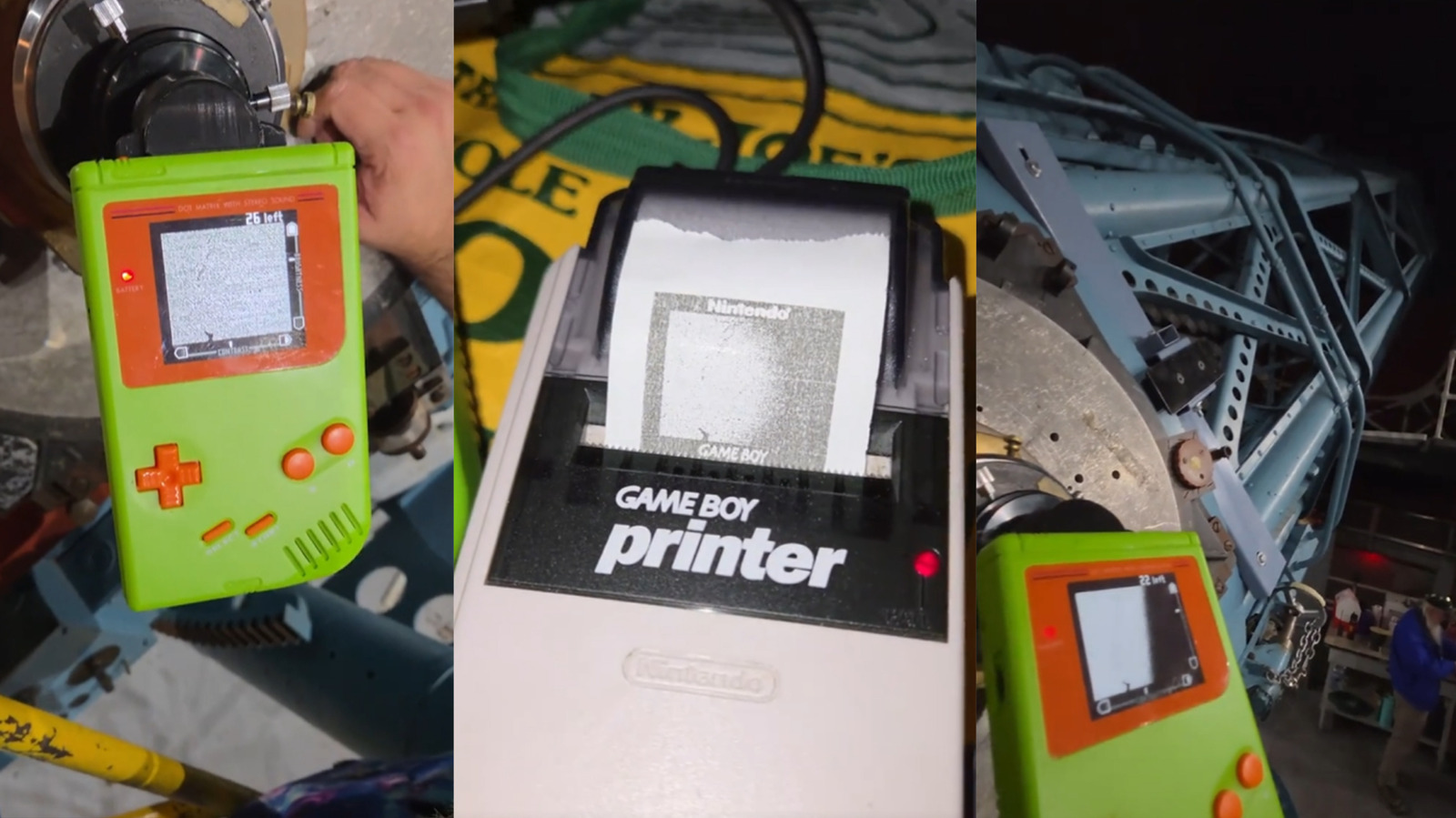
Astronomers truly live in a bold new era, where ground-breaking camera technology could change the way we understand the universe. No, not the Nancy Grace Roman Space Telescope with its pathetic 300-megapixel camera out in the depths of space. Nor is it the Vera C. Rubin Observatory with its paltry 3,200-megapixel camera. We’re talking about the latest, most powerful imaging system imaginable: a Game Boy Camera from 1998. Boasting an astonishing 0.014-megapixel camera and capable of two entire bits of information (four shades of grey!), this bold new frontier in photography will soon reveal the secrets of the cosmos to us. Who knows what we might find? Or even be able to make out through the pixelated fuzziness?
The hero who even attempted to do this was Chris Graue, who posted his success on TikTok. The trick was to 3D print a custom mount for the Game Boy Camera that could attach both a C-mount lens and a towering 60-inch telescope at the Mount Wilson Observatory in Los Angeles, California. Keep in mind that this telescope was the largest and most advanced in the world on its debut in 1908. In fact, it’s the very telescope that first took pictures of stars outside our galaxy. And yet, incredibly, the Game Boy Camera was fully 90 years more advanced (it came out in 1998)! With these two technological titans combined, only magic could result.
Graue first tried taking some photos of the Moon, but our nearest neighbor turned out to be so close to such a big telescope that the camera couldn’t really make it out. Never mind that it can barely make out anything at all, that’s not the point! Next up was a bigger success: the planet Jupiter, which the Nintendo wonder could clearly see. Even the stripes were visible. Scientists will be scrambling to analyze these photos, for sure. They might have to wait a minute for the photos to print first, though. Yes, print, as in from a receipt printer. Ah, the halcyon days of the 1990s.
The good and the bad of looking up at the stars
Of course, those other telescopes mentioned at the top just might do some good work, too. Where the Game Boy Camera only has the memory for 30 pictures total, the Rubin Observatory will be taking 1,000 pictures per night, or about 20 terabytes of information. In fact, by the end of its first year of operation (going on now), it is expected to gather more space data than every other observatory combined, ever.
Not enough for you? Then how about the Roman Space Telescope, designed to be the greatest discoverer in human history. Once fully deployed at Earth’s Lagrange Point 2 a billion miles away, its job will be to discover more objects than ever before. That means billions of new galaxies. Billions! Ok, not bad, Roman. Maybe the Game Boy Camera couldn’t do that.
The problem is that, in a few years, Rubin and Roman may not actually be much better than the Nintendo relic. With the advent of satellite constellations, composed of tens of thousands of orbiters each, scientists are predicting that up to 96% of all future astronomic photos could be ruined by them as they pass by. Yes, the damage could be to pictures taken by telescopes in orbit, too. All that incredible image-capturing power, only to see the underbellies Starlink satellites. Might as well just use the Game Boy, honestly.

