


You have full access to this article via your institution.
Hello Nature readers, would you like to get this Briefing in your inbox free every day? Sign up here.

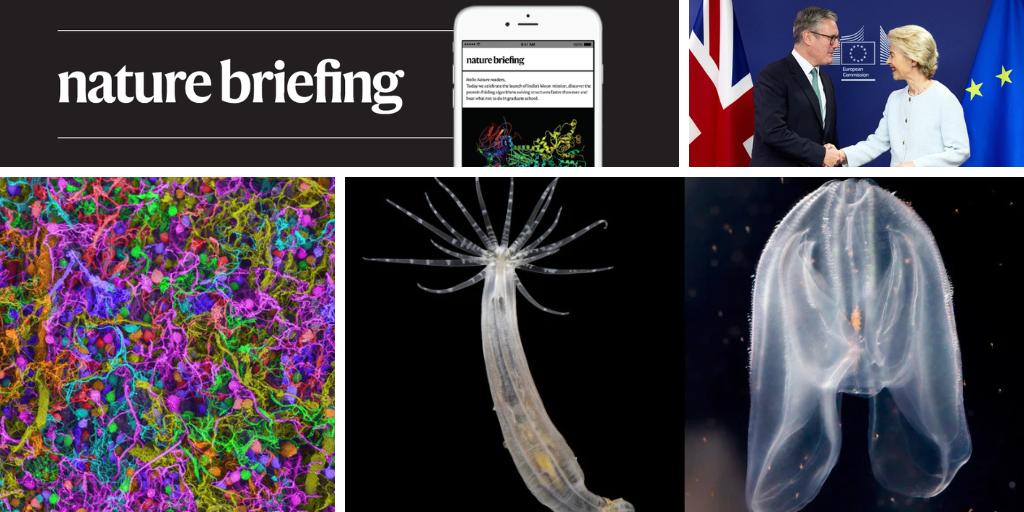
Researchers transplanted cells between embryos of a warty comb jelly (Mnemiopsis leidyi, right) and a starlet sea anemone (Nematostella vectensis, left) — organisms that belong to entirely different branches of the tree of life. (Paul R. Sterry/Nature Photographers Ltd/Alamy, Phil Degginger/Science Photo Library)
Researchers have discovered a new ‘embryonic organizer’ in marine predators called comb jellies (Ctenophora) and successfully transplanted them into sea anemones (Cnidaria). Organizer cells determine an organism’s body axis — a map that plots where various parts of the embryo should develop. After the transplant, the anemones developed a second body axis, complete with extra mouths and pharynxes. The findings support the idea that the emergence of organizing activity was a key step in animal evolution, says evolutionary developmental biologist Ulrich Technau.
Researchers have tracked the electrical activity of individual brain cells during conversation in real time, capturing how sentences are built before a single word is spoken. By observing these neurons in a brain region called the frontotemporal cortex, scientists have discovered that individual neurons act as specialized linguistic building blocks. “We used to think language was this diffuse, whole-network phenomenon,” says neurosurgeon and study co-author Ziv Williams. “But it turns out you have specific neurons that only care if a word is a noun, or only care if a phrase is ending.”
Ten years after the United Kingdom voted to leave the European Union, the UK is set to rejoin Erasmus+, an EU exchange scheme used by PhD students and university staff. And the UK’s share of the EU’s flagship Horizon Europe funding scheme has begun to recover after the country rejoined the programme in 2024. But hurdles remain, such as how much input the UK might have in the next iteration of Horizon Europe, and the country’s increasingly inhospitable visa requirements for researchers and students.
Sharply lowering body temperature with two well-established drugs reduces stroke-related brain damage in mice. Mice given the drugs during a stroke had less dead brain tissue than did those that didn’t receive them, and scored better on a post-stroke neurological assessment. A clinical trial in people showed that the drugs were safe, but ineffective at the doses tested. Researchers are now planning a second trial to administer the drugs to people over a shorter timeframe, which they hope will improve outcomes.
Nature | 4 min readReference: Science Translational Medicine paper
Features & opinion
To accommodate the booming population of Florida, housing complexes are popping up left, right and centre. Before construction projects can start, developers are required to relocate any gopher tortoises (Gopherus polyphemus) on the land. More than 97,000 tortoises have been moved around the state since 2009 in an attempt to conserve this vulnerable species. But scientists aren’t sure whether it’s working. The move is stressful for the reptiles, and could introduce them to unfamiliar diseases, both of which can impact their reproduction rates.
In her new book Little Blue Dot, energy reporter Katherine Dunn explores how the satellite-based navigation network known as GPS evolved from a military tool to a cornerstone of everyday life. In an excerpt, she tells the tale of engineer Todd Humphreys, who showed that GPS ‘spoofers’ could manipulate the system in dangerous ways, such as to crash a drone or to steal a superyacht.
Distressing images recorded on the remote Heard and McDonald Islands in the far south of the Indian Ocean show that more than three-quarters of its young southern elephant seals (Mirounga leonina) have been killed by H5N1 avian influenza. Infections and deaths were also seen among penguin species. The islands make up an uninhabited nature reserve managed by the Australian government.
BBC | 6 min read & 30 sec video
Reference: bioRxiv preprint (not peer reviewed)
Today I’m sitting back to watch the time pass — an experience that might be different for creatures of other species.
A group of researchers are now investigating the ‘timescapes’ of other animals, that being how they perceive the temporal world, for a window into the non-human consciousness.If you’ve got some spare time, please use it to send us your feedback on this newsletter. Your emails are always welcome at [email protected].Thanks for reading,
Jacob Smith, associate editor, Nature Briefing
With contributions by Flora Graham
• Nature Briefing: Careers — insights, advice and award-winning journalism to help you optimize your working life
• Nature Briefing: Microbiology — the most abundant living entities on our planet — microorganisms — and the role they play in health, the environment and food systems
• Nature Briefing: Anthropocene — climate change, biodiversity, sustainability and geoengineering
• Nature Briefing: AI & Robotics — 100% written by humans, of course
• Nature Briefing: Cancer — a weekly newsletter written with cancer researchers in mind
• Nature Briefing: Translational Research — covers biotechnology, drug discovery and pharma

