


You have full access to this article via your institution.
Hello Nature readers, would you like to get this Briefing in your inbox free every day? Sign up here.

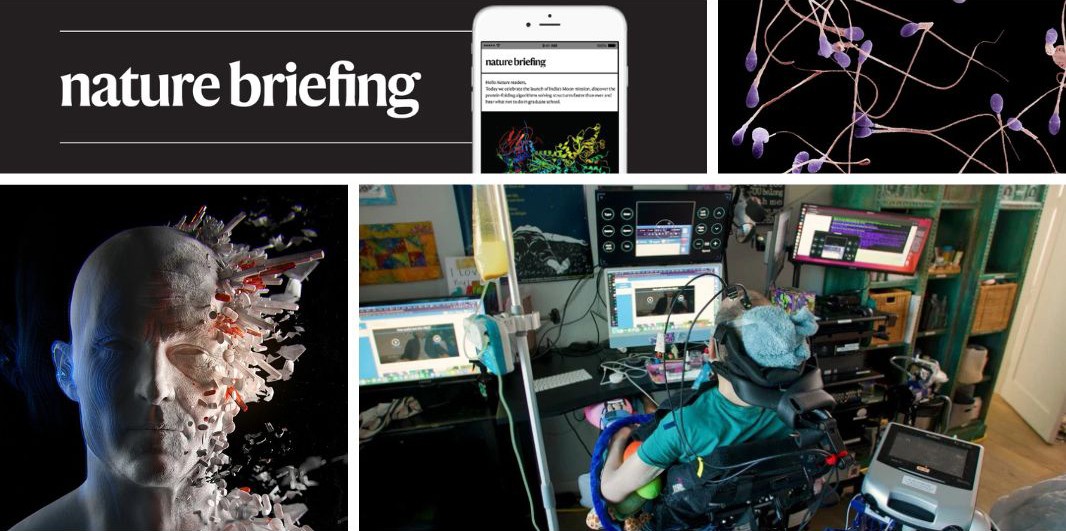
Casey Harrell using the brain-computer interface at his home. Credit: Regents of the University of California, Davis
A man with paralysis uses a brain implant to help him to communicate and use his computer at home. The brain–computer interface (BCI) translates the neural activity of 48-year-old Casey Harrell, who was diagnosed with a type of motor neuron disease six years ago, into text that appears on a computer screen and enables him to operate a computer, send text messages and e-mails and continue his job working in climate advocacy. It is “nothing short of revolutionary”, says Harrell.
Reference: Nature Medicine paper
The latest generation of obesity drugs might increase testosterone levels and improve the quality of sperm in men, according to a systematic review. Researchers identified five randomized controlled trials of GLP-1 medications that included measurements of testosterone levels. The results of two of these showed that testosterone levels rose in those taking GLP-1 drugs, and one trial also showed an increase in sperm quality. More robust trials are needed to confirm the association, says endocrinologist and review co-author Pratibha Natesh. But emerging evidence from other sources points in the same direction. The results were presented at the Endocrine Society’s annual meeting.
Four senior Chinese academics have been disciplined after ‘Student Geng’ — a vlogger and former PhD student whose real name is Geng Hongwei — flagged data anomalies in their published papers in a series of social-media videos. In the posts, watched almost ten million times, Geng analyses patterns in the data of papers published in Nature and other Nature-branded journals and concludes that some figures might have been fabricated. Geng’s virality has laid bare some challenges faced by China’s academic system, which is “very prone” to misconduct in part because of the high volume of papers its researchers publish, says research-integrity sleuth Elisabeth Bik.
Features & opinion
Some rich folks are testing a laundry list of life-extension tricks, despite questions about effectiveness and safety. Experts tend to agree that many of these efforts — such as supplementation with the textile dye and medical treatment methylene blue — have a sound basis in biology, but lack experimental evidence in humans. Biogerontologist Matt Kaeberlein calls it “a signal-to-noise problem”: in the limited available data about these interventions, he says, “there’s signal there, but there’s a whole lot of noise”. That makes it hard for the public to separate the two.
“If artificial intelligence and automation begin to replace human labour at scale, the key economic question won’t be the speed at which jobs vanish — it will be who pays the bill,” argues complexity scientist Ljubica Nedelkoska. She suggests that governments must start looking beyond income tax and levy a surcharge on tech-driven windfalls instead. Or people could hold a direct stake in AI-generated profits through a sovereign wealth fund, rather than those gains accruing entirely to private shareholders.
Even if you know your fermions from your bosons, the actual number of fundamental particles — the electrons, quarks and other building blocks of physics — is still uncertain. From the 17 that feature on posters on classroom walls, “where you stop depends on your taste for complexity and mystery”, explains science writer Natalie Wolchover. “Plausible answers range from 17 to — in all seriousness — 995.5.”
Today I’m enjoying learning about the Avondvierdaagse — the ‘four-day evening walk’ — in the Netherlands. These 10-km or 5-km community promenades are a tradition celebrated as a time of exploration, achievement, friendship and plenty of sweets.
While I plan an all-weather excursion soundtracked with some Eurovision hits and powered by the traditional half-an-orange topped with a peppermint, why not send me your favourite local celebrations — and your feedback on this newsletter — at [email protected]. And if you’re an Avondvierdaagser, let me know if it’s as great as it sounds.
Thanks for reading,
Flora Graham, senior editor, Nature Briefing
With contributions by Jacob Smith
• Nature Briefing: Careers — insights, advice and award-winning journalism to help you optimize your working life
• Nature Briefing: Microbiology — the most abundant living entities on our planet — microorganisms — and the role they play in health, the environment and food systems
• Nature Briefing: Anthropocene — climate change, biodiversity, sustainability and geoengineering
• Nature Briefing: AI & Robotics — 100% written by humans, of course
• Nature Briefing: Cancer — a weekly newsletter written with cancer researchers in mind
• Nature Briefing: Translational Research — covers biotechnology, drug discovery and pharma

