


You have full access to this article via your institution.
Hello Nature readers, would you like to get this Briefing in your inbox free every day? Sign up here.

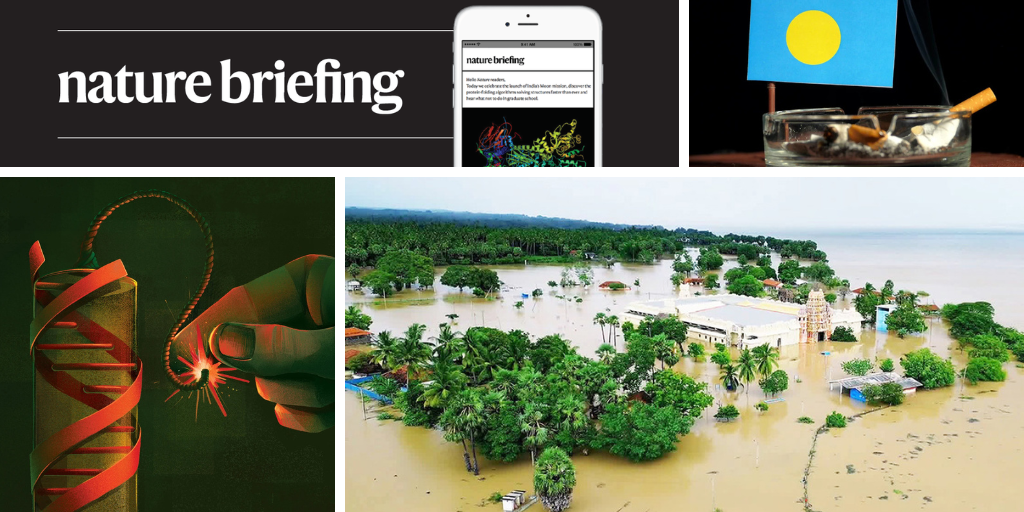
During cyclone Ditwah, Sri Lanka received 10% of its yearly rainfall in a single day. (Majority World/Getty)
Sea levels and ocean temperatures reached alarming highs in Asia last year, while Japan, China and Korea all recorded their hottest summer on record. Deadly floods hit Pakistan, extreme rain fell in Sri Lanka and 14 tropical cyclones impacted the Macao region. “The report clearly shows that the Asian region is one of the most vulnerable to climate change,” says oceanographer Matthew England. Early warning and coordinated action will be essential to save lives, says the report.
Reference: State of the Climate in Asia report
Should nicotine be regulated like drugs?
A call by the Pacific island nation of Palau for nicotine to be regulated like narcotics by the United Nations will trigger an assessment and a vote by member states. If nicotine were to be added to the UN Convention on Psychotropic Substances, it would effectively make it illegal to sell nicotine products that aren’t considered medicinal, says nicotine-treatment specialist Renee Bittoun. But tobacco-company lobbying makes it unlikely that nicotine will be added to the list, says Bittoun.
Domestic goats (Capra hircus) can follow the voice of a person to find a reward. A group of goats were each presented with two buckets, one empty and one containing food. When a hidden researcher spoke enthusiastically in the direction of the full bucket, the goats moved toward it 60% of the time — more often than would be expected by chance. Voice-following abilities have previously been found in dogs, but not chimpanzees, which could suggest that the skills arose through domestication.
Reference: Royal Society Open Science paper
Last month, the National Science Foundation (NSF) abruptly decided to dismantle much of the Ocean Observatories Initiative (OOI) — a network of underwater and floating infrastructure, and a fixed subsea observatory in the Pacific Northwest. Marine scientists have long debated the correct balance between spending on costly infrastructure like these, and funding research grants. But the sudden break-up of OOI has triggered widespread condemnation. The NSF has not shared its reasoning for the decision, so researchers are left wondering to what extent the move reflects scientific priorities, policy changes or the predilections of the Trump administration.
The first removals of instrumented moorings were scheduled to begin today. There has been a bipartisan effort by some lawmakers to stop the process, and Democrats from the US Senate have called the move “expensive, destructive, and — crucially — illegal”.
Science | 9 min read & Associated Press | 6 min read
Where academic freedom is up (and down)
Bangladesh, Uzbekistan and Montenegro are among the nine countries that have seen significant improvements in academic freedom in the past ten years, says a new report that looks at individual and institutional metrics. Meanwhile, 50 countries — including big hitters such as the United Kingdom — experienced declines. The report specifically calls out the “fast and steep deterioration” of academic freedom in the United States because of “state and federal attacks [that] have generated severe pressure on American universities”.
Scientific American | 6 min read
Reference: Academic Freedom Index report
Features & opinion
The proteins that protect us from mutations
Our genomes are full of mutations that have the potential to cause harm. But often they don’t, thanks to a family of proteins that ‘buffer’ the mutation’s ill effects. These proteins, called HSPs, have been on scientists’ radar for decades, but advances in techniques such as cell screening and genetic editing are giving new insight into the proteins’ roles. Researchers are now trying to unpick how buffer proteins have influenced human evolution, and are investigating how to exploit them in treatments for diseases such as breast cancer.

Galápagos sharks (Carcharhinus galapagensis) have been caught on camera scraping up against manta rays (Mobula birostris) to scratch themselves. The backs and bellies of mantas are covered with rough dermal denticles that might help the sharks scrape parasites off their snouts and gills. The mantas don’t seem to mind when young sharks do it, but get a bit skittish when bigger sharks get too close for comfort.
Scientific American | 5 min read & 30 sec video
Reference: Marine Biodiversity paper & Environmental Biology of Fishes paper
Today I’m taking my hat off to MAVEN, and those who worked on that Mars orbiter mission. The spacecraft did 11 years of good science before it lost contact during a routine communications blackout. MAVEN’s team called it “the loss of a loved one”, but pointed to the positives: the spacecraft was originally planned to investigate the atmosphere of Mars for only two years. Four remaining active orbiters — Mars Odyssey, Mars Reconnaissance Orbiter, Mars Express and the European Space Agency’s Trace Gas Orbiter — will keep at it.
Let me know what you’re persevering with — or any other feedback on this newsletter — at [email protected].
Thanks for reading,
Flora Graham, chief editor, Nature Briefing
With contributions by Jacob Smith
• Nature Briefing: Careers — insights, advice and award-winning journalism to help you optimize your working life
• Nature Briefing: Microbiology — the most abundant living entities on our planet — microorganisms — and the role they play in health, the environment and food systems
• Nature Briefing: Anthropocene — climate change, biodiversity, sustainability and geoengineering
• Nature Briefing: AI & Robotics — 100% written by humans, of course
• Nature Briefing: Cancer — a weekly newsletter written with cancer researchers in mind
• Nature Briefing: Translational Research — covers biotechnology, drug discovery and pharma

