


Written By Tymia “Ty” Ballard
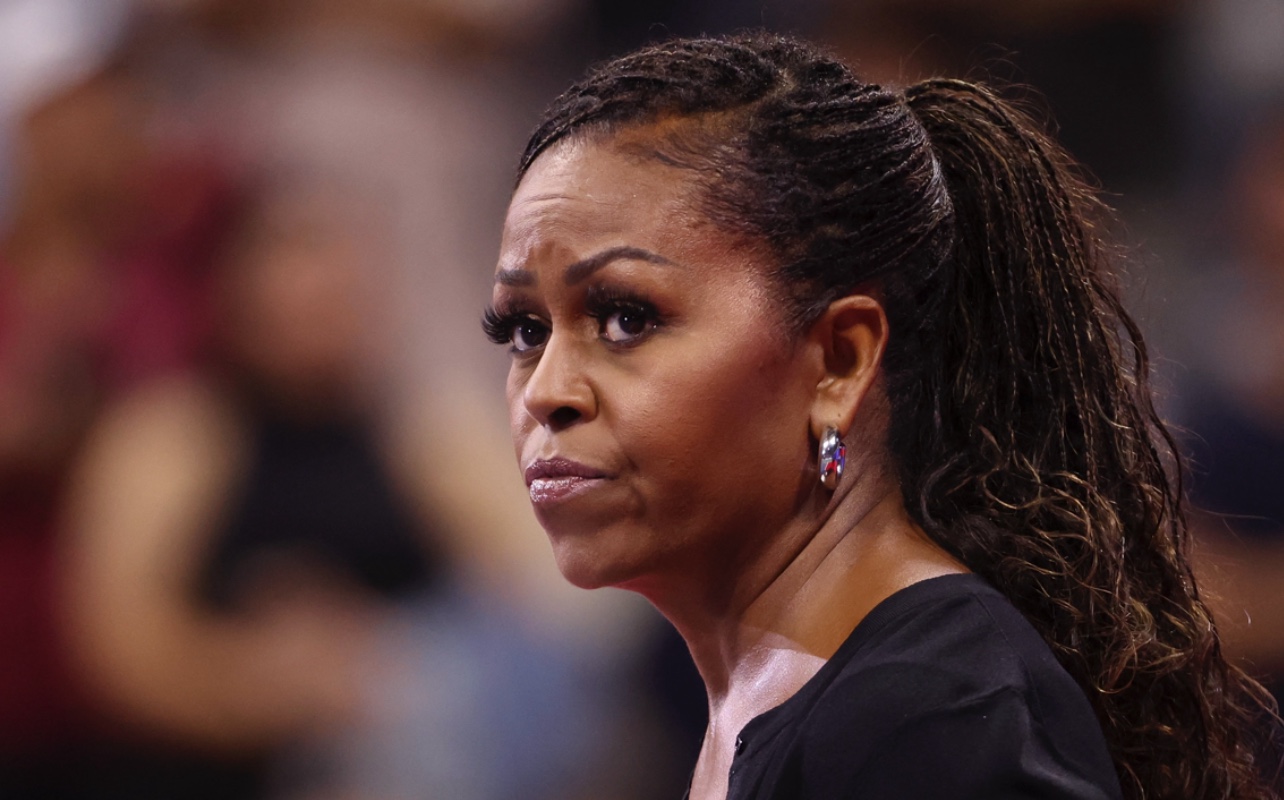
On Sunday, June 14, UFC fighter Josh Hokit used a post-fight interview on White House grounds to repeat a remark that has followed former first lady Michelle Obama for years.
“Michelle Obama is a man, am I right, America?” Hokit said during a post-fight interview with right-wing podcaster Joe Rogan at UFC Freedom 250, the first professional sporting event to take place at the White House.
For many, the comment might seem easy to dismiss as simply crude, ignorant, or attention-seeking. Others treated it as a joke. But the remark deserves a deeper examination, not because it was new, but because it was all too familiar. And continues to be just as harmful.
Michelle Obama’s is a target of racist and sexist remarks
Michelle Obama has spent years being subjected to racist and sexist attacks questioning her appearance, femininity, and womanhood. But long before social media made these statements commonplace, Black women have been forced to navigate a society that often denies them the grace, softness, and humanity routinely afforded to white women. It is part of a growing phenomenon often referred to as transvestigation, the conspiracy theory that public figures, particularly cis women–a person who was assigned female at birth and identifies as a woman– are secretly transgender. While often dismissed as internet nonsense, these accusations are rooted in the same logic that fuels anti-trans panic: the belief that strangers have the authority to inspect, evaluate, and determine who is “really” a woman.
For years, opponents of transgender equality have framed their efforts as a matter of protecting women. We have heard arguments about bathrooms, sports, identification documents, healthcare, and public accommodations. We are told that these debates are about safety, fairness, and common sense. But this past Sunday revealed something else.
What happened at the White House was not simply an attack on Michelle Obama. It was a reminder of how racism, misogyny, and transphobia often work together and how the harm of anti-trans rhetoric extends far beyond transgender people. And the insult only works if people agree that being perceived as transgender is something shameful. The joke relies on the assumption that being mistaken for a trans woman is inherently humiliating. That assumption is not incidental to the attack. It is the attack.
Already, transgender women often bear the brunt of this system. They face harassment, discrimination, and violence simply for existing in public. Being publicly accused, singled out, or “outed” can lead to discrimination, harassment, loss of employment, housing instability, and violence. And Black transgender women in particular continue to face disproportionate rates of violence and fatal attacks. But once we normalize the idea that womanhood can be questioned based on appearance, there is no logical stopping point. The policing of gender has never remained confined to one group. The scrutiny inevitably expands to anyone who fails to conform to society’s expectations. And our society continues to attempt to treat womanhood as something that must be verified, inspected, and proven. Everyone has become vulnerable. The question stops being whether someone is a woman and becomes whether they are woman enough. And we’ve already seen the consequences.
And Black women, in particular, have long been forced to carry this burden.
A Eurocentric Standard of Femininity
The National Black Justice Collective has noted that women of color are disproportionately accused of being transgender or intersex because of racist assumptions about their bodies and rigid demands for gender conformity. Across the country, cisgender women have reported being harassed in public restrooms because someone decided they looked too masculine. Female athletes have had their bodies scrutinized and their identities questioned. Women whose appearance falls outside narrow and often white-centered Eurocentric beauty standards are subjected to invasive speculation about their bodies and identities.
The history of misogynoir, the specific intersection of anti-Black racism and sexism experienced by Black women, is filled with examples of Black women being denied femininity. Black women have been stereotyped as aggressive, masculine, hypersexual, physically imposing, and fundamentally different from the delicate idea of womanhood that American culture has historically reserved for white women.
World-class athletes like Venus and Serena Williams and Brittney Griner have had their bodies mocked and masculinized. Artists such as Ciara and Megan Thee Stallion have faced similar attacks online. Time and again, Black women are told that their strength makes them less feminine, that their physical features make them suspicious, or that their existence somehow requires explanation.
And so the message becomes clear. If a woman does not fit a narrow, Eurocentric standard of femininity, her womanhood becomes open for debate. And that same logic sits at the heart of modern anti-trans rhetoric.
That is why transphobia, or transmisia, a term that I personally prefer because it shifts the conversation from fear to active prejudice and systemic discrimination, is not solely a transgender issue. It is a cultural and justice issue. And it’s why this is not merely a disagreement about language or policy. This shapes how people move through the world. It influences who is protected and who is considered deserving of dignity. A reality that other activists have been saying for years.
And frankly, it’s getting old, and it’s getting tired.
When a public figure can stand on White House grounds and casually repeat transphobic and racist language about a former first lady, it signals how normalized this rhetoric has become. It tells us that questioning a woman’s identity has become acceptable entertainment. It tells us that some people still view accusations of being transgender as a punchline. That trans people are a joke to them.
But there is nothing funny about a culture that teaches people to distrust women based on how they look. There is nothing harmless about rhetoric that encourages strangers to evaluate, investigate, and challenge another person’s identity. And there is certainly nothing protective about a movement that claims to defend women while simultaneously creating an environment where women are constantly forced to prove themselves.
It’s not that Michelle Obama deserves better because she is Michelle Obama. It’s that all women, cis, trans, and/or queer, deserve better because they are people.
We should not have to meet a particular standard of beauty, softness, size, race, or presentation to be respected and treated with decency. We should not have to perform femininity to satisfy strangers. And we should not have to fear that our identities will be questioned simply because someone believes we do not look the way a woman is supposed to look.
The answer is not deciding who counts as a woman. It is recognizing the humanity of all women and rejecting the systems that encourage us to treat their identities as public property. Because the moment we grant people permission to decide who is “really” a woman, we create a world where every woman is subject to judgment and none of us are truly safe from it.
RELATED CONTENT: President Obama Blasts Trump’s Racist AI Video Depicting He And Michelle As Apes

