


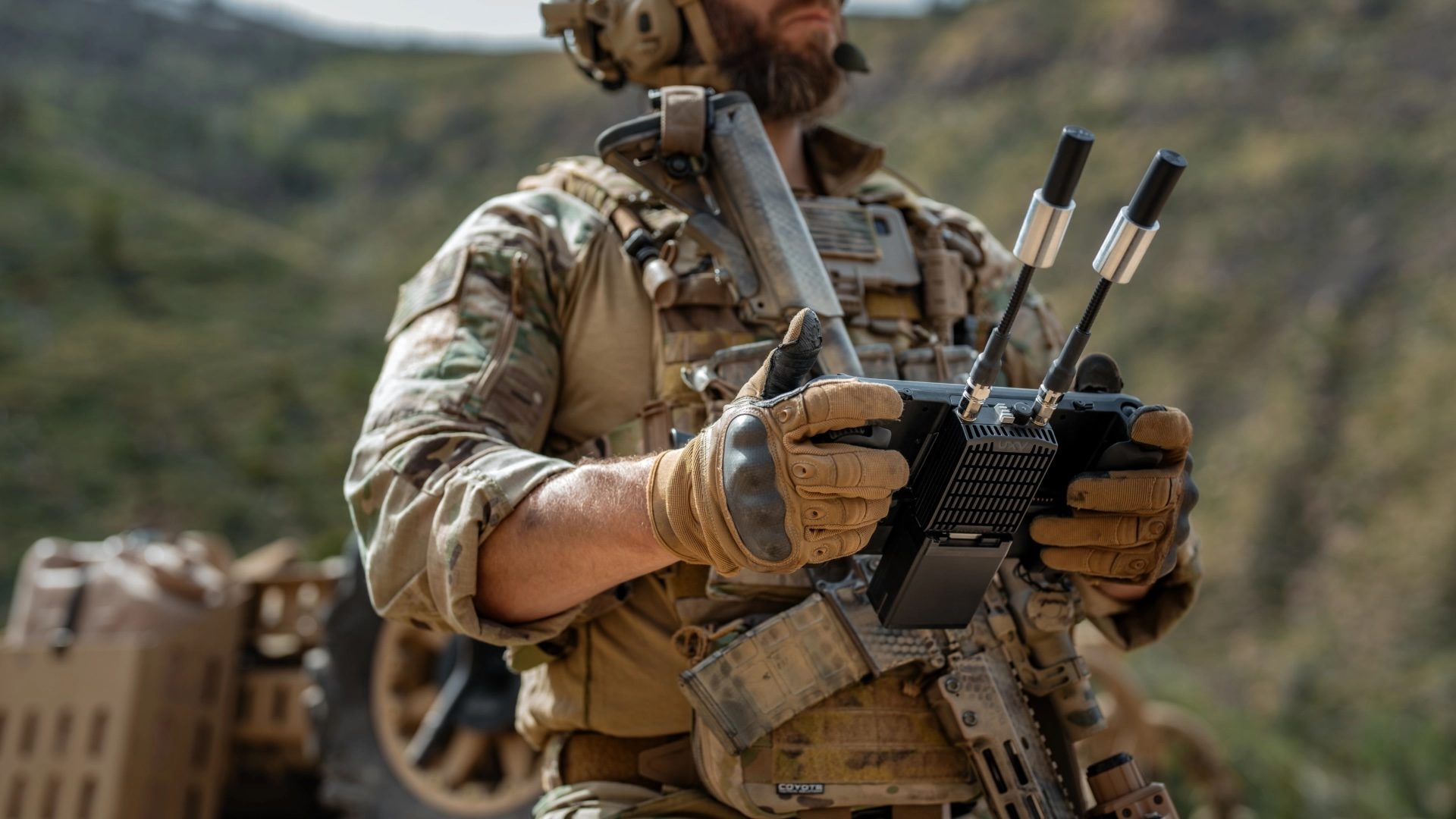
PDW works to develop advanced drone communications systems
By DRONELIFE Features Editor Jim Magill
As modern warfare increasingly relies on the use of drones for surveillance, targeting and attacks, militaries across the world are beginning to recognize the vital importance of maintaining communications links with UAVs that are operating in highly communication-contested environments.
Ensuring that from the outset robust and reliable radio frequency (RF) communications technology is built into the heart of unmanned aerial systems is one of the founding principles of Huntsville, Alabama-based defense technology firm PDW Holdings, CEO James Slider said in an interview with DRONELIFE.
“For those who know RF, it’s a little bit of magic and a little bit of science, kind of combined. And we have a thesis: that in future operations, being able to function in contested environments is table stakes. You have to be able to work within disrupted-comms and -GPS environments,” Slider said.
To advance its goal of achieving communications mastery in such challenging environments, PDW recently announcedits planned acquisition of Rochester, New York-based electronics manufacturer Vanteon Corporation, an engineering firm with decades of experience developing advanced communications, radio Frequency (RF) systems and software-defined radio technologies.
“Vanteon has a great performance pedigree and background creating radio technology that works in those environments. So, we’re excited to have them come into the fold,” Slider said.
According to the PWD press release, “Vanteon brings more than 40 years of experience delivering advanced communications and embedded systems, along with a team of approximately 40 engineers with deep expertise in RF design, and mission-critical software and hardware.”
Slider said PDW is very familiar with Vanteon’s operations, having worked with the company for several years on the development of BlackWave radio technology that provides a powerful wireless control link for use in military operations.
Originally formed by a core group of tech-savvy entrepreneurs who got their start designing fast and nimble first-person-view drones for the Drone Racing League, PDW has evolved into a producer of battle-ready drones and weapons systems for the defense industry. Slider said the company’s background of designing FPV drones capable of performing complex maneuvers under high-stress conditions has positioned PDW to be able to provide the type of drone technology vital to the modern defense industry.
“I think the military needs all kinds of high-performance drones and airframes that are secure and also navigable, that can do lots of different things,” he said. “Our drones do sensing, radio relay, they work with kinetics. So, we want to bring a high-performance airframe and drone from our racing heritage and pair that with a lot of that new capability.”
PDW’s defense line of products includes the C100 quadcopter, configured for intelligence, surveillance and reconnaissance missions and featuring extended mission-critical communications systems, as well as the AM (Attritable Multirotor) Defense, National Defense Authorization Act-compliant tactical strike drone. The company also produces a public safety version of the c100 for civilian law enforcement and emergency response personnel.
“Our AM, which is a Group One quadcopter is multimodal, multifunctional and has swappable drivetrain payloads and battery technology,” Slider said.
As a sign of the company’s rapid growth, he pointed to the expansion of the company’s production technology, with the opening of the Drone Factory 01 in Huntsville last August. Modeled after the Army’s Transformation in Contact initiative, the 90,000-square-foot state-of-the-art DF01 was designed to manufacture up to 100,000 NDAA-compliant systems annually
“We have a lot of overhead in our Huntsville facility at DF01,” Slider said. He said the company is upgrading some of its assembly automation techniques, to allow it to mass produce the low-cost attritable drones required by the U.S. Armed Services.
Additionally, the company’s vertical-integration manufacturing strategy allows it to bypass fragmented supply chains that impact most domestic drone makers. The new DF01 plant enables PDW to achieve peak production of up to 350 C100s and 5,000 AM-FPVs per month.
“Our customers are mostly defense. We do have customers within the federal security/law enforcement/tech space, but mostly our focus is on serving the needs of the war fighter,” he said.
PDW has entered into several purchase contracts with the U.S. Department of War (DOW). With a price tag of $15 million, the most recent defense contract with the U.S. Army, has also been the company’s largest. Slider said the military is currently deploying PDW’s technology in a number of high-stress environments.
“I think the DOW has rightly recognized that drones have a lot of potential in modern conflict and in combat. And our goal is to create a number of different drone systems that are usable organically, systems that come out of a soldier’s rucksack that can be hand-carried, can be deployed, and can meet that sweet spot of having a lot of capability, but also being easy to use and cost-effective,” he said.
“We design the drones to be usable in all kinds of different environments and in all kinds of different ways, and I think the customer takes full advantage of that.”
Read more:

Jim Magill is a Houston-based writer with almost a quarter-century of experience covering technical and economic developments in the oil and gas industry. After retiring in December 2019 as a senior editor with S&P Global Platts, Jim began writing about emerging technologies, such as artificial intelligence, robots and drones, and the ways in which they’re contributing to our society. In addition to DroneLife, Jim is a contributor to Forbes.com and his work has appeared in the Houston Chronicle, U.S. News & World Report, and Unmanned Systems, a publication of the Association for Unmanned Vehicle Systems International

