


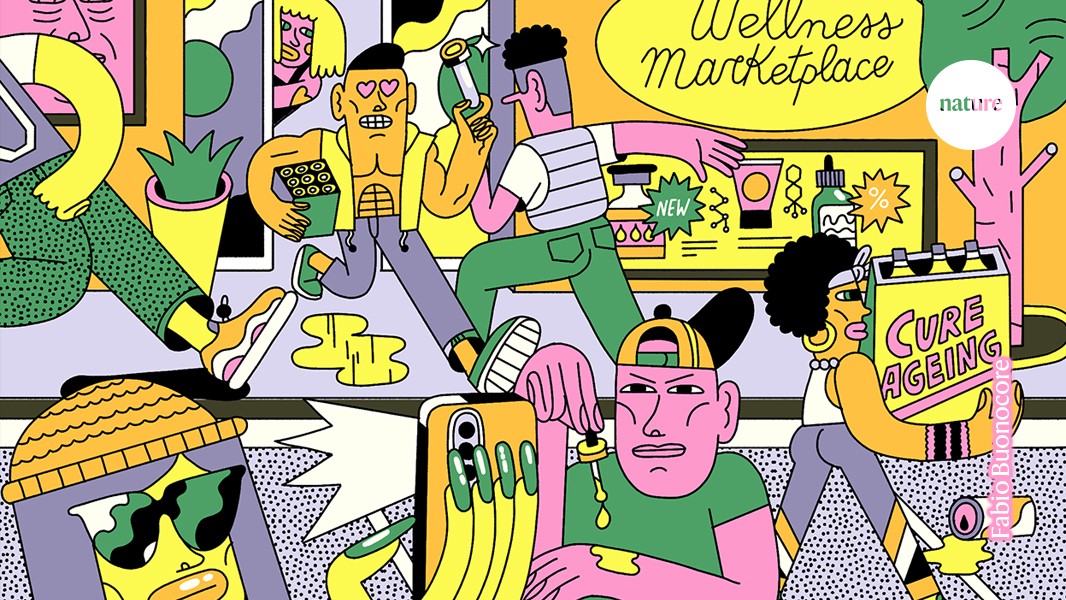
Peptides have become the latest cure-all trend on social media — a way to eliminate wrinkles, build lean muscle, boost metabolism, clear brain fog, heal torn ligaments and more. Influencers rave about their peptide-fuelled glow-ups on TikTok. Bodybuilders exchange information about their favourite combinations at the gym. US health secretary Robert F. Kennedy Jr is a proponent. “I’m a big fan of peptides,” he told US podcaster Joe Rogan in February. “I’ve used them myself, and used them with really good effect on a couple of injuries.”
Peptides are made of the same building blocks as proteins, but are shorter — typically less than 50 amino acids long. And they can be powerful medicines. The hugely successful GLP-1 diabetes and weight-loss drugs, for example, are peptides; as is the hormone insulin. But when wellness gurus and fitness enthusiasts talk about peptides, they’re often referring to an alphabet soup of chemicals: BPC-157, MOTS-c and TB-500. These compounds come in vials labelled ‘for research use only’ because they are not approved for use in humans. It’s a “completely unregulated industry”, says Vikas Patel, an emergency-medicine physician at Elmhurst Hospital in Illinois.
Will blockbuster obesity drugs revolutionize addiction treatment?
The popularity of peptides has skyrocketed over the past couple of years. Google searches on the term worldwide rose from about 1.3 million each month in 2024 to around 8 million per month in 2026. The enthusiasm has been driven, in part, by social media. “The influencer crowd has sort of created this perception that these are miracle drugs,” says Matt Kaeberlein, a longevity researcher at the University of Washington in Seattle. And although the obsession is a global phenomenon, people in the United States seem particularly enamoured with them, says Patel. He attributes the phenomenon to a growing suspicion of the medical establishment in the country. “We’ve hit this tipping point of people not trusting physicians or science,” says Patel, who has also co-founded a private longevity clinic. (Patel doesn’t sell or prescribe peptides, but says that he does point people to the most reliable vendors if they decide to seek them out.)
But what does the science say? Animal research suggests that many of these experimental peptides hold promise for treating certain conditions. The evidence that these compounds work in people, however, is lacking.
That hasn’t stopped Kennedy from pushing to make them more accessible. In April, the US Food and Drug Administration (FDA), which he oversees, began the process of removing regulatory hurdles that prevent many of these compounds from being made in specialized pharmacies. Former FDA official, Peter Lurie, now executive director of the Center for Science in the Public Interest, a non-profit organization in Washington DC that advocates for evidence-based food and health policies, worries that authorizing pharmacies to make and sell unproven therapies will deter companies from investing in drug development. “It reduces the incentive, if not abolishes it entirely, for people to bring potentially effective drugs to market through the drug-approval process,” he says. “And then what we’ll have are a bunch of peptides on the market being sold and nobody generating any evidence to separate out the effective from the ineffective.”
Peptide potential
Peptides occur naturally in the human body and perform essential functions. They serve as growth factors, neurotransmitters, antimicrobials and more. Tens of thousands have been identified, and many more probably exist.
Although made of the same amino-acid building blocks, peptides are much shorter than proteins. Some arise when larger proteins are cleaved. Insulin, for example, comes from a larger protein, called proinsulin, that is split in the pancreas. Others are encoded by the human genome, but not by the 20,000–25,000 canonical protein-coding genes that have been identified. Rather, they are part of the ‘dark proteome’, hidden in vast swathes of DNA and once dismissed as irrelevant, says Pinchas Cohen, a geroscience researcher at the University of Southern California’s School of Gerontology in Los Angeles. These hidden peptides “expand the scope of the human genome to possibly a million genes”.

Testosterone therapy is trending. Who really needs it, and why?
Peptides are attractive as therapeutics because they tend to be smaller than proteins and bind more specifically to their target than do small molecules. “They generally have less off-target interactions,” says Carrie Haskell-Luevano, a peptide chemist at the University of Minnesota in Minneapolis. But peptides also come with some drawbacks. They aren’t as stable as proteins, and they often degrade quickly in the body. These are challenges that can be overcome, Haskell-Luevano says. In fact, they already have. Nearly 100 FDA-approved drugs are peptides, including oxytocin, human growth hormone and the GLP-1 drugs. Around 150 more are in clinical trials. “Peptides can be very powerful substances,” says Paul Knoepfler, a stem-cell biologist at the University of California, Davis, who has been following the debate over peptides closely. And, he says, “there’s no reason to think there aren’t going to be dozens of other peptide drugs that are going to be proven safe and effective”.
Scarce science
Cohen began to get excited about peptides a couple of decades ago. He and his team had started mining mitochondrial DNA for peptide-encoding genes and synthesizing the molecules to study their function. One of their finds was MOTS-c.
In mice, the compound prevented obesity and insulin resistance and improved physical performance1. It even extended lifespan. It worked so well that CohBar, a company co-founded by Cohen and Nir Barzilai at the Albert Einstein College of Medicine in New York City, licensed the MOTS-c patent. CohBar tweaked the compound to make it more effective and more stable, and then, in 2018, tested it in a safety study.
Researchers first administered the compound to 65 healthy adults to determine dosing. They then randomized 20 people with obesity and non-alcoholic fatty liver disease and gave the compound to about half of them for four weeks. Participants who received the peptide had lower glucose levels, greater reductions in markers of liver injury and a trend towards weight loss compared with the placebo group2.
CohBar raised US$80 million to get the drug through an initial trial. But, says Cohen, “we couldn’t raise the next round to do a phase II”. In 2023, the company shut down. That hasn’t stopped MOTS-c from becoming one of the most popular unapproved peptides. “Guys it’s like you have unlimited energy,” raves one Instagram user.
Other popular unlicensed peptides have been studied in even fewer people. Flynn McGuire, a physician specializing in physical medicine and rehabilitation at the University of Utah in Salt Lake City, and his colleagues delved into the literature on BPC-157, a peptide that purportedly helps to repair tissue injuries3. They managed to dig up 3 pilot studies with a total of 30 participants. “The amount of human data that exists for it is of dubious enough quality that you can essentially just ignore it,” he says. “There are no long-term studies. There are no safety studies, even in animals.”

Peptides labelled ‘for research use only’ are often sold for human consumption.Credit: Anna Hoychuk/Shutterstock
To complicate matters, people who use peptides often inject multiple compounds together as ‘stacks’. One popular combination, called the ‘Wolverine stack’, after the Marvel Comics character, consists of BPC-157 and TB-500, a fragment of a larger peptide called thymosin-β4. The combination hasn’t been tested in humans. But clinical data do exist for thymosin-β4, including a phase III trial of eye drops for dry eye syndrome.
The treatment failed to meet the goal of the trial, but testing is ongoing. Deepak Srivastava, a cardiac stem-cell biologist at the Gladstone Institute of Cardiovascular Disease in San Francisco, California, is more interested in what thymosin-β4 can do for the heart. He and his colleagues found that the compound helps heart muscle to regenerate after injury4, and he suspects that it might play a part more broadly in reversing ageing.
But he doesn’t think it should be used in a do-it-yourself fashion for general wellness. “It’s really remarkable that this trend has started,” he says. It reminds him of the raft of stem-cell clinics that have popped up around the world promising to cure myriad ailments. “People pay a lot of money out of their own pocket, even though there’s absolutely no reason to think any of this would work,” he adds.
Safety concerns
Peptides such as BPC-157, MOTS-c and TB-500 are widely available from vendors who market them for research purposes. “What people are shooting up out there is what I would give to mice,” Cohen says. Many enthusiasts call this the grey market, but “there’s nothing grey about it”, Kaeberlein says. “It is illegal for people to sell experimental therapies on the Internet for human consumption.” The FDA can — and sometimes does — crack down on these companies, but enforcement is sporadic.
Because there’s no regulatory oversight of the labs that manufacture these peptides, the purity varies widely. In a preprint study5, researchers examined publicly available data for 14 peptides from a third-party testing platform that evaluates the purity and abundance of the substances. Out of about 6,000 samples from 203 companies, more than 40% failed to meet even basic purity and dose standards. And of the roughly 250 samples that were tested for endotoxins, a marker of bacterial contamination, 15% had low but measurable quantities. Endotoxins can cause symptoms that range from fever and chills to, at high levels, septic shock.

The surprising science behind red-light therapy — and how it really works

