


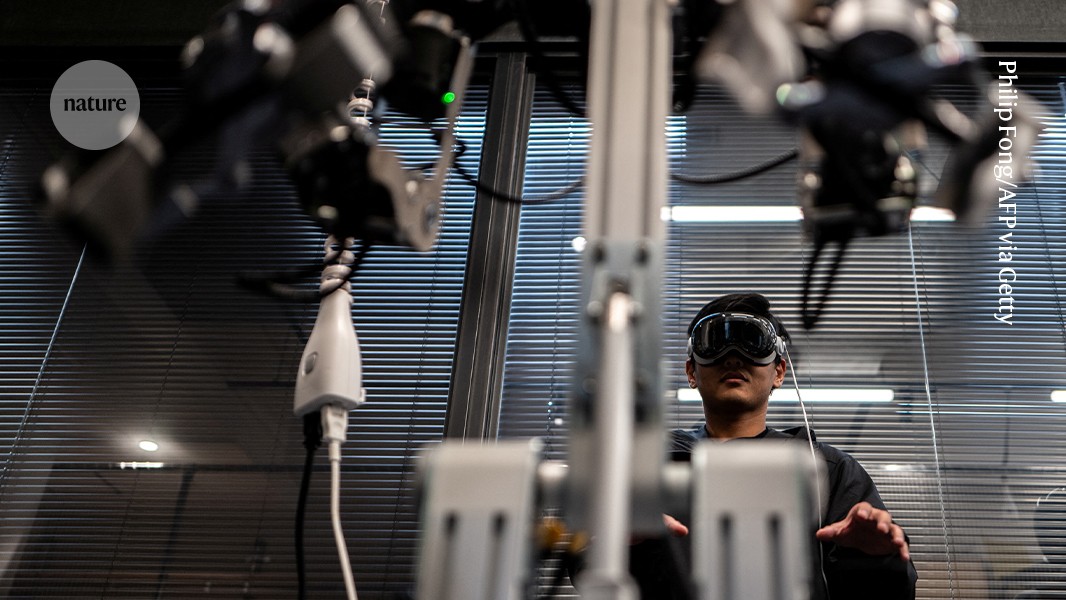

An engineer at Japan-based robotics firm Enactic uses a virtual-reality headset to test robotic arms in the company’s office in Tokyo.Credit: Philip Fong/AFP via Getty
China has continued its steep rise in research output, according to Nature Index’s annual rankings, but there is growing evidence that other East Asian countries are also challenging major research nations in Europe and North America.
The Research Leaders tables rank countries and territories according to their contributions to articles published in journals tracked by Nature Index. They show that China’s contribution rose by 22% between 2024 and 2025, far ahead of the rest of the top ten, to extend the country’s lead at the top of the ranking.
Japan and South Korea, which are ranked fifth and seventh, respectively, each posted an increase of almost 10% growth in output according to a metric called Share, which tracks author affiliations on research articles. That’s a bigger increase than higher-ranked Western peers such as the United States, Germany and the United Kingdom (see ‘Relative measures’).
This year’s ranking marks a watershed for the Nature Index, which for the first time has integrated a set of applied-sciences journals into the database, amounting to about 20,000 extra articles in 2025. A number of social-science journals have also been added, representing about 2,000 extra articles. Furthermore, the database has switched to categorizing research disciplines at the article level, rather than by journal, to better reflect the subject mix found in journals. To ensure that year-on-year performance is tracked fairly, however, data from both 2024 and 2025 have been added, and output increases have been calculated against the updated figures.
Mission critical
Increases in Share from 2024 to 2025 should be assessed against the year-on-year growth in the total number of articles in the database. This comes out at 11%, so Japan and South Korea, which each had an increase in Share that was slightly lower than this, lost a little ground to China. Adjusted Share, a metric that accounts for changes in database size, fell by 1% for South Korea and 2% for Japan. But the figures still point to these countries performing much better than large research systems in Europe and North America did: adjusted Share dropped by 6% for the United States and by 7% for Germany and the United Kingdom. Some major Western research institutions also had large drops in adjusted Share from 2024 to 2025, including Harvard University in Cambridge, Massachusetts, which lost its position as the leading university for Nature Index output to Zhejiang University in Hangzhou, China.
Nature Index 2026 Research Leaders
For Japan, the encouraging numbers will raise a hopeful question. Is the country’s often-discussed research malaise — represented by sharp falls in its adjusted Share in the Nature Index from 2015 to the early 2020s and concerns over cuts to university funding — beginning to ease? Motoko Kotani, adviser to the president of Tohoku University in Sendai, Japan, says that the numbers do suggest that Japan is adapting to a global research environment that is increasingly tilted towards interdisciplinary, mission-led and computational work.
Kotani traces some of that shift back to a change about ten years ago in how Japanese policymakers framed research. Up to that point, Japan’s science system was often described as siloed and slow to adapt, with universities operating in highly specialized academic enclaves that did not collaborate enough with industry. In the mid-2010s, Kotani says, policymakers started asking what science was really for. “The answer wasn’t scientists,” she says. “It was society.” Once science is framed that way, interdisciplinarity follows, she argues, because “you cannot solve society’s problems with only one discipline”.
These policy conversations were followed by reforms such as stronger backing for strategically selected universities, greater institutional autonomy and better support for early-career researchers, according to Kotani. In 2017, for example, the government rolled out its Designated National University Corporation System, which selects a small number of universities deemed capable of rivalling what the government calls the “world’s top-level” research institutions. These universities are granted freedoms from certain regulations, so that they can establish spin-off companies and offer increased salaries to attract foreign researchers.
All of this has been reinforced with significant government spending. In 2023, the government created a ¥10-trillion endowment fund (worth US$63 billion today) — its most ambitious academic investment in decades. The move aimed to emulate the US model, in which large university endowments are invested to generate steady returns that support research in the long run. A year later, Tohoku University became the first recipient of funding from the endowment pot.
Japan still has hurdles to clear. “Our challenge remains internationalization,” says Kotani. The country’s academia is still wrestling with how to make universities less insular, more attractive to foreign researchers and more open to collaboration with institutions overseas.
The government hopes that the Japan Science and Technology Agency’s Adopting Sustainable Partnerships for Innovative Research Ecosystem (ASPIRE) programme — launched in 2023 to strengthen international collaboration — will help. Under ASPIRE, “top scientists” can apply for up to ¥500 million for projects that involve partners based in a select number of countries, in strategically chosen research areas such as artificial intelligence, biotechnology and semiconductors.
Ecosystem effect
South Korea’s biggest Share jump came in applied sciences, in which its score rose by 14% from 2024 to 2025; its natural-sciences performance was strong, too, rising by 11%.
Ramón Pacheco Pardo, a researcher in international relations at King’s College London and the institution’s regional envoy for East and southeast Asia, says that South Korea’s success cannot be traced to one ministry, company or subfield. “It’s the whole ecosystem,” he says. “South Korea’s research system has long been tied to its industrial strategy and bolstered by its advanced manufacturing and technology-heavy exports.”
That opinion is echoed by So Young Kim, a science and technology policy researcher at the Korea Advanced Institute of Science and Technology in Daejeon. “This approach is historically rooted in the country’s industrial policy during its development decades. What we’re seeing now is the global revival of industrial policy,” she says.
In 2023, South Korea spent close to 5% of its entire economic output on research and development — second only to Israel among members of the Organisation for Economic Co-operation and Development (OECD). But a high proportion of this investment takes place in private companies: 81% of South Korea’s research spending in 2024 was in the business sector, according to OECD data.
The government says that the country’s total 2025 research budget was more than 16% higher than that in 2024. Like Japan, South Korea has chosen to home in on specific research fields: the government wants 44% of its research budget to be directed towards a ‘pioneering’ research approach that focuses on technologies that it calls game-changing, such as AI and quantum technology.

Humanoid robots being trained at the headquarters of South Korean electronics firm LG in Seoul.Credit: SeongJoon Cho/Bloomberg via Getty
South Korea’s method of combining private and public research means it is especially well aligned with the direction of global science, says Pacheco Pardo. In semiconductors, robotics and AI, research is not happening in a vacuum in the country: it sits in a well-funded industrial base that can absorb it, scale it up and pay for more of it, he argues. This matters not just at the level of national strategy and funding, but also in terms of attracting the best scientific talent, from both inside and outside the system.
Still, the South Korean system has gaps. Pacheco Pardo argues that it remains less dominant in fundamental research than China, Europe, Japan and the United States. Its latest ranking in the Nature Index perhaps reflects this: South Korea places eighth in natural sciences and third in applied sciences (see ‘Subject specialists’). This gap is one reason, he says, that South Korean institutions are increasingly considering partnering with firms from countries where fundamental research is a strength.

