


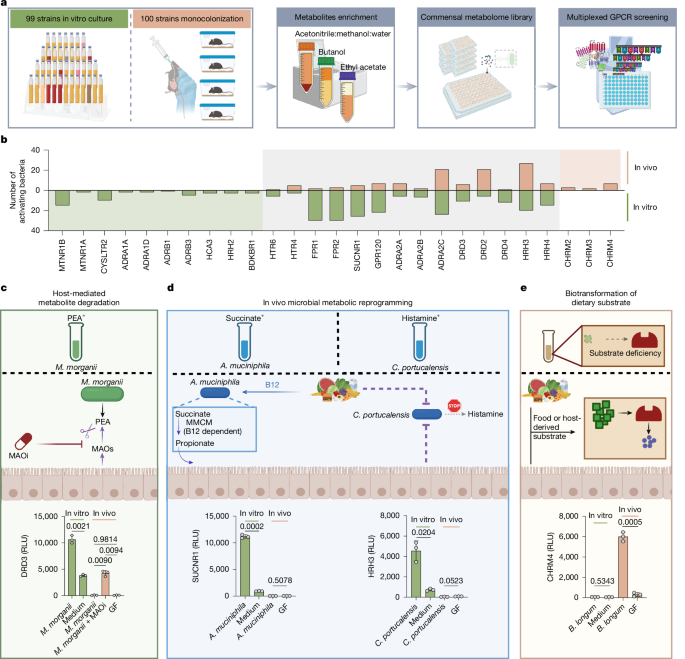
Bacterial growth and generation of in vitro bacterial metabolite libraries
Based on phylogenetic diversity, 100 bacterial strains were picked from the HMP bacterial culture collection and our laboratory’s internal human gut bacterial culture collections (Supplementary Table 1). Anaerobic bacteria were cultured in a vinyl anaerobic chamber (Coy Laboratory Products), containing 4% H2, 10% CO2 and 86% N2. Aerobic bacteria were cultured in an aerobic microbiological incubator. All bacteria were cultured in triplicate at 37 °C for 48 h. To extract bacterial metabolites with an acetonitrile-methanol-water (2:2:1) mixture (ACN-MeOH-water), the bacterial cultures were dried overnight at room temperature under vacuum (GeneVac). Then, the dried matter was resuspended in ACN-MeOH-water with intermittent sonication. The suspensions were centrifuged at 4,000g for 10 min, and the supernatant was dried overnight at room temperature under a vacuum (GeneVac). The dried extracts were dissolved in sample buffer (PBS containing 10% DMSO, v/v). To extract bacterial metabolites with butanol or ethyl acetate, the bacterial cultures were mixed with two volumes of butanol or ethyl acetate and shaken vigorously for 10 min in a horizontal shaker at room temperature. The organic phase was collected and dried overnight at room temperature under a vacuum (GeneVac), and the dried extracts were dissolved in sample buffer. The three types of extracts comprise the bacterial in vitro metabolome libraries.
Mouse experiments
All animal protocols were approved by the Yale University Institutional Animal Care and Use Committee (IACUC Protocol 11513). Mice were on a dark–light cycle of 12 h–12 h with temperature (22 °C) and humidity (50%) controlled.
Gnotobiotic mice and generation of in vivo bacterial metabolite libraries
GF C57BL/6 mice were maintained in flexible film isolators (Class Biologically Clean) with all bedding, chow (Teklad, 2018S) and water autoclaved before import. All GF breeding isolators were regularly monitored for bacteria (culture-dependent and -independent techniques). For the monoassociation gnotobiotic experiment, male GF mice (aged 6 to 8 weeks) were transferred from the isolators to positive pressure ventilated microisolator cages (Tecniplast, ISO72P) and gavaged with 0.2 ml of bacterial culture. Bacterial inocula from all 100 strains were freshly prepared and aliquoted in 2 ml screw cap tubes (Sarstedt, 72.693.005). After 2 weeks of colonization, the caecal contents were collected after euthanization. To prepare the bacteria in vivo metabolome libraries, the caecal contents were resuspended using ACN-MeOH-water solvent. After vigorously shaking in the horizontal shaker at room temperature, the supernatant was collected after centrifuging at 4,000g for 10 min. The supernatant was divided equally into three parts. They were directly dried overnight at room temperature under a vacuum, and the dried extracts were resuspended in sample buffer. One of them was saved as ACN-MeOH-water extracted metabolomes. The other two parts were further extracted using either butanol or ethyl acetate, respectively, followed by drying and dissolving using the same method described for preparing the in vitro metabolome libraries. These three types of extracts comprise the bacteria in vivo metabolome libraries.
Chemical supplementation in mouse drinking water
To support B. breve WT (NWP289) and Δchat colonization and ACh production, mice in these experiments received drinking water supplemented with 1.5% (w/v) HMOs (LayerOrigin SuperHMO Prebiotic Mix) and 0.25% choline (Sigma-Aldrich, C1879). To enhance the potential impacts of commensal ACh, the AChEi rivastigmine (TCI America, R0093) was supplemented in the mouse drinking water (40 mg l−1). Atropine (Cayman Chemical, 12008) and mecamylamine (Cayman Chemical, 14602) were provided in the drinking water at 25 mg l−1. Water was replenished weekly.
Serum sample preparation
To prepare serum samples, blood was collected in serum tubes (SAI Infusion Technology, PMTS-SG-1.1). After centrifugation at 4,000g for 5 min, serum samples were collected and stored at −80 °C until use. To collect brain and liver samples, mice were perfused with 10 ml of ice-cold PBS after euthanization. The liver and brain samples were then collected, flash–frozen and stored at −80 °C until use.
SPF mouse experiments
Wild-type C57BL/6J male mice (aged 6 weeks) were ordered from Jackson Laboratory (000664) and housed in the mouse facility at Yale School of Medicine. To deplete the endogenous microbiota, mice were orally gavaged with an antibiotic cocktail twice on the same day with a 12 h interval. The antibiotic cocktail43 comprised 10 mg ml−1 ampicillin (Sigma-Aldrich, A6140), 10 mg ml−1 neomycin (Sigma-Aldrich, N1876), 10 mg ml−1 metronidazole (Sigma-Aldrich, M1547) and 5 mg ml−1 vancomycin (Gold Biotechnology, V-200-25).
Rag1
−/− mouse experiment
GF Rag1−/− male mice (aged 6–8 weeks old) were maintained under the same conditions as GF C57BL/6 mice described above and used for the indicated in vivo bacterial cultivation and IgA-binding experiments.
Sample size, randomization and blinding
No statistical methods were used to predetermine sample size. Sample sizes were estimated based on preliminary experiments. Sex- and age-matched mice were randomly assigned to experimental groups for all mouse experiments. Blinding was not used because the primary readouts in this study were based on objective measurements, including sequencing-based datasets, GPCR activity assays, metabolite quantification and flow cytometry, for which investigator awareness of group assignment was unlikely to influence data collection or analysis.
Multiplexed GPCRome bioactivity screening
The multiplexed GPCRome bioactivity screening experiment was performed using our recently developed GPCR screening technology, PRESTO-Salsa5. The PRESTO-Salsa reporter cell line was maintained in DMEM supplemented with 10% FBS (GeminiBio, 100-106), 1% penicillin–streptomycin (Gibco, 15140122) and 2 µg ml−1 puromycin (Sigma-Aldrich, P8833). Cells were tested and confirmed free of mycoplasma. When the cell density reached approximately 90% confluency, the reporter cells were seeded into 96-well flat-bottom plates and grown to around 90% confluence.
For each plasmid pair, 100 ng of GPCR plasmid and 100 ng of PRESTO-Salsa reporter plasmid were mixed with 600 ng PEI Max (Polysciences, 24765) in DMEM. After 20 min of incubation at room temperature, the transfection mixtures were added to the cell culture. Then, 6 h after transfection, the cell medium was discarded. The wells containing unique pairs of GPCR/PRESTO-Salsa reporter plasmids were trypsinized, resuspended (using DMEM with 10% FBS and 1% penicillin–streptomycin), and pooled to form the PRESTO-Salsa reporter cell library.
The cell library was then seeded back to new 96-well flat bottom poly-d-lysine-coated (Thermo Fisher Scientific, A3890401) plates and allowed to grow for 12 h. The medium was replaced with 180 μl of DMEM with 1% penicillin–streptomycin and 20 mM HEPES (AmericanBio, AB06021). Then, 2 h later, 20 μl of each in vitro and in vivo bacterial metabolome samples were added to the wells in triplicate, followed by 9 h of stimulation.
The total RNA was extracted using the Qiagen RNeasy 96 kit (Qiagen, 74181) according to the manufacturer’s instructions, and RNA concentration was quantified using a NanoDrop 8000 spectrophotometer. 1 µg of RNA from each well was used for cDNA synthesis with the iScript cDNA Synthesis Kit (Bio-Rad, 1708891) according to the manufacturer’s instructions. Next, 1 µl of the cDNA product from each well was used as a template for generating the amplicons by a standard 2-step PCR protocol. The second-round PCR products were pooled and purified by cutting the 264 bp band on an agarose gel, followed by purification using the QIAquick Gel Extraction Kit (Qiagen, 28704) to form the PRESTO-Salsa screening amplicon library. The library was then sequenced on the Illumina NovaSeq 6000 system.
Multiplexed GPCR screening data analysis
The sequencing data were preprocessed to generate the GPCR read counts for each sample based on the method described previously5. A metadata file associating plate-well identifiers previously designated in the sequencing sample sheet with sample names and assigned plate-specific controls was also generated. GPCR read count table and metadata file were input into DESeq2 (v.1.42.1)44. GPCRs with less than 100 reads were filtered out. log2[FC] values adjusted for effect-size shrinkage values for each GPCR-ligand combination were calculated using apeglm (v.1.26.0)45; adjusted P values were calculated using the Benjamini–Hochberg method, with a significance cut-off of 0.05. Hit calling was based on the threshold of adjusted log2[FC] of more than 0.8 and an adjusted P value of less than 0.05. If a given receptor–sample interaction had a hit in at least one of the three types of extracted metabolomes (ACN-MeOH-water, butanol, ethyl acetate), the interaction was considered to be positive. The screening quality was monitored using the positive-control wells on each plate. To facilitate exploration of the screening dataset, the GPCR screening results have been made publicly available through an interactive Shiny app.
PRESTO-Tango assay
PRESTO-Tango assay was performed as previously described4. In brief, the HTLA cell line, the PRESTO-Tango reporter cell line that stably expresses β-arrestin/TEV and tTA-luciferase (a gift from G. Barnea), was maintained in DMEM supplemented with 10% FBS, 1% penicillin–streptomycin, 100 µg ml−1 hygromycin B (Invitrogen, 10687010) and 2 µg ml−1 puromycin. Cells were tested and confirmed free of mycoplasma. When cell density reached approximately 90% confluency, 200 ng of GPCR plasmid was transfected into HTLA cells with PEI Max. Then, 20 h after transfection, the medium was replaced with DMEM supplemented with 1% penicillin–streptomycin and 20 mM HEPES, and the cells were stimulated with 20 µl of each sample. Next, 20 h after stimulation, the cell supernatant was discarded, and 50 µl of Bright-Glo luciferase substrate solution (Promega, E2620) was added to each well. After 15 min of incubation at room temperature, luminescence was measured using a SpectraMax i3x with SoftMax Pro 6.5 and SoftMax Pro 7 (Molecular Devices).
Bacterial metabolite quantification
Chemical quantification of neurotransmitters
Serum samples were thawed and mixed by pipetting. Then, 20 µl of serum was mixed with 20 µl of methanol and centrifuged at 18,000g for 10 min. Next, 10 µl of the resulting supernatant was subjected to analysis using high-performance liquid chromatography coupled with quadrupole time-of-flight mass spectrometry (MS) (HPLC–QTOF). Caecal content and brain samples were resuspended in ACN-MeOH-water solvent, with occasional sonication and heating (65 °C). The samples were centrifuged at 18,000g for 10 min, and 10 μl of supernatant was subjected to HPLC–QTOF analysis. In vitro samples were dried overnight under vacuum (GeneVac) and resuspended in ACN-MeOH-water with sonication. The samples were centrifuged at 18,000g for 10 min and 10 μl of supernatant was subjected to HPLC–QTOF analysis. For all samples, standard curves for each neurotransmitter (tyramine, PEA, histamine and ACh) were generated in tandem to quantify their concentrations in biological samples.
Chemical quantification of organic acids
Liver and caecal samples were resuspended in ACN-MeOH-water with occasional sonication and heating (65 °C). The samples were centrifuged at 18,000g for 10 min, 30 µl of the resulting supernatant was mixed with 15 µl of 3-nitrophenylhydrazine (dissolved in 50% aqueous acetonitrile) and 15 µl of 1-ethyl-3-(3-dimethylaminopropyl)carbodiimide (dissolved in 50% aqueous acetonitrile + 6% pyridine). The solutions were incubated at 42 °C for 30 min and subsequently diluted with 150 µl of 10% aqueous acetonitrile. The samples were centrifuged again at 18,000g for 10 min and 10 µl of the supernatant was subjected to HPLC–QTOF analysis. Serum samples were thawed and mixed by pipetting, and 30 µl of the sample was functionalized with 3-nitrophenylhydrazine and subjected to HPLC–QTOF analysis as described above. For all samples, standard curves for each short-chain fatty acid (propionate and succinate) were generated in tandem to quantify their concentrations in biological samples. These standards were subjected to the same 3-nitrophenylhydrazine functionalization protocol as the samples.
HPLC–QTOF analysis
High-resolution electrospray ionization MS (HRMS) was performed on an Agilent iFunnel 6550 quadrupole time-of-flight (QTOF) MS instrument coupled to an Agilent 1290 Infinity HPLC system equipped with a Phenomenex Kinetex C18 (100 Å) 5 µm (250 × 4.6 mm) column. Data were acquired using MassHunter Workstation Data Acquisition v.B.05.01 (Agilent). Chromatography was conducted using a linear water–ACN gradient containing 0.1% formic acid at a flow rate of 0.7 ml min−1 over 25 min for the aromatic neurotransmitters, or 30 min for the derivatized short-chain fatty acids. For the aromatic neurotransmitters, the gradient proceeded from 5% ACN to 50% ACN, followed by a 5 min wash with 100% ACN. For the derivatized short-chain fatty acids, the gradient proceeded from 10% ACN to 100% ACN, followed by a 5-min 100% ACN wash. Mass spectra were recorded in positive ionization mode with a mass range of 100 m/z to 1,700 m/z. To measure the concentrations of specific compounds in biological samples, extracted ion chromatograms (EICs) were constructed with a 10 ppm error limit of the exact monoprotonated [M+H]+ masses of compounds to be quantified. The peaks in the EICs were integrated using the MassHunter Qualitative Analysis v.B.06.00. Peak areas were compared to standard curves generated with commercially available standards to determine concentration. Standard curves were run in the same worklist as the corresponding samples. The metabolomics data generated in this study have been deposited in the NIH Common Fund’s National Metabolomics Data Repository, the Metabolomics Workbench46.
Bacterial whole-genome sequencing and annotation
Whole-genome sequencing
Single bacterial colonies were picked from agar plates and grown in broth overnight. The bacterial genomic DNA was isolated using the DNeasy UltraClean Microbial Kit (Qiagen, 12224-250) according to the manufacturer’s instructions. Sequencing libraries were prepared using the Illumina Nextera XT library preparation kit (Illumina, FC-131-1024) and barcoded using the Nextera XT Index Kit V2 (Illumina, FC−131-2001). The libraries were sequenced with NovaSeq 6000 at a coverage of 150×.
De novo genome assembly
Genome assembly and annotation were performed as previously described47. All Illumina paired-end reads were filtered and trimmed using Trimmomatic v.0.38 with the following parameters: ILLUMINACLIP: NexteraPE-PE.fa:2:30:12:1:true LEADING:3 TRAILING:3 MAXINFO:40:0.994 MINLEN:36 (ref. 48). The output files after trimming included two (forward and reverse) FASTQ files with paired reads and two FASTQ files with unpaired reads. All four files from each strain were assembled into contigs using SPAdes (v.3.13.0)49 with the default parameters for paired-end libraries. Genome coverage was calculated using BBMap (v.39.06; https://sourceforge.net/projects/bbmap/).
Genome annotation
For each genome assembly, scaffolds longer than 2,000 bp were uploaded to the RAST server (v.2.0)19 for annotation (using the default RASTtk pipeline).
Protein expression and purification
Recombinant putative acetyltransferases were purified using methods previously described50. In brief, the putative acetyltransferases were cloned into an N-terminal 6×His-SUMO2-tagged pET vector and transformed into BL21-RIL E. coli (Agilent Technologies, 230245). Large-scale cultures were grown for approximately 5 h at 37 °C, then induced with IPTG overnight at 16 °C. Bacterial pellets were resuspended and sonicated in lysis buffer (20 mM HEPES-KOH pH 7.5, 400 mM NaCl, 30 mM imidazole, 10% glycerol and 1 mM dithiothreitol) and purified using Ni-NTA resin (Qiagen, 30230). Ni-NTA resin was washed with lysis buffer supplemented to 1 M NaCl and eluted with lysis buffer supplemented to 300 mM imidazole. The eluted proteins were concentrated using a 3 kDa cut-off concentrator (Millipore, UFC500324). Protein gels were imaged on an Azure c200 imaging system using Azure c200 imaging software (Azure Biosystems). Samples were then flash-frozen in liquid nitrogen and stored at −80 °C.
Acetyltransferase in vitro assay
The acetyltransferase in vitro assay was performed as previously described51. The reaction mixtures containing 50 mM potassium phosphate (pH 7.4), 1 mM EDTA, 20 mM choline chloride, 250 mM sodium chloride, 0.1 mM acetyl-CoA and 2 μg of recombinant putative acetyltransferase protein were incubated for 15 min at 37 °C. The reaction was terminated by immediate incubation on ice and followed by separation with a 3-kDa cutoff concentrator (Millipore, UFC500324) to remove the proteins at 4 °C. Acetyltransferase activity was evaluated by measuring CHRM4 activation and ACh concentration.
Bioinformatic analyses of hexapeptide repeat proteins
Structure models were created using AlphaFold2 (v.2.3.0)52, with multimeric states chosen manually based on homology. Models were compared to the PDB and Z scores were calculated using DALI53 (accessed in 2024). The sequences of proteins in the hexapeptide repeat family (G3DSA:2.160.10.10) with experimentally determined structures were accessed from the PDB. Sequence alignments were generated and a phylogenetic tree were constructed using MAFFT (v.7)54 after manually removing eukaryotic sequences, then visualized with iTOL (v.7)55.
Construction of B. breve ChAT disruption strain
Generation of plasmid pFREM28-Bb_chat as a non-replicative vector for creating B. breve
chat gene insertion mutant
The pFREM28-Bb_chat non-replicative plasmid was constructed in the pFREM28 vector backbone using standard cloning techniques56. In brief, an internal 400 bp fragment of the Bbchat gene was amplified from B. breve NWP289 genomic DNA using primer pair (Bb_chat+138_EcoRI_fwd: TAGGCCGAATTCTCTCCAGCTTGAACTCAACG; Bb_chat_-536_HindIII_rev: TAGGCCAAGCTTACCAGCGAGTTGGCGCCAAT). The amplified product was cloned into the pFREM28 vector at the EcoRI and HindIII restriction sites using sticky-end cloning. The construct was transformed and propagated in E. coli EC1000 by electroporation and grown on LB plates with kanamycin and erythromycin. The plasmid was isolated from 100 ml culture using ZymoPURE II Plasmid Midiprep Kit (Zymo, D4201) and concentrated using Amicon 30 kDa Ultra Centrifugal Filter (Sigma-Aldrich, UFC503024).
Generation of B. breve
chat gene insertion mutant
The Bbchat gene insertion mutant was created using the non-replicative pFREM28-Bb_chat plasmid using the method described previously57 with minor modifications. B. breve NWP289 cells were made electrocompetent. A single colony of B. breve NWP289 was grown in 10 ml RCM supplemented with 0.05% cystine and 1% lactose, anaerobically at 37 °C for 18–20 h. The overnight culture was diluted 1:50 in fresh 10 ml RCM supplemented with 0.05% cystine and 1% lactose for about 16–18 h. Then the culture was diluted in 50 ml MRS supplemented with 0.05% cystine and 1% lactose to adjust the starting optical density (OD) to around 0.3. The cells were grown to a final OD600 of 0.8–0.9. The cells were chilled on ice for 20 min and washed three times with the chilled electroporation buffer (sucrose-citrate buffer; 0.5 M sucrose and 1 mM ammonium citrate, pH 5.8). Then, 50 μl of the electrocompetent cells was transformed by electroporation with 6–7 µg of pFREM28-Bb_chat plasmid DNA and recovered overnight in RCM broth at 37 °C. The recovered cells were plated on Gifu agar supplemented with 5 µg ml−1 erythromycin. All of the steps were carried out in an anaerobic chamber (except electroporation) with pre-reduced materials. Plasmid insertion was confirmed by PCR amplification and sequencing using primer pairs (Bb_chat_+38_SphI-fwd: TAGGCCGCATGCATGATGCGACGCGCGAGAAA; Bb_chat_-623_KpnI-rev: TAGGCCGGTACCTAGTAGACGTCGTCGCGTTC).
Bacterial RNA-seq
In vitro culture total RNA isolation
C. portucalensis overnight culture was inoculated 1:100 into fresh medium, cells were collected when the density reached OD600 = 0.32. 3 ml of bacteria culture was mixed with 6 ml of RNA protect reagent (Qiagen, 76506) and incubated at room temperature for 5 min. Then the bacterial cells were digested with 120 µl of digestion buffer (40 µl TE buffer, 60 µl of 50 mg ml−1 lysozyme, 20 µl of 20 mg ml−1 proteinase K) for 15 min at room temperature. 700 µl of buffer RLT (containing 1% of β-mercaptoethanol) was then added, and bead-beaten with lysing matrix B beads for 10 min. After centrifugation at 13,000g for 10 s, the supernatant was then transferred into a new tube and an equal volume of 70% ethanol was added. Then total RNA was isolated using RNeasy mini kit (Qiagen, 74106) following the instructions.
Monocolonized bacterial total RNA isolation
Caecal contents from mice that had been monocolonized with C. portucalensis NWP28 for 2 weeks were collected and resuspended in 5 ml PBS. After centrifuging at 50g for 5 min, 3 ml of the top fraction (containing the bacterial cells) was collected and mixed with 6 ml of RNA protect reagent. The samples were then processed using the same protocol as described for the in vitro cultured bacteria.
Library preparation
Ribosomal RNA was depleted from total RNA, followed by ethanol precipitation and fragmentation. First-strand cDNA was synthesized using random hexamer primers, and second-strand cDNA synthesis was performed using dUTPs to allow strand specificity. The libraries were then prepared through end repair, A-tailing, adapter ligation, size selection, PCR amplification and purification. Library quality and concentration were assessed using Qubit fluorometry, quantitative PCR and the Agilent Bioanalyzer. Sequencing was performed on the Illumina NovaSeq X Plus platform.
Data analysis
Trimmed reads were generated using Cutadapt (v.5.0)58 with adapter removal and quality trimming. Trimmed reads were aligned to the C. portucalensis NWP28 reference genome using BWA-MEM (v.0.7.17-r1188)59. The resulting BAM files were sorted and indexed with SAMtools (v.1.21)60. Gene-level read counts were obtained using featureCounts (v.2.0.3)61 with the GFF genome annotation. Differential gene expression analysis was performed in R using DESeq2 (v.1.42.1)44, comparing in vivo and in vitro conditions. Functional enrichment analysis of differentially expressed genes was performed with fgsea (v.1.28.0)62 using KEGG-orthology-based gene sets.
Whole-gut transit time
The whole-gut transit time experiment was performed as described before with minor modifications63. Mice were gavaged with 150 µl of 6% carmine solution, and the time of gavage was recorded. Immediately after gavage, mice were single-housed in microisolator cages placed on an IsoRack. The cages were monitored for the appearance of the first red faecal pellet without disturbing the animals. Whole-gut transit time was calculated as the time interval between the gavage and the first observed red faecal pellet. To assess impacts of CHRM3 antagonist on gut motility, 1 mg per kg 4-DAMP (Cayman Chemical, 14574) was administered by intraperitoneal injection 1 h before carmine gavage.
Faecal water content
Four to five faecal pellets were collected into tubes and were dried in the oven at 80 °C overnight. The faecal water content was calculated according to the equation: (fresh faeces weight − dried faeces weight)/fresh faeces weight × 100%.
LP immune cell isolation
After euthanization, the ileal and colon tissues were collected, and the Peyer’s patches and the remaining mesentery/fat were excised. Tissues were kept in cold DMEM on ice until all tissues were collected. The gut tissues were opened longitudinally with a ball-tipped scissors and rinsed sequentially in three beakers containing ice-cold PBS. The tissue was cut into 1 cm pieces into 50 ml conical tubes containing 10 ml of PBS (without Ca2+ and Mg2+), 1 mM dithiothreitol and 30 mM EDTA. Tubes were shaken at 37 °C, 250 rpm for 10 min, and the tubes were placed almost horizontally. The tissues were drained with a tissue strainer and washed with 10 ml of PBS on the strainer. The tissues were then transferred into a new 50 ml conical tube containing 10 ml of PBS and shaken at 37 °C, 250 rpm for 10 min. Tissues were drained on a tissue strainer and rinsed with 10 ml of PBS. Tissues were transferred into six-well plates and minced before adding digestion enzyme buffer (2 ml of DMEM supplemented with 10 mM HEPES, 2% FBS, 2 mg ml−1 type IV collagenase (Gibco, 17104019), 0.5 mg ml−1 DNase I (Sigma-Aldrich, 10104159001)). Tissues were digested at 37 °C, 120 rpm for 30 min, followed by vigorous pipette mixing. The digestion was terminated by adding 5 ml of DMEM with 2% FBS. The digested suspensions were passed through a nylon mesh (100 μm pore size). Cells were pelleted and applied to 80% and 40% Percoll gradient to separate immune cells by centrifugation at 500g, room temperature for 20 min (without brake). Immune cells at the middle layer were collected for either bulk RNA-seq or flow cytometry analysis.
LP immune cell scRNA-seq
Library preparation and sequencing
Immune cells at the middle layer were collected and sorted for live CD45+ cells. Cell densities were adjusted to 1000 cells per μl and submitted for single-cell library construction using Chromium Next GEM Single Cell 5’ Reagent Kits v2 (10x Genomics, PN-1000263). The single cell libraries were sequenced with Illumina NovaSeq X Plus platform.
scRNA-seq data analysis
The sequencing data were processed with Cell Ranger (10x Genomics Cloud Analysis) to generate a merged digital expression matrix using Cell Ranger (v.7.2.0) aggregation.
Cell clustering and annotation
The merged digital expression matrix from Cell Ranger was further analysed using Seurat (v.5.1.0) following the instructions64. In brief, cells were filtered to have more than 200 features and less than 5% mitochondrial transcripts. Variable features were then identified using the FindVariableFeatures function. The ScaleData function was used to regress out the sequencing depth for each cell. The identified variable features were used in principal component analysis (PCA) to reduce the data dimension. Then, 20 principal components were used in the UMAP analysis to further reduce the dimension to 2. The cells were then grouped into different cell clusters with a resolution of 0.5 using the function of FindClusters. Cluster marker genes were then found for each cluster using the FindAllMarkers function. Cell types were manually annotated based on the cluster marker genes. The proportion of each cell type was calculated by dividing the number of cells in each cluster by the total number of cells in the corresponding sample. UMAP plots were generated with monocle3 (v.1.3.1).
Pseudobulk expression analysis
Cells were grouped by cell type and colonization group (colonization condition) to create pseudobulk profiles using the AggregateExpression function in Seurat. Raw count data was extracted from the pseudobulk Seurat object using the GetAssayData function. A DESeq2 dataset was created using DESeqDataSetFromMatrix. DESeq2 was used to normalize the data and perform differential expression analysis. Differential expression results were obtained by comparing groups (WT versus Δchat B. breve). Differentially expressed genes were visualized using volcano plots.
LP immune cell RNA-seq
RNA isolation
Immune cells isolated from the gut LP were lysed with buffer RLT (Qiagen, 79216) containing 1% β-mercaptoethanol, and the total RNA was isolated using the RNeasy Mini kit (Qiagen, 74106) following the instructions. RNA quality was assessed using the NanoPhotometer spectrophotometer for RNA purity and using the RNA Nano 6000 Assay Kit of the Bioanalyzer 2100 system.
Library preparation
mRNA was purified from total RNA using poly(T) oligo-attached magnetic beads and subsequently fragmented. First-strand cDNA was synthesized using random hexamer primers, followed by second-strand synthesis incorporating dTTP. The resulting double-stranded cDNA was processed through end repair, A-tailing, adapter ligation, size-selection, PCR amplification and purification. Library quality and concentration were evaluated using Qubit fluorometry and real-time PCR, and fragment size distribution was analysed on a Bioanalyzer 2100 system. Libraries were then pooled and sequenced on the Illumina NovaSeq X Plus platform.
Data analysis
Trimmed reads were generated using Cutadapt (v.5.0)58 with adapter removal and quality trimming. Trimmed reads were quantified at the transcript level using Salmon (v.1.4.0)65 with germinal centre (GC) and sequence bias correction enabled, using the Mus musculus reference transcriptome (GRCm39, Ensembl). Transcript abundances were summarized to the gene level using the tximport package (v.1.30.0)66 in R. Differential gene expression analysis was performed with DESeq2 (v.1.42.1)44. GSEA was conducted with clusterProfiler (v.4.10.1)67 using GSEA on a ranked list of genes.
Flow cytometry
LP immune cell flow cytometry
LP immune cells were prepared as described above. Cells were stained sequentially with Near-IR live/dead (Invitrogen, L34976, 1:1,000) for 10 min, Fc blocker (BioLegend, 156604, 1:100) and antibodies against CD45 (BioLegend, 103149, 1:200), B220 (BioLegend, 103243, 1:200), CD19 (BioLegend, 115534, 1:200), TACI (BioLegend, 133403, 1:200) and CD138 (BioLegend, 142507, 1:200) for 20 min. Then cells were permeabilized with Cytofix/Cytoperm Fixation and Permeabilization solution (BD, 554722) and stained intracellularly for IgA (Thermo Fisher Scientific, 17-4204-82, 1:200) and IgM (eBioscience, 11-5790-81, 1:200) for 2 h. Stained cells were analysed using CytoFLEX (Beckman Coulter). Data were acquired using CytExpert v.2.1 and analysed using FlowJo software (v.10.9.0). Intracellular staining of IgA to distinguish IgA plasma cells was based on direct comparison between intracellular versus surface IgA staining, where intracellular staining revealed modest but significantly higher proportions of IgA+ cells (Supplementary Fig. 6).
Bacterial flow cytometry
Bacterial cells recovered from faecal samples were blocked with 1% BSA and stained for IgA (Thermo Fisher Scientific, 17-4204-82) for 20 min. Cells were then resuspended with SYTO9 green fluorescent nucleic acid stain (Thermo Fisher Scientific, S34854) and analysed using CytoFLEX (Beckman Coulter). Bacterial cells recovered from in vitro cultures or from Rag1−/− mouse faeces were stained with supernatant (containing free IgA) from faecal suspension before blocking. Data were analysed using FlowJo (v.10.9.0).
IgA ELISA
Mouse faecal pellets were weighed and homogenized in 1 ml of PBS with lysing matrix D (MP, 116913050-CF) for 15 s in BeadBeater (Biospec). The mixtures were sonicated for 30 s and thoroughly vortexed. Faecal water samples were collected after centrifuging at 10,000g for 5 min.
Immuno MaxiSorp Plate (Thermo Fisher Scientific, 439454) were coated for 30 min at 37 °C with 50 μl anti-mouse IgA capture antibody (Abcam, ab97231). After washing with TBS-T (20 mM Tris, 150 mM NaCl, 0.1% Tween-20, pH 7.4), the plates were blocked with 150 μl of 3% BSA (in PBS) for 2 h at room temperature. After washing with TBS-T, 50 μl of mouse IgA standards (BD Biosciences, 553476) or samples were added to the plates and incubated for 2 h at room temperature. After washing with TBS-T, plates were labelled with 50 μl of HRP-conjugated goat anti-mouse IgA (Sigma-Aldrich, A4789) for 30 min at room temperature. Plates were then washed with TBS-T and developed with 100 μl of TMB substrate (Thermo Fisher Scientific, 34022) for 10 min at room temperature. Development was stopped with 100 μl of 2 N H2SO4 (Avantor, H381-05), and the plates were read at 450 nm using a SpectraMax i3x.
LCN2 ELISA
LCN2 ELISA was performed using the Mouse Lipocalin-2 DuoSet ELISA kit (R&D Systems, DY1857) according to the manufacture’s instructions. Mouse faecal samples were processed using the same method described for IgA ELISA.
The Immuno MaxiSorp Plates (Thermo Fisher Scientific, 439454) were coated with 4 µg ml−1 of capture antibody at room temperature for 2 h. After washing with TBS-T (20 mM Tris, 150 mM NaCl, 0.1% Tween-20, pH 7.4), the plates were blocked with 150 μl of 1% BSA (in PBS) for 1 h at room temperature. After washing with TBS-T, 100 µl of diluted samples and standards were added to plates and incubated at room temperature for 2 h. After washing with TBS-T, 100 µl of 50 ng ml−1 detection antibody was added to each well and incubated at room temperature for 2 h. After washing with TBS-T, the plates were labelled with 100 µl of Streptavidin-HRP for 20 min at room temperature. After washing with TBS-T, the plates were developed with 100 µl of TMB substrate at room temperature for 10 min. The development was stopped with 50 µl of 2 N H2SO4 (Avantor, H381-05) and read at 450 nm using the SpectraMax i3x system.
Bacterial 16S rRNA-seq
Bacterial genomic DNA was extracted using MagAttract PowerSoil DNA EP kit (Qiagen, 27100-4-EP). The 16S rRNA V4 region was amplified from the genomic DNA using dual index multiplexing strategy as described previously68. Libraries were quantified using KAPA Library Quantification Kit (Roche Diagnostics, KK4835), and sequenced on an Illumina MiSeq platform using a MiSeq Reagent Kit v2 (500 cycles) (Illumina, MS-102-2003). Sequencing data were collected through MiSeq System Suite v.4.1.0, and processed using QIIME 2 (v.2024.2).
S. Tm ΔssaV infection
S. Tm ΔssaV (a gift from J. Galán laboratory)32 was streaked on LB agar plate supplemented with 50 µg ml−1 streptomycin and cultured at 37 °C overnight. A colony was picked and grown in LB broth for 6 h at 37 °C with shaking at 220 rpm. We next adjusted the bacteria density to 106 colony-forming units (CFU) per ml, and gavaged each mouse with 200 µl (equivalent to 2 × 10⁵ CFU each mouse). For enumerating faecal S. Tm ΔssaV CFUs, faeces were weighed, homogenized by bead beating, serially diluted in sterile PBS and plated on LB agar plates supplemented with 50 µg ml−1 streptomycin. Plates were incubated for 12 h at 37 °C before enumeration.
Statistical analysis
All statistical analyses were performed using GraphPad Prism (v.10.1.1) or R (v.4.3.0). PRESTO-Salsa screening data, mouse LP immune cell bulk RNA-seq data, bacterial RNA-seq data and pseudobulk differential expression analysis of scRNA-seq data were analysed using DESeq2 (v.1.42.1) in R. scRNA-seq data were processed using Seurat (v.5.1.0) and Monocle3 in R. For comparisons between two groups, unpaired two-sided t-tests or Welch’s t-tests were used as appropriate. For comparisons among more than two groups, one-way ANOVA followed by Tukey’s post hoc test, Welch’s ANOVA followed by Games–Howell post hoc test or Kruskal–Wallis test followed by Dunn’s multiple-comparison test was used as appropriate. For selected nonparametric comparisons, two-sided Wilcoxon rank-sum tests were used. For repeated-measures experiments, a two-sided mixed-effects model followed by Šidák’s multiple-comparison test was used. For DESeq2 analyses, statistical significance was assessed using two-sided Wald tests with Benjamini–Hochberg correction for multiple comparisons. The statistical test used for each experiment is indicated in the corresponding figure legend and source data.
Reporting summary
Further information on research design is available in the Nature Portfolio Reporting Summary linked to this article.

