


Data
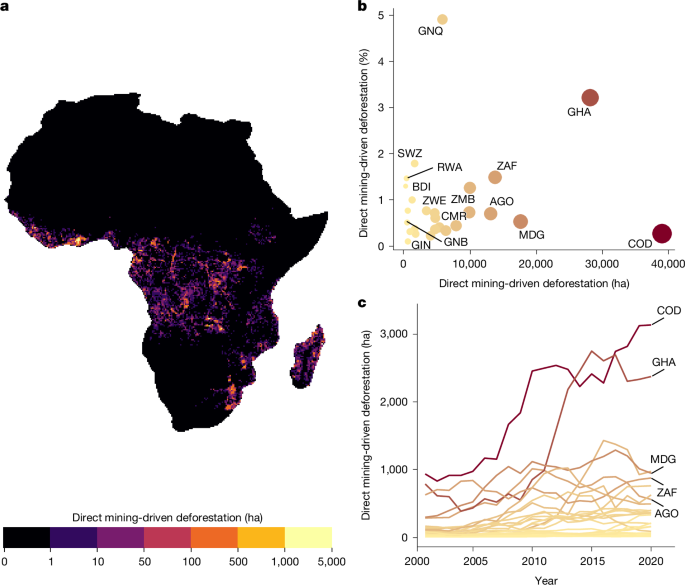
To map and analyse the spatial extent of direct mining-induced deforestation of dense forest across sub-Saharan Africa, we used previously published data23 that map post-deforestation land use across sub-Saharan Africa between 2001 and 2020 at a resolution of 30 m. The dataset first used the global forest change data24 to identify areas of forest loss between 2001 and 2020, before combining an active learning framework with high-resolution (5 m) Planet–Norway’s International Climate and Forests Initiative data to train a deep-learning model that predicts post-deforestation land use. Post-deforestation land use is assigned to one of 15 different classes by the model, one of which is mining. Mining is defined as land used for extractive subsurface and surface mining activities (such as underground and strip mines, quarries and gravel pits), including all associated surface infrastructure as described previously23. Mining as a post-deforestation land use is mapped with high accuracy, with a 98% user’s accuracy and an 82% producer’s accuracy (see ref. 23 for original accuracy metrics). We used all instances of mining mapped previously23 to represent areas of mining activity in this analysis.
The mining data are presented at a resolution of 30 m pixels, with pixels representing either direct mining-induced deforestation or not. It was thus important to group proximate mining pixels together to create distinct ‘clusters’ of mining activity for use in the analysis. We therefore used distance-based density clustering to group together all nearby mining pixels into one cohesive mining cluster. Clustering was performed to group together all pixels within 1 km of another mining pixel, with a minimum of 5 pixels required to form a cluster. Notably, this clustering method does not require any predefined shape or size of clusters, allowing clusters to be created that can accurately reflect the staggered growth of mining activities, which can often spread across long distances and follow particular directions (for example, the growth of mining activities along a riverbank). After performing the clustering process, 67,586 distinct mining clusters remained across sub-Saharan Africa. However, because we were interested in mining-induced deforestation, we then filtered these mining clusters to retain only clusters that were located in densely forested regions, which we defined as having more than one-third dense forest cover (defined as pixels with ≥50% tree cover) in a 5 km buffer from the mine cluster at the start of the analysis period in 2000. We did not consider areas to be forest if they were classified as plantations by the latest version (v.2) of the Spatial Database of Planted Trees (SDPT)54. This final filtering step left 16,627 mining clusters in forested areas for analysis.
Deforestation measures around mines
We define three different forms of deforestation associated with mining activity in and around our mining clusters.
First, direct deforestation defined as annual deforestation caused directly by the mine in the mining cluster footprint (such as, pits and tailing ponds). This includes all pixels with ≥50% tree cover in 2000 that became deforested between 2001 and 2020 with the end use classified as mining 23.
Second, offsite deforestation defined as annual deforestation through any other processes (such as, road construction, and agricultural and/or urban expansion), outside the mining footprint that may be triggered by mine establishment. This represented all pixels that with ≥50% tree cover in 2000 that became deforested between 2001 and 2020 as described previously24 (v1.11) and that were not classified as mining23 and were not identified as plantations in the SDPT v.2 data54.
Third, total deforestation defined as the annual sum of both the direct and offsite deforestation.
DID framework
To estimate the additional total deforestation triggered by mine establishment, we used recent advances in heterogeneity-robust DID models. To assess mining-induced deforestation across spatial scales, we created four concentric ring buffers of increasing size (0–1 km, 1–5 km, 5–10 km and 10–20 km) around the centre of each mine (Extended Data Fig. 1). We defined our response variable as the total (sum of offsite and direct) deforestation around clusters in each buffer per year between 2001 and 2020. We calculated the total annual deforestation in each buffer as a proportion of the total forested area (≥50% tree cover) present in 2000.
We leveraged the staggered nature with which mining operations commenced in a DID quasi-experimental design that incorporated not-yet-treated mining sites as controls. Mining clusters are classed as treated from the year 10% of pixels in that cluster are deforested owing to mining in the mining cluster. The preceding not-yet-treated period corresponds to the period before mining commences in a cluster. See the section ‘Sensitivity analyses’ for analyses of alternative cut-offs for defining the start of mining operations. Mining clusters that were always treated (those with mines present in the first year) or only treated in the last year could not be included. Therefore, 15,477 clusters could be used in total for estimation. An alternative paradigm to using not-yet-treated mines would be to use statistical matching to balance covariates that drive variation in either the outcome or assignment between mining clusters and comparable never-treated sites. However, it is possible that even post-matching, never-treated sites may differ systematically from treated sites in both treatment assignment and outcomes in a manner not likely captured by matching variables (such as the presence of appropriate minerals and the type of sediment or rock).
We used a recently proposed group–time average treatment effect DID estimator25 that is robust to heterogeneous treatment effects and staggered study designs. This estimator identifies the group–time-specific average treatment effect on the treated (ATT(g, t) as defined in equation 1), where the group is the year mining clusters are first treated (g, mining first detected) and observed in calendar year (t). Thus, for mining first detected in year g and observed in the year t, the estimate is the difference in Y (cumulative deforestation as a proportion of forest cover in 2000) years g – 1 and t across mines that commence in year g, minus the same difference for mining clusters in which mining is detected in later years but not in year t (termed the not-yet-treated clusters and defined by G the time period a unit becomes treated and the binary indicator Dt).
$$\rmA\rmT\rmT(g,t)=\mathbbE[Y_t-Y_g-1|G=g]-\mathbbE[Y_t-Y_g-1|D_t=0,G\ne g]$$
(1)
These group–time specific ATTs do not enforce homogenous treatment effects across all time periods or groups (first year of mining detection). Group–time ATTs were then aggregated into dynamic treatment effects relative to the year mining was detected. Standard errors were clustered at the mine cluster level.
We applied this approach at the national level for all countries in sub-Saharan Africa with 30 or more identified mining clusters. We included a total of 23 sub-Saharan countries with sufficient coverage; 6 countries with insufficient numbers of clusters were dropped from the national analyses (South Sudan, n = 4; Rwanda, n = 9; Malawi, n = 4; Comoros, n = 24; Burundi, n = 15; and Eswatini, n = 6). The number of clusters per country included in the models ranged from 32 (Guinea-Bissau) to 5,069 (the DRC). For each country, we applied the group–time-specific estimator on total deforestation in concentric buffer rings of 0–1 km, 1–5 km, 5–10 km and 10–20 km around each mining cluster to estimate the total additional deforestation attributable to the average mining cluster per country. We also estimated an effect across sub-Saharan Africa using all clusters from all countries with mining-driven forest loss detected (29 countries, 15,477 clusters). This estimate followed the same approach as laid out previously for country-level estimates, except we included country as an additional fixed effect. This was repeated for each of the four increasing concentric buffer rings.
We calculated pseudo-ATTs to assess the pre-treatment assumption of parallel trends. We did this for all national concentric ring buffers for a shift of 1–5 years. Across all buffers and time periods, there was strong evidence for parallel trends. Only 1–2 countries out of 23 showed evidence of non-parallel trends, and this was most common for the year before a mine was established in the 1 km buffer.
To assess the relative size of additional direct deforestation compared with additional offsite deforestation, we used the previously outlined DID framework to separately estimate the number of ha of additional direct and offsite deforestation triggered by mine establishment separately. We then post-processed these estimates to estimate the offsite deforestation for each ha of direct deforestation, defined as the additional offsite loss divided by the direct loss. We estimate this for a 0–5 km buffer around all mines at the national and sub-Saharan African scale. We only calculated ratios for countries where the effects of both the direct and offsite model were significant five years after mine establishment. In an additional analysis, we further disaggregated the non-mining deforestation data (indirect) to obtain annual time series specifically for deforestation driven by agriculture, settlements, and roads (as derived previously23) in the 0–5 km buffer (Supplementary Information). We then modelled this in the same dynamic DID framework as described above to elucidate the additional impact mine establishment specifically had on agricultural and settlement expansion and road development (Supplementary Figs. 9 and 10).
Commodity varying impacts
We used a new database that includes 42,799 mine properties and 217,200 polygons, covering a total area of 145,738.1 km² globally32. This database links commodity data from55 the S&P Global Mine and Metals database56 and data from the Global Coal Mine Tracker of the Global Energy Monitor57, to previously published mining land-use polygons33,58,59. We overlaid this database with our 16,627 mining clusters and assigned commodities to clusters in cases in which the cluster was within 5 km of a mining site with a known commodity. Many mines extract more than one commodity or mineral and it is impossible to estimate at a regional or national scale the relative quantities of each extracted mineral or the relative influence of each mineral on mine expansion and deforestation. Therefore, each cluster was assigned all of the commodities known to be extracted at that site. We also repeated the analysis using only the main commodity listed per mine and these results aligned closely with those presented in the main text (Supplementary Fig. 15). In total, 1,127 clusters could be linked to known commodities. We then ran DID analyses as described previously for each commodity linked to at least 30 mining clusters. Owing to the relatively low sample size per commodity, we did this at the aggregated sub-Saharan African scale, but not at the national scale.
Sensitivity analyses
We used a comprehensive suite of justifiable alternative approaches and alterations to our main approach that were decided a priori to commencing the main analyses to assess the robustness of our results to analytical choices. These are shown and discussed in detail in the Supplementary Information.
First, we repeated the national-level analysis and included covariates that may influence deforestation dynamics in the first stage of the DID estimator (Supplementary Fig. 2). The covariates included travel time from the nearest settlement with a population of more than 5,000 individuals60, population density61, elevation and slope62. The inclusion of covariates is often necessary to meet the parallel pre-trends assumption; however, we note our models without covariates already met this assumption (Supplementary Fig. 2).
Second, we repeated our whole analysis using an alternative, recently proposed two-stage imputation-based DID estimator31, which, similarly to our main text estimator, addresses biases that often hamper conventional estimators used to estimate DID (Supplementary Figs. 3–5). The first-stage model identifies cluster and year-specific fixed effects that would occur in the absence of any treatment from the not-yet-treated observations (such as the cluster- and time-specific effects on cumulative deforestation before the start of mining). Thus, the untreated outcome (cumulative deforestation), accounting for cluster and year fixed effects, can then be imputed and removed from the observed treated outcome. Additional covariates that are likely to affect trends in the cumulative outcome can also be incorporated in this first model (Supplementary Fig. 6). The second-stage model then regresses this residualized outcome on the time since mining operations started to estimate the dynamic ATT. Standard errors of the coefficients were clustered at the mine cluster level. For our data, this approach finds greater levels of deforestation than our main analysis group-time ATT approach and is more certain of these impacts in more countries. However, we note that, when checking the parallel trends assumption of this approach, we found that it failed this assumption for a number of countries and pre-treatment years, particularly in the 0–1 km and 1–5 km concentric buffers.
We also repeated our main analysis at the national and sub-Saharan African scale wide using a second alternative stacked DID trimmed aggregate ATT63. In brief, this modifies a standard stacked DID regression approach, which often fails to estimate a defined causal parameter because of improper weighting, to apply corrective weights when stacking to estimate a trimmed ATT focusing around a specific trimmed period before and after treatment. For our analysis, we created trimmed sub-experimental periods with a five-year pre-treatment and five-year post-treatment window. This method generates highly similar results to the approach described in the main text, but when checking the parallel trends assumption of this approach, we found that it performed inconsistently for our data (Supplementary Figs. 7 and 8).
Third, for the analysis described in the main text, we categorize the start of mining operations as when 10% of a mining cluster is deforested because of mining. This minimizes the risk that any single erroneously classified pixel substantially biases our analysis. However, we also reran our main analysis (Fig. 2) using two alternative criteria. The first was less conservative and assumes mining commences the year the very first pixel is lost from the cluster; and the second is more conservative and requires 20% of the cluster to be deforested by mining directly before mining operations are assumed to have commenced (Supplementary Figs. 16 and 17).
Fourth, although the gold standard for comprehensive analyses of mining impacts at scale is a highly accurate wall-to-wall geospatial map of mining sites that maximizes spatial coverage and minimizes omission errors, it is inevitable that, despite the high user accuracy of the data used here23, a small number of pixels may be misclassified as mining-driven. Thus, we also repeated our main analysis using an alternative manually verified dataset of mining sites32,33, which resulted in a smaller dataset of 2,504 mines in forested landscapes, according to our defined criteria (Supplementary Fig. 18).
Fifth, the spatial patterning and non-random clustering of mines around ore deposits and rivers results in many mines being established in the vicinity of existing mines. Thus, it can be difficult to differentiate between the direct impact of an individual mine and the spillover effects of other nearby mines. This may especially be the case in regions where mining activities have large areas of effect. To address this, we used a proposed modification of the two-stage imputation-based estimator described above to disentangle direct and spillover impacts64. This method modifies the first-stage imputation of the outcome in not-yet-treated mines to impute only the outcomes for mines that are both not-yet-treated and are also not exposed to potential spillover from nearby mines. Subsequently, the main treatment year (the year in which the mine became operational) and the spillover treatment year (the year the mines buffer first intersected with that of another mine) are then included in the second-stage regression to isolate both the direct effects of mining operations and the additional spillover effect probably attributable to nearby mines. We classified mines as being exposed to potential spillover effects if a mining cluster had another mining cluster within a 10 km radius. Thus, it is possible to separate the estimated effects directly due to the mining cluster from those of spillover effects from nearby clusters (Supplementary Figs. 19–22).
Finally, to assess whether our results are sensitive to the specific forest-loss data used, we repeated our analysis using the Tropical Moist Forest data from the European Commission Joint Research Centre65. We processed the dataset identically to the main analysis, generating mine-cluster-specific deforestation time series analogous to those used in the main analysis, because this dataset covers only a specific biome, unlike the data from ref. 24, this led to the analysis focusing on a subset of mines in areas dominated by tropical moist forest (n = 7,859). As a comparison, we also repeated the previously described analysis for this subset of mines to check for congruency or systematic differences due to the choice of forest-loss data (Supplementary Fig. 23).
Reporting summary
Further information on research design is available in the Nature Portfolio Reporting Summary linked to this article.

