


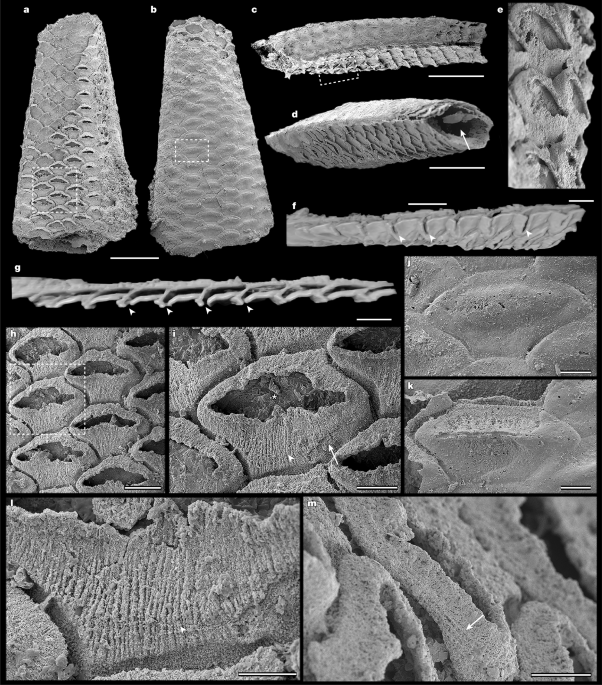
Budd, G. E. & Mann, R. P. Survival and selection biases in early animal evolution and a source of systematic overestimation in molecular clocks. Interface Focus 10, 20190110 (2020).
Zhang, Z. et al. Fossil evidence unveils an early Cambrian origin for Bryozoa. Nature 599, 251–255 (2021).
Erwin, D. H. et al. The Cambrian conundrum: early divergence and later ecological success in the early history of animals. Science 334, 1091–1097 (2011).
Wray, G. A. Molecular clocks and the early evolution of metazoan nervous systems. Philos. Trans. R. Soc. B 370, 20150046 (2015).
Budd, G. E. & Jackson, I. S. C. Ecological innovations in the Cambrian and the origins of the crown group phyla. Philos. Trans. R. Soc. B 371, 20150287 (2016).
Erwin, D. H. The origin of animal body plans: a view from fossil evidence and the regulatory genome. Development 147, dev182899 (2020).
Zhang, X. & Shu, D. Current understanding on the Cambrian Explosion: questions and answers. PalZ 95, 641–660 (2021).
Yang, J., Lan, T., Zhang, X. & Smith, M. R. Protomelission is an early dasyclad alga and not a Cambrian bryozoan. Nature 615, 468–471 (2023).
Xiang, K., Yin, Z., Liu, W., Zhao, F. & Zhu, M. Early Cambrian Cambroclavus is a scleritomous eumetazoan unrelated to bryozoan or dasyclad algae. Geology 52, 130–134 (2024).
Ernst, A. in Phylum Bryozoa (eds Helmcke, J. G. et al.) 11–56 (De Gruyter, 2020).
Landing, E. et al. Early evolution of colonial animals (Ediacaran Evolutionary Radiation–Cambrian Evolutionary Radiation–Great Ordovician Biodiversification Interval). Earth Sci. Rev. 178, 105–135 (2018).
Landing, E., English, A. & Keppie, J. D. Cambrian origin of all skeletalized metazoan phyla—discovery of Earth’s oldest bryozoans (Upper Cambrian, southern Mexico). Geology 38, 547–550 (2010).
Landing, E. et al. Distinguishing Earth’s oldest known bryozoan (Pywackia, late Cambrian) from pennatulacean octocorals (Mesozoic–recent). J. Paleontol. 89, 292–317 (2015).
Fritz, M. A. Cambrian Bryozoa. J. Paleontol. 21, 434–435 (1947).
Bassler, R. S. Taxonomic notes on genera of fossil and recent Bryozoa. J. Wash. Acad. Sci. 42, 381–385 (1952).
Rowland, S. M. Earliest cavity-dwelling organisms (coelobionts), Lower Cambrian Poleta Formation, Nevada: discussion. Can. J. Earth Sci. 20, 1348–1349 (1983).
Taylor, P. D. Marcusodictyon Bassler from the Lower Ordovician of Estonia: not the earliest bryozoan but a phosphatic problematicum. Alcheringa 8, 177–186 (1984).
Xia, F., Zhang, S. & Wang, Z. The oldest bryozoans: new evidence from the Late Tremadocian (Early Ordovician) of East Yangtze Gorges in China. J. Paleontol. 81, 1308–1326 (2007).
Taylor, P. D., Berning, B. & Wilson, M. A. Reinterpretation of the Cambrian ‘bryozoan’ Pywackia as an octocoral. J. Paleontol. 87, 984–990 (2013).
Hageman, S. J. & Vinn, O. Late Cambrian Pywackia is a cnidarian, not a bryozoan: insights from skeletal microstructure. J. Paleontol. 97, 990–1001 (2023).
Orr, R. J. et al. Paleozoic origins of cheilostome bryozoans and their parental care inferred by a new genome-skimmed phylogeny. Sci. Adv. 8, eabm7452 (2022).
Pruss, S. B., Leeser, L., Smith, E. F., Zhuravlev, A. Y. & Taylor, P. D. The oldest mineralized bryozoan? A possible palaeostomate in the lower Cambrian of Nevada, USA. Sci. Adv. 8, eabm8465 (2022).
Saadi, A. J. et al. Phylogenomics reveals deep relationships and diversification within phylactolaemate bryozoans. Proc. R. Soc. Lond. B 289, 20221504 (2022).
Ernst, A. Fossilized soft tissues in Palaeozoic bryozoans. Pap. Palaeontol. 9, e1483 (2023).
McMenamin, M. A. S. The Cambrian Explosion: macroevolution and biomineralization. Acad. Biol. https://doi.org/10.20935/AcadBiol6036 (2023).
Reid, C. M., Wyse Jackson, P. N. & Key, M. M. Latitudinal influences on bryozoan calcification through the Paleozoic. Paleobiology 49, 271–283 (2023).
Nielsen, C. & Pedersen, K. J. Cystid structure and protrusion of the polypide in Crisia (Bryozoa, Cyclostomata). Acta Zool. 60, 65–88 (1979).
Schwaha, T. F., Ostrovsky, A. N. & Wanninger, A. Key novelties in the evolution of the aquatic colonial phylum Bryozoa: evidence from soft body morphology. Biol. Rev. 95, 696–729 (2020).
Schwaha, T. in Phylum Bryozoa, Handbook of Zoology (ed. Schwaha, T.) (De Gruyter, 2020).
Hageman, S. J. et al. Bryozoan growth habits: classification and analysis. J. Paleontol. 72, 418–436 (1998).
Taylor, P. D. & James, N. P. Secular changes in colony-forms and bryozoan carbonate sediments through geological history. Sedimentology 60, 1184–1212 (2013).
Taylor, P. D. Bryozoan Paleobiology (Wiley, 2020).
Ma, J., Taylor, P. D., Xia, F. & Zhan, R. The oldest known bryozoan: Prophyllodictya (Cryptostomata) from the lower Tremadocian (Lower Ordovician) of Liujiachang, south-western Hubei, central China. Palaeontology 58, 925–934 (2015).
Blake, D. B. Acanthopore morphology and function in the bryozoan family Rhabdomesidae. J. Paleontol. 47, 421–435 (1973).
Ma, J., Buttler, C. J. & Taylor, P. D. Cladistic analysis of the ‘trepostome’ suborder Esthonioporina and the systematics of Palaeozoic bryozoans. Studi Trent. Sci. Nat. 94, 153–161 (2014).
Taylor, P. D., Lombardi, C. & Cocito, S. Biomineralization in bryozoans: present, past and future. Biol. Rev. 90, 1118–1150 (2015).
Wernström, J. V., Gąsiorowski, L. & Hejnol, A. Brachiopod and mollusc biomineralisation is a conserved process that was lost in the phoronid–bryozoan stem lineage. EvoDevo 13, 17 (2022).
Erwin, D. H. Early metazoan life: divergence, environment and ecology. Philos. Trans. R. Soc. B 370, 20150036 (2015).
Gorjunova, R. V. New cryptostomide bryozoans from the Upper Devonian of Transcaucasia and some aspects of the evolution of the Order Cryptostomida. Paleontol. J. 41, 600–613 (2007).
Karklins, O. L. in Treatise on Invertebrate Paleontology, Part G, Revised, Bryozoa (ed. Robison, R. A.) 453–488 (Geological Society of America and Univ. Kansas Press, 1983).
Yang, A. et al. Niche expansion of archaeocyaths during their palaeogeographic migration: evidence from the Chengjiang Biota. Palaeogeogr. Palaeoclimatol. Palaeoecol. 653, 112419 (2024).
Song, B. et al. Small skeletal fossils associated with archaeocyath reefs from the Xiannüdong Formation (Cambrian Series 2), southern Shaanxi, China. Palaeobio. Palaeoenv. https://doi.org/10.1007/s12549-025-00677-y (2026).
Chang, S. et al. New probable cnidarian fossils from the lower Cambrian of the Three Gorges area, South China, and their ecological implications. Palaeogeogr. Palaeoclimatol. Palaeoecol. 505, 150–166 (2018).
Park, T. et al. A stem-group cnidarian described from the mid-Cambrian of China and its significance for cnidarian evolution. Nat. Commun. 2, 1–6 (2011).
Manzuk, R. A., Maloof, A. C., Kaandorp, J. A. & Webster, M. Branching archaeocyaths as ecosystem engineers during the Cambrian radiation. Geobiology 21, 66–85 (2022).
McKinney, F. K. & Jackson, J. B. C. Bryozoan Evolution (Univ. Chicago Press, 1989).
Taylor, P. D. & Waeschenbach, A. Phylogeny and diversification of bryozoans. Palaeontology 58, 585–599 (2015).
Li, G., Zhu, M., Van Iten, H. & Li, C. Occurrence of the earliest known Sphenothallus Hall in the Lower Cambrian of southern Shaanxi Province, China. Geobios 37, 229–237 (2004).
Song, B. et al. Supplementary Data 1–4 from: High-fidelity modular skeletons authenticate a Cambrian origin for Bryozoa. Figshare https://doi.org/10.6084/m9.figshare.31995942 (2026).

