


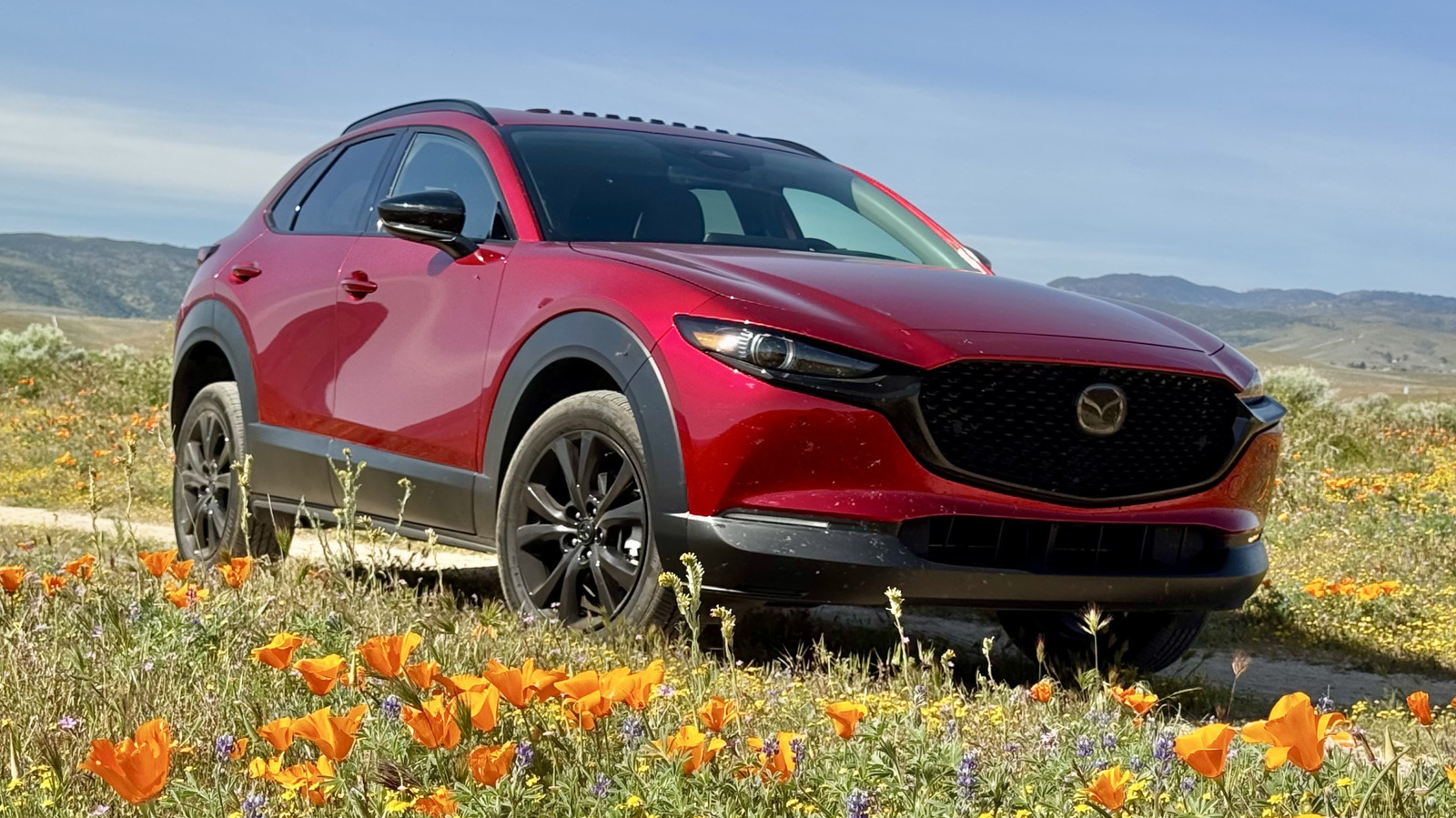
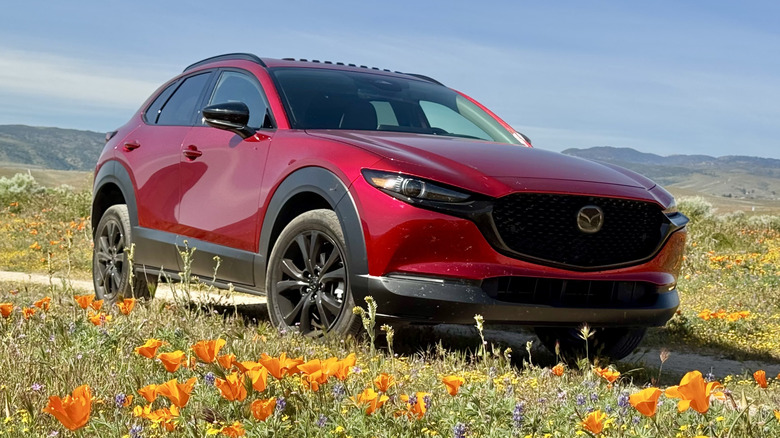
The global economy ain’t looking great at the moment, so the vast majority of us are looking for ways to get more for our money, regardless of what we’re buying. The 2026 Mazda CX-30 Turbo Premium Plus is a subcompact crossover that competes with the likes of the Toyota Corolla Cross, Honda HR-V, Subaru Crosstrek, Chevrolet Trax, Hyundai Kona, and Nissan Kicks, but where most of those models come well-equipped around the $30,000 mark, my press car had an MSRP over $40,000. That sounds like a bad deal, but that’s not the whole story.
The CX-30 Turbo may compete with that list of tiny crossovers on paper, but in practice, it feels more like it ought to compete in the luxury subcompact crossover class against the likes of the BMW X1, Audi Q3, Mercedes-Benz GLA and Volvo XC40. Most of those models start around the $40,000 mark, but that’s without any of the desirable options that the CX-30 Premium Plus has baked into its $40,000 price tag. I think that the CX-30 Turbo’s real value comes when you looks at as a bargain Porsche Macan, which sounds crazy, but it’s really true. We said this when we tested it in 2019, and we’re saying it again now, six years later: the Mazda CX-30 Turbo is still a fantastic Porsche Macan dupe.
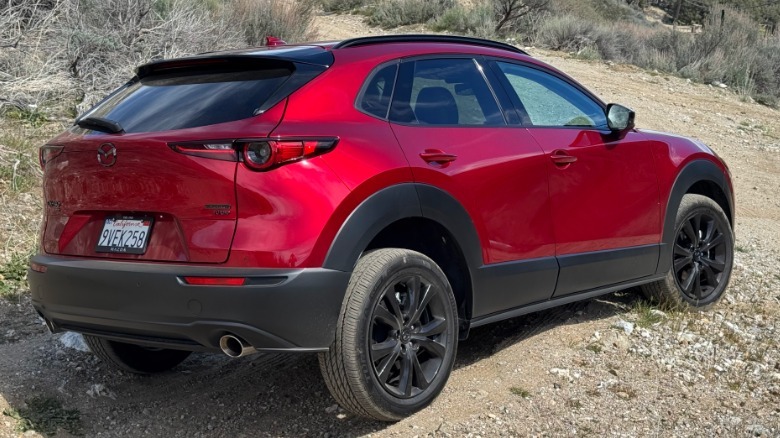 Logan K. Carter/ Jalopnik
Full disclosure: Mazda leant me a 2026 CX-30 Turbo Premium Plus for a week. I lived with it, used it as my daily driver, and even took it on the long drive from Los Angeles to San Luis Obispo for the new Audi Q3 first drive event.
The new and the numbers
Let’s get the biggest number out of the way first: that price. My test car is a top trim CX-30 Turbo Premium Plus, which starts at $39,395 including a $1,495 destination charge, but this one is fitted with the $165 cargo cover, $575 illuminated door sill plates, and the excellent and cheap $595 Soul Red Crystal Metallic paint, so its MSRP was $40,730. The CX-30 starts as low as $27,470 for the base S trim, and the cheapest turbocharged model you can get is the Turbo Aire Edition, which starts at $35,905. Despite the fact that these prices are higher than its subcompact crossover competition, I think it still represents a fantastic value for the buyer who appreciates a fun-to-drive car.
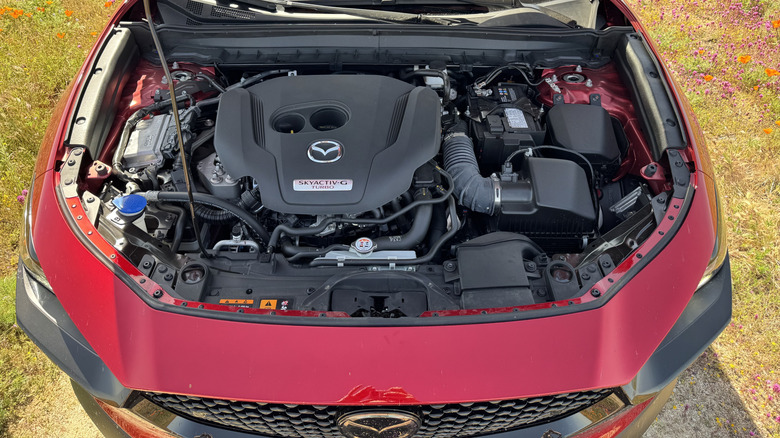
This is not a new car — it was introduced six years ago, about the time when we’d be expecting a new generation — and though the turbocharged powertrain option debuted later in 2021 and is not new either, it’s still damn good. The turbocharged 2.5-liter inline-4 engine under the hood cranks out a respectable 250 horsepower and a huge 320 pound-feet of torque. The CX-30’s standard naturally aspirated 2.5-liter four-cylinder produces 186 hp and 186 lb-ft of torque, which aren’t actually bad numbers for this class, but naturally I prefer the turbo.
 Logan K. Carter/ Jalopnik
Though it does not have a proper manual transmission, unlike many of its subcompact crossover competitors, the CX-30 has an honest-to-goodness 6-speed automatic transmission with steering wheel-mounted paddle shifters. The CX-30 Turbo Premium Plus isn’t necessarily a lightweight, but its curb weight of 3,527 pounds is about aligned with the rest of its class.
For 2026, the CX-30 receives updated dampers and a brake-based limited-slip differential to improve traction and stability. All CX-30s come standard with all-wheel drive, Mazda’s G-Vectoring Control Plus which helps the car feel more responsive to steering inputs by metering the power headed to the front wheels, and Off-Road Traction Assist which maximizes off-road abilities by applying the brakes to wheels without traction thus sending the power to the wheels with traction.
It’s a hoot to drive hard, but quiet and comfortable in daily driving
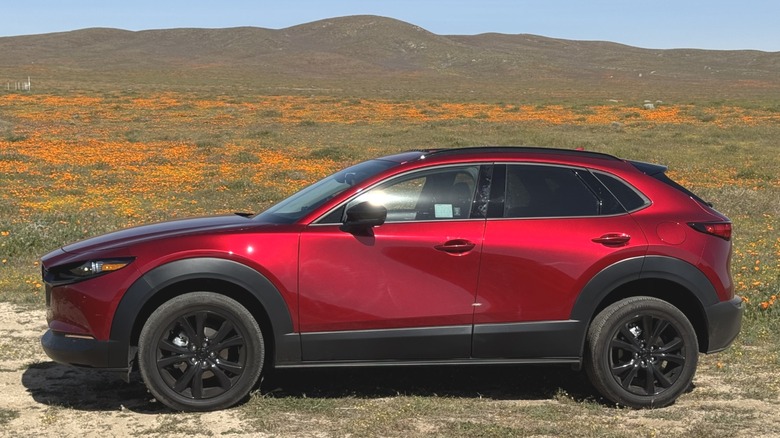
Mazda knows how to make reasonably practical and affordable cars that are still fun to drive, and the CX-30 is no exception. I might have touched on it before, but it bears repeating: the turbocharged engine kicks ass. I recently had a Hyundai Kona Limited press car, one of the only other subcompact crossovers with an optional turbocharged engine, and though its extra power was appreciated, it was not any fun to drive. Fortunately, this isn’t the case with the Mazda CX-30 Turbo.
The first thing you’ll notice when driving the CX-30 Turbo is the brilliance of its powertrain. It feels supremely torquey, and the drivetrain calibration is great, from the throttle to the six-speed automatic transmission. Then there’s the sound it all makes as it zooms down the road. It turns in sharply and, despite exhibiting a fair bit of body lean, clings to the pavement, even rotating nicely on liftoff. This is difficult to explain, but the CX-30 just feels incredibly linear; it reacts to the driver’s inputs in a way that is satisfyingly cohesive. It’s a big contrast to the turbocharged Kona’s inconsistent response that left me guessing how far I’d have to push the throttle pedal to get a downshift.
 Logan K. Carter/ Jalopnik
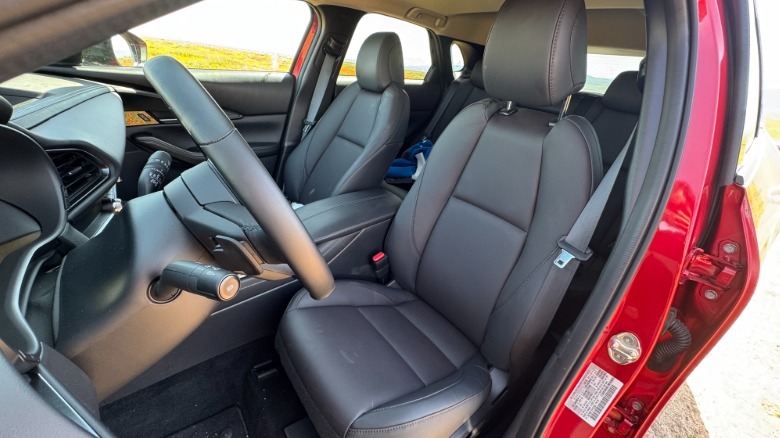
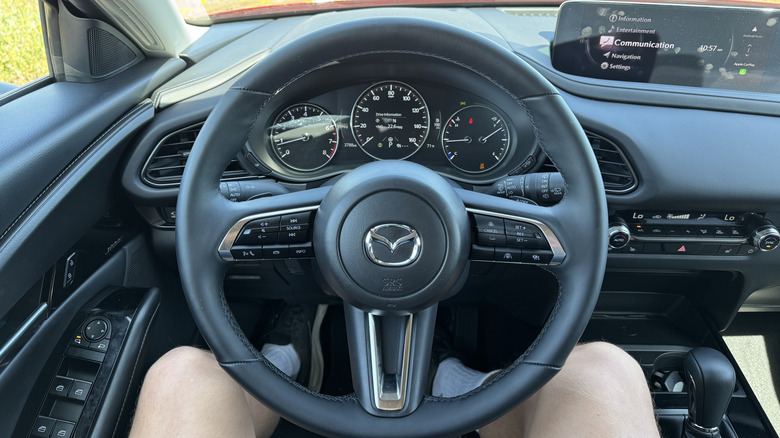
On more sedate jaunts, be they urban or on a wide open highway, the CX-30 impresses with a cushy ride quality and a very quiet cabin. The overall interior vibe is decidedly upscale if very dark in my test car, but it has what might be my favorite arm rests in the industry: both the center arm rest and the door arm rests are topped by a thick layer of supremely squishy foam that coddles even the boniest of elbows. That’s luxury. I’m also a sucker for a head-up display, and the CX-30’s is simple and effective, even though the projection jiggles rather aggressively over big bumps or pockmarked pavement.
The CX-30 Turbo is nearly $30,000 less than a Porsche Macan, and it makes more torque
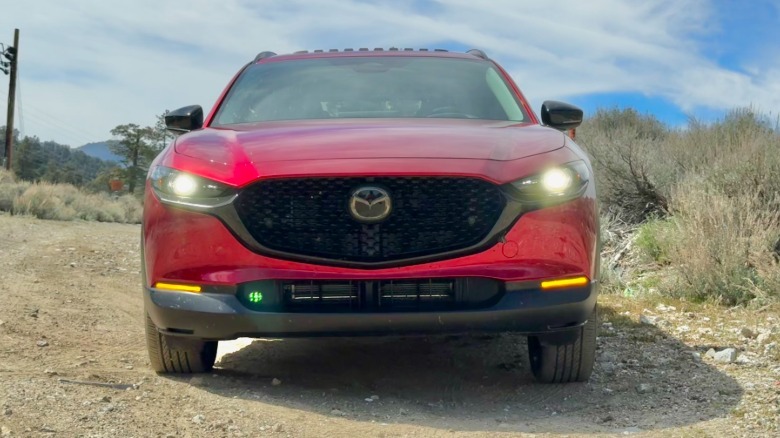
Mazda has started to creep upmarket with its more recent offerings, and I really do think the CX-30 Turbo is a viable competitor to the base Porsche Macan, despite the Mazda costing 27,020 fewer of your hard-earned dollars. I promise, I’m not entirely as insane as I sound.
Remember, the base Porsche Macan is powered by a turbocharged 2.0-liter inline-4 engine that it shares with various Volkswagen and Audi models. In the Macan, it produces 261 horsepower and 295 lb-ft of torque that’s sent through a 7-speed PDK dual-clutch automatic transmission to standard all-wheel drive. That may be 11 horsepower more than the CX-30’s turbocharged four-cylinder produces, but the German four popper falls a whopping 25 lb-ft short of the Mazda mill.
 Logan K. Carter/ Jalopnik
The CX-30 also weighs 622 pounds less than the Porsche, a not-insignificant amount, and though Mazda hasn’t released an official 0-to-60 time for the CX-30 Turbo, Car and Driver‘s 2021 CX-30 Turbo achieved the sprint in 5.8 seconds, two-tenths quicker than Porsche’s 6.0-second estimate for the base Macan. C/D tested a base Macan in 2022, but it was equipped with the Sport Chrono Package that includes Porsche’s brilliant launch control, enabling a 0-to-60 sprint of 5 seconds flat. In C/D’s more real-world 5-to-60 mph rolling start test, the gap closes with the Macan’s 5.9-second time and the CX-30’s 6.4-second time.
Is it starting to sound like I’m the meme of Charlie from “It’s Always Sunny in Philadelphia” when he’s trying to make sense of a conspiracy theory? Yes, but considering that the Mazda CX-30 costs nearly $30,000 less than the Macan while offering comparable performance to a freakin’ Porsche, this is about as close as you can get to a Macan dupe without turning to the used car market.
It’s not perfect
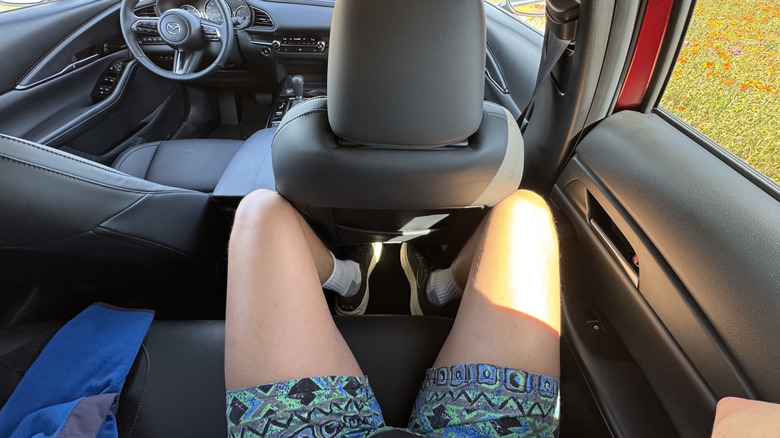
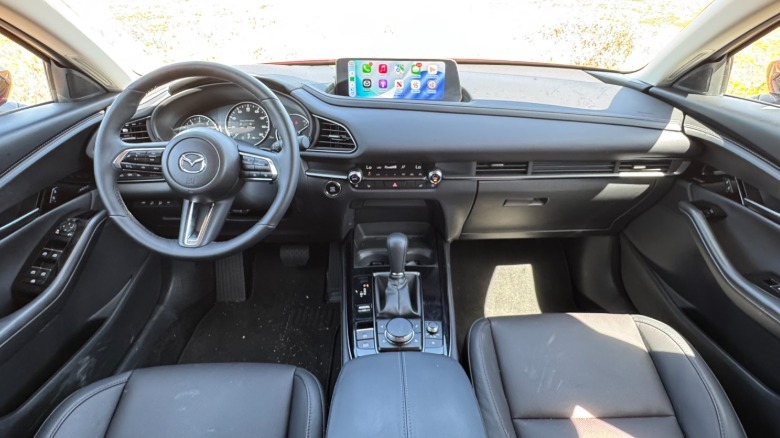
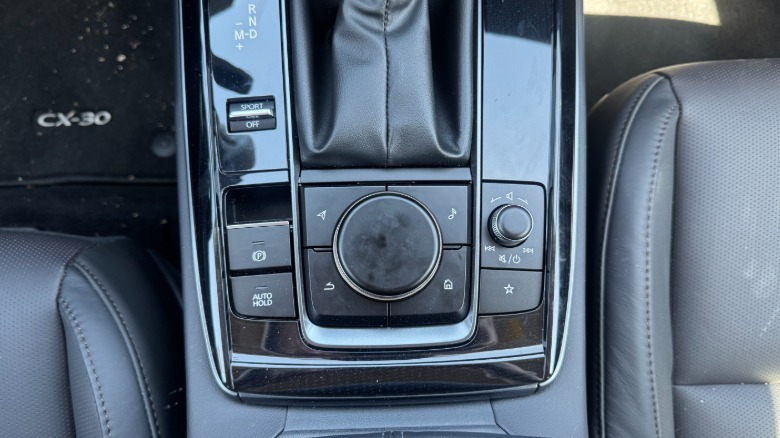
As wonderful as its drivetrain is, the CX-30 is not without fault. The biggest demerits are its old tech and its cramped interior aft of the front seats. Depending on your persuasion, you may actually appreciate the somewhat dated technology suite in the 2026 CX-30; there are oodles of physical buttons and knobs, and the only way to navigate the infotainment system in most cases is via a scroll wheel in the center console. What year is it, 2019? I really don’t mind using the wheel to navigate the infotainment system — in fact I think it makes doing so easier than a touchscreen — but the screen’s small size and dark menus don’t make things feel very user friendly.
At least there is standard wireless Apple CarPlay and Android Auto. When you use that phone mirroring software the infotainment screen sometimes becomes a touchscreen, but only for some functions. You’re left guessing, or in my case cussing at the screen, when you can tap on one icon but you need to use the scroll wheel to select the icon right next to it. It’s maddening. If you just use the scroll wheel for everything, it’s mildly less frustrating.
 Logan K. Carter/ Jalopnik
The CX-30 also feels a bit claustrophobic inside due to its squat windows and high beltline, but I didn’t feel cramped in the front seat despite my 6-foot-8-inch long-legged stature. Front seat headroom may be an issue for someone with a longer torso, but overall I felt plenty comfortably behind the wheel. The back seats? Not so much.
If you need to carry above average-height people with any frequency, your passengers would probably prefer you choose something bigger than the CX-30. The back seat isn’t very roomy, and the claustrophobic feeling you get up front is amplified in the rear as there’s very little glass area to let light in. The cargo area is about average for the class at 20.2 cubic-feet of space with the rear seats up, but fold them down and you only get 45.2 cubic feet. Seats up that’s 3 cubic-feet more than a Macan, but seats down the Mazda offers 7.9 cubic feet less than the Porsche.
I really love the CX-30 Turbo
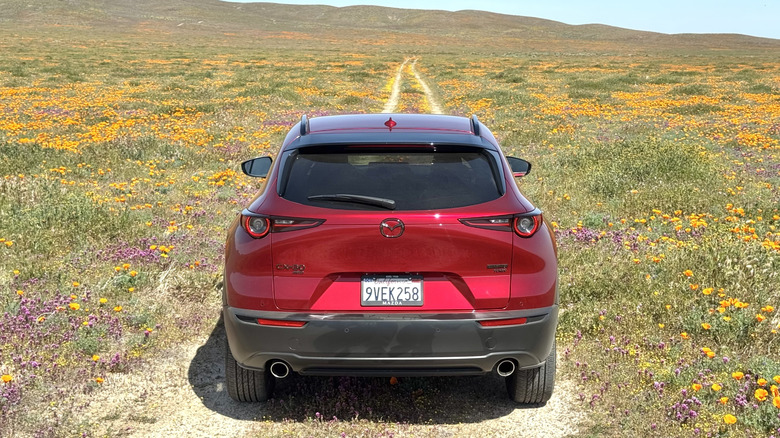
I walk away from my week with the CX-30 Turbo Premium Plus feeling sad to see it go. I ended up really enjoying my time with the car, from its positively plush arm rests to its gutsy drivetrain and playful driving dynamics. I also love looking at it, especially in direct sunlight as the Soul Red paint still looks exceptional. I previously said that the Subaru Crosstrek is the subcompact crossover I’d buy with a $30,000 budget, but I think the Mazda CX-30 Turbo Premium Plus is the subcompact crossover I’d buy with $40,000. In fact, it actually got me looking at the prices of gently used CX-30 Turbos, as I’ve been yearning for something that I could feel more confident taking off-road than my Mini.
Value-wise, the CX-30 Turbo Premium Plus is a great alternative to a luxury subcompact crossover, but if you simply don’t have $40,000 to spend, the playful chassis and crisp steering still apply to the non-turbo powertrain.
The cheapest way to get the turbo is on the new CX-30 2.5 Turbo Aire Edition, which is about $3,500 less than the Premium Plus trim, if you want the power but can do without a couple fancy features like a windshield wiper de-icer, paddle shifters, a heated steering wheel, real leather, and satellite radio. Though it may not be at the precipice of modern technology and engineering, I think the CX-30 is still a very compelling subcompact crossover that deserves serious consideration.

