


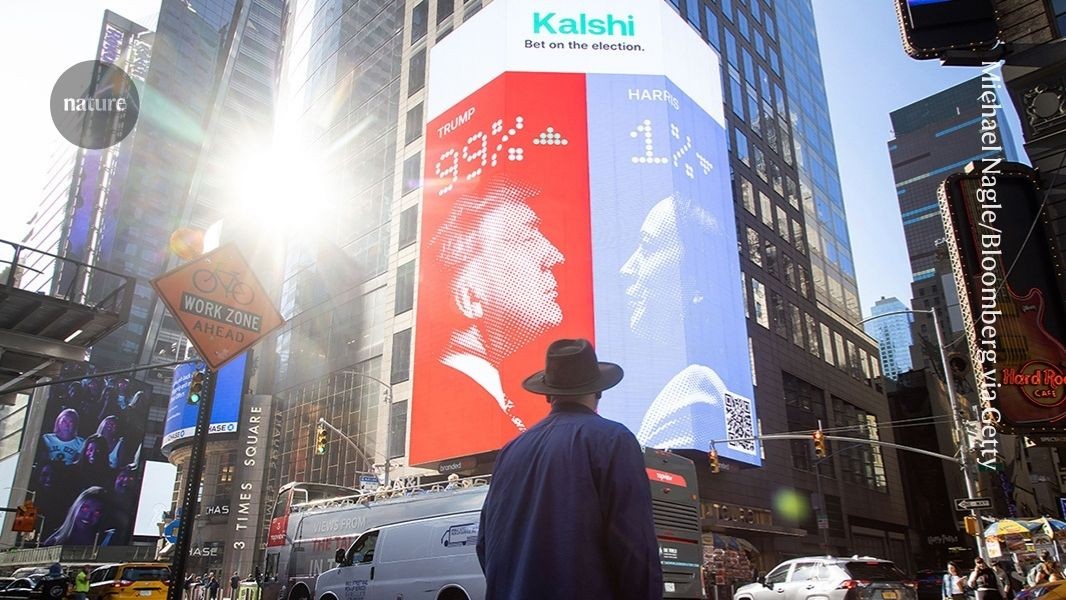

Prediction markets such as Kalshi allow users to speculate on the outcomes of real-world events using cryptocurrency.Credit: Michael Nagle/Bloomberg via Getty
Prediction markets such as Polymarket and Kalshi have soared in popularity over the past few months. From bets on disease outbreaks to wagers about artificial intelligence, many of their markets relate to science and research. So how do Polymarket’s prediction powers compare to the opinions of subject-matter experts?
In prediction markets, users bet on a future event by buying and selling shares in favour of various outcomes. The price of each share is determined neither by expert opinions nor by the ‘house’ setting odds. Rather, prices are based on demand, reflecting the market’s collective belief in the probability of the outcome.
But as well as providing a gambling platform, prediction markets offer a test of the concept of the wisdom of crowds — the long-held idea that collective predictions by large groups of people tend to be better than forecasts by subject specialists. According to Polymarket’s website, prediction markets can often determine outcomes more accurately than experts or polls because “economic incentives ensure market prices adjust to reflect true odds as more knowledgeable participants join”.
Research has found that prediction markets sometimes outperform other forecasting methods in political elections1, but some researchers remain unconvinced that they can rival the work of expert scientists.
Prediction markets are “potentially helpful forecasting supplements” when it comes to science, says Richard Borghesi, who researches finance and prediction markets at the University of South Florida in Tampa. The markets can be useful to gauge how scientific information is received by the public, he says, but they are not “substitutes for models, peer review or expert judgement”, and are less informative when the people trading lack specialist knowledge on the subject.
There are also growing concerns about market manipulation and insider trading on Polymarket and Kalshi. In October last year, Norwegian officials who oversee the Nobel Peace Prize investigated a surge in bets for Venezuelan opposition leader Maria Corina Machado hours before she was awarded the prize.
Possible pandemics
One science-based area in which researchers question the effectiveness of prediction markets’ forecasting is disease outbreaks. When an outbreak of hantavirus was reported on a cruise ship in early May, a Polymarket market predicted a 19% probability of the World Health Organization (WHO) declaring a hantavirus pandemic this year. But that sank after the shock of the initial news; when this article was published, the market sat at a probability of 5%, with about US$14 million in shares traded so far. A similar Kalshi market predicts a 7% chance of the WHO declaring a hantavirus outbreak a public-health emergency of international concern in 2026.

There is no vaccine for deadly hantavirus: what that means for future outbreaks
Users in these markets do follow some scientific evidence, with comment sections referencing WHO updates and case numbers. In comparison, researchers usually forecast disease spread using mathematical models and a variety of data, including hospital surveillance, genomic data and even school absences.
It is difficult for experts to pin down the precise probability of a pandemic, but the chance of a global hantavirus outbreak “is very, very low,” says Vaithi Arumugaswami, an infectious-disease researcher at the University of California, Los Angeles. Forecasting from the US Centers for Disease Control and Prevention suggests that the virus’s risk to the US public is extremely low, and the WHO says that transmission between humans is uncommon.
The way users trade may be an effect of anxiety surrounding pandemics, which seems especially present since the COVID-19 pandemic, says Bill Hanage, an epidemiologist at Harvard University in Cambridge, Massachusetts. “In that regard, Polymarket bets do “tell you something about how the public feels.”
Climate forecasting
Another science-based subject creating buzz in prediction markets is climate change — and there, some bets seem “reasonably in line with experts’ estimates”, says Zeke Hausfather, a climate scientist at the research organization Berkeley Earth in California.

