


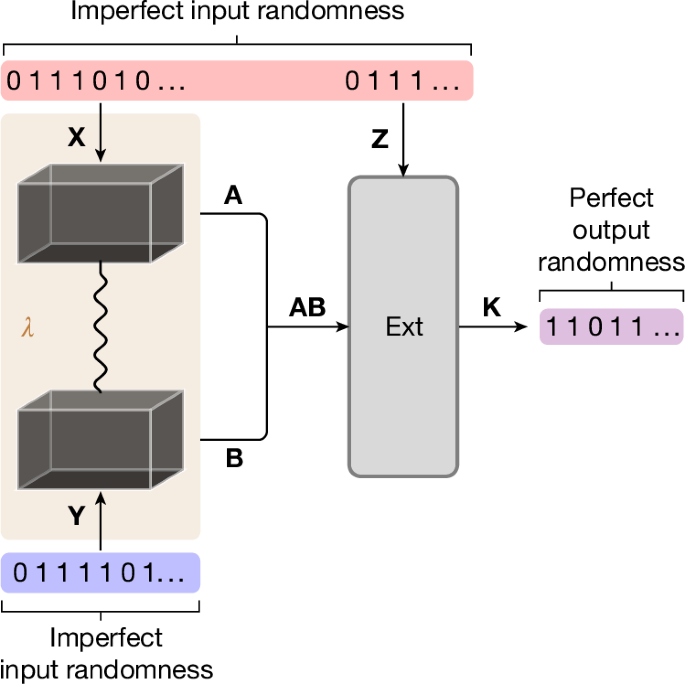
Colbeck, R. & Renner, R. Free randomness can be amplified. Nat. Phys. 8, 450–454 (2012).
Hensen, B. et al. Loophole-free Bell inequality violation using electron spins separated by 1.3 kilometres. Nature 526, 682–686 (2015).
Giustina, M. et al. Significant-loophole-free test of Bell’s theorem with entangled photons. Phys. Rev. Lett. 115, 250401 (2015).
Shalm, L. K. et al. Strong loophole-free test of local realism. Phys. Rev. Lett. 115, 250402 (2015).
Santha, M. & Vazirani, U. V. Generating quasi-random sequences from semi-random sources. J. Comput. Syst. Sci. 33, 75–87 (1986).
Brown, G. W. History of RAND’s Random Digits: Summary Technical Report P113 (RAND, 1949); http://www.rand.org/pubs/papers/P113.html.
von Neumann, J. John von Neumann Collected Works, Vol. 5: Design of Computers, Theory of Automata and Numerical Analysis 768–770 (Pergamon Press, 1961).
Colbeck, R. & Renner, R. No extension of quantum theory can have improved predictive power. Nat. Commun. 2, 411 (2011).
Petrov, M. et al. Independent quality assessment of a commercial quantum random number generator. EPJ Quantum Technol. 9, 17 (2022).
Rivest, R. L., Shamir, A. & Adleman, L. A method for obtaining digital signatures and public-key cryptosystems. Commun. ACM 21, 120–126 (1978).
Heninger, N., Durumeric, Z., Wustrow, E. & Halderman, J. A. Mining your Ps and Qs: detection of widespread weak keys in network devices. In Proc. 21st USENIX Security Symposium 205–220 (USENIX Association, 2012).
Lenstra, A. K. et al. Ron was wrong, Whit is right. IACR Cryptology ePrint Archive https://eprint.iacr.org/2012/064 (2012).
RAND Coorporation A Million Random Digits with 100,000 Normal Deviates (American Book Publishers, 2001).
Bell, J. S. On the Einstein Podolsky Rosen paradox. Physics 1, 195 (1964).
Clauser, J. F., Horne, M. A., Shimony, A. & Holt, R. A. Proposed experiment to test local hidden-variable theories. Phys. Rev. Lett. 23, 880–884 (1969).
Freedman, S. J. & Clauser, J. F. Experimental test of local hidden-variable theories. Phys. Rev. Lett. 28, 938–941 (1972).
Aspect, A., Grangier, P. & Roger, G. Experimental realization of Einstein–Podolsky–Rosen–Bohm gedankenexperiment: a new violation of Bell’s inequalities. Phys. Rev. Lett. 49, 91–94 (1982).
Rowe, M. A. et al. Experimental violation of a Bell’s inequality with efficient detection. Nature 409, 791–794 (2001).
Salart, D., Baas, A., Branciard, C., Gisin, N. & Zbinden, H. Testing the speed of ‘spooky action at a distance’. Nature 454, 861–864 (2008).
Kessler, M. & Arnon-Friedman, R. Device-independent randomness amplification and privatization. IEEE J. Sel. Areas Inf. Theory 1, 568–584 (2020).
Vazirani, U. Strong communication complexity or generating quasirandom sequences form two communicating semi-random sources. Combinatorica 7, 375–392 (1987).
Chor, B. & Goldreich, O. Unbiased bits from sources of weak randomness and probabilistic communication complexity. SIAM J. Comput. 17, 230–261 (1988).
Liu, M. et al. Certified randomness using a trapped-ion quantum processor. Nature 640, 343–348 (2025).
Blais, A., Grimsmo, A. L., Girvin, S. M. & Wallraff, A. Circuit quantum electrodynamics. Rev. Mod. Phys. 93, 025005 (2021).
Storz, S. et al. Loophole-free Bell inequality violation with superconducting circuits. Nature 617, 265–270 (2023).
Portmann, C. & Renner, R. Security in quantum cryptography. Rev. Mod. Phys. 94, 025008 (2022).
Pütz, G., Rosset, D., Barnea, T. J., Liang, Y.-C. & Gisin, N. Arbitrarily small amount of measurement independence is sufficient to manifest quantum nonlocality. Phys. Rev. Lett. 113, 190402 (2014).
Sandfuchs, M., Ferradini, C. & Renner, R. Randomness from causally independent processes. Preprint at https://arxiv.org/abs/2510.05203 (2025).
Abellán, C., Amaya, W., Mitrani, D., Pruneri, V. & Mitchell, M. W. Generation of fresh and pure random numbers for loophole-free Bell tests. Phys. Rev. Lett. 115, 250403 (2015).
Koch, J. et al. Charge-insensitive qubit design derived from the Cooper pair box. Phys. Rev. A 76, 042319 (2007).
Kurpiers, P. et al. Deterministic quantum state transfer and remote entanglement using microwave photons. Nature 558, 264–267 (2018).
Kurpiers, P., Walter, T., Magnard, P., Salathe, Y. & Wallraff, A. Characterizing the attenuation of coaxial and rectangular microwave-frequency waveguides at cryogenic temperatures. EPJ Quantum Technol. 4, 8 (2017).
Magnard, P. et al. Microwave quantum link between superconducting circuits housed in spatially separated cryogenic systems. Phys. Rev. Lett. 125, 260502 (2020).
Walter, T. et al. Rapid high-fidelity single-shot dispersive readout of superconducting qubits. Phys. Rev. Appl. 7, 054020 (2017).
Magnard, P. et al. Fast and unconditional all-microwave reset of a superconducting qubit. Phys. Rev. Lett. 121, 060502 (2018).
Cirac, J. I., Zoller, P., Kimble, H. J. & Mabuchi, H. Quantum state transfer and entanglement distribution among distant nodes in a quantum network. Phys. Rev. Lett. 78, 3221–3224 (1997).
Storz, S. et al. Complete self-testing of a system of remote superconducting qubits. Phys. Rev. Lett. 135, 030801 (2025).
Garg, A. & Mermin, N. D. Detector inefficiencies in the Einstein–Podolsky–Rosen experiment. Phys. Rev. D 35, 3831–3835 (1987).
Eberhard, P. H. Background level and counter efficiencies required for a loophole-free Einstein–Podolsky–Rosen experiment. Phys. Rev. A 47, R747–R750 (1993).
Larsson, J.-A. Loopholes in Bell inequality tests of local realism. J. Phys. A 47, 424003 (2014).
Rukhin, A. et al. A Statistical Test Suite for Random and Pseudorandom Number Generators for Cryptographic Applications rev.1a (NIST, 2010); https://csrc.nist.gov/projects/random-bit-generation/documentation-and-software.
Marsaglia, G. & Tsang, W. W. Some difficult-to-pass tests of randomness. J. Stat. Softw. https://doi.org/10.18637/jss.v007.i03 (2022).
Kelsey, J., Brandão, L. T., Peralta, R. & Booth, H. A Reference for Randomness Beacons: Format and Protocol Version 2 Technical Report (NIST, 2019); https://doi.org/10.6028/NIST.IR.8213-draft.
Kavuri, G. A. et al. Traceable random numbers from a non-local quantum advantage. Nature 642, 916–921 (2025).
Yao, A. C. Protocols for secure computations. In 23rd Annual Symposium on Foundations of Computer Science (sfcs 1982) 160–164 (IEEE, 1982).
Goldreich, O., Micali, S. & Wigderson, A. How to play any mental game. In STOC ’87: Proc. Nineteenth Annual ACM Symposium on Theory of Computing 218–229 (ACM, 1987); https://doi.org/10.1145/28395.28420.
Dodis, Y., Ong, S. J., Prabhakaran, M. & Sahai, A. On the (im)possibility of cryptography with imperfect randomness. In 45th Annual IEEE Symposium on Foundations of Computer Science 196–205 (IEEE, 2004).
Nadlinger, D. P. et al. Experimental quantum key distribution certified by Bell’s theorem. Nature 607, 682–686 (2022).
Zhang, W. et al. A device-independent quantum key distribution system for distant users. Nature 607, 687–691 (2022).
Ekert, A. & Renner, R. The ultimate physical limits of privacy. Nature 507, 443–447 (2014).
Li, M.-H. et al. Test of local realism into the past without detection and locality loopholes. Phys. Rev. Lett. 121, 080404 (2018).
Liu, Y. et al. Device-independent quantum random-number generation. Nature 562, 548–551 (2018).
Zhang, Y. et al. Experimental low-latency device-independent quantum randomness. Phys. Rev. Lett. 124, 010505 (2020).
Shalm, L. K. et al. Device-independent randomness expansion with entangled photons. Nat. Phys. 17, 452–456 (2021).
Li, M.-H. et al. Experimental realization of device-independent quantum randomness expansion. Phys. Rev. Lett. 126, 050503 (2021).
Liu, W.-Z. et al. Device-independent randomness expansion against quantum side information. Nat. Phys. https://doi.org/10.1038/s41567-020-01147-2 (2021).
Bierhorst, P. et al. Experimentally generated randomness certified by the impossibility of superluminal signals. Nature 556, 223–226 (2018).
Liu, W.-Z. et al. Toward a photonic demonstration of device-independent quantum key distribution. Phys. Rev. Lett. 129, 050502 (2022).
Hensen, B. et al. Loophole-free Bell test using electron spins in diamond: second experiment and additional analysis. Sci. Rep. 6, 30289 (2016).
Rosenfeld, W. et al. Event-ready Bell test using entangled atoms simultaneously closing detection and locality loopholes. Phys. Rev. Lett. 119, 010402 (2017).
Frauchiger, D., Renner, R. & Troyer, M. True randomness from realistic quantum devices. Preprint at https://arxiv.org/abs/1311.4547 (2013).
Portmann, C. & Renner, R. Cryptographic security of quantum key distribution. Preprint at https://arxiv.org/abs/1409.3525 (2014).
Ferradini, C., Sandfuchs, M., Wolf, R. & Renner, R. Defining security in quantum key distribution. Preprint at https://arxiv.org/abs/2509.13405 (2025).
Brunner, N., Cavalcanti, D., Pironio, S., Scarani, V. & Wehner, S. Bell nonlocality. Rev. Mod. Phys. 86, 419–478 (2014).
Ekert, A. K. Quantum cryptography based on Bell’s theorem. Phys. Rev. Lett. 67, 661–663 (1991).
Acín, A. et al. Device-independent security of quantum cryptography against collective attacks. Phys. Rev. Lett. 98, 230501 (2007).
Colbeck, R. Quantum And Relativistic Protocols For Secure Multi-Party Computation. PhD thesis, Univ. Cambridge (2009).
Pironio, S. et al. Random numbers certified by Bell’s theorem. Nature 464, 1021–1024 (2010).
Renner, R. Security of Quantum Key Distribution. PhD thesis, ETH Zurich (2005); https://doi.org/10.3929/ethz-a-005115027.
Tomamichel, M. & Hayashi, M. A hierarchy of information quantities for finite block length analysis of quantum tasks. IEEE Trans. Inf. Theory 59, 7693–7710 (2013).
Arnon-Friedman, R., Portmann, C. & Scholz, V. B. Quantum-proof multi-source randomness extractors in the Markov model. In 11th Conference on the Theory of Quantum Computation, Communication and Cryptography (TQC 2016), Leibniz International Proceedings in Informatics (LIPIcs) Vol. 61 (ed. Broadbent, A.) 2:1–2:34 (Schloss Dagstuhl – Leibniz-Zentrum für Informatik, 2016).
Dupuis, F., Fawzi, O. & Renner, R. Entropy accumulation. Commun. Math. Phys. 379, 867–913 (2020).
Metger, T., Fawzi, O., Sutter, D. & Renner, R. Generalised entropy accumulation. In 2022 IEEE 63rd Annual Symposium on Foundations of Computer Science (FOCS) 844–850 (IEEE, 2022).
Storz, S. Non-local Physics with Superconducting Circuits. PhD thesis, ETH Zurich (2023).

