


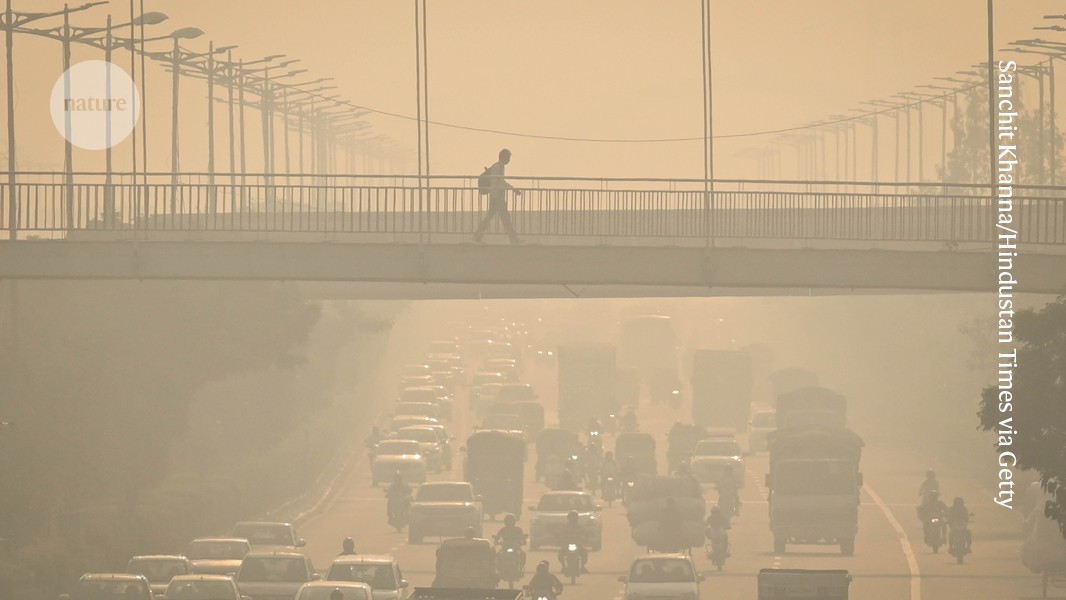
A layer of smog sits over Wazirabad in New Delhi, India.Credit: Sanchit Khanna/Hindustan Times via Getty
In July 2025, Lily Nguyen was arranging a vase of flowers at her home in Los Angeles, California, when she felt a “radiating heat and numbness” sweep down the right side of her body. Moments later, she was wracked by violent muscle convulsions. She went to the emergency department, but the physician dismissed her concerns.
When the convulsions happened again the next day, Nguyen filmed herself. She showed the footage to a different physician, who sent her for a magnetic resonance imaging (MRI) scan. The scan revealed three brain tumours. Five days later, Nguyen underwent surgery to remove them. Biopsies uncovered an unexpected and devastating cause: Nguyen had stage 4 lung cancer. “I was in shock,” she says.

Nature Outlook: Lung cancer
Nguyen is just 41 years old, has never smoked and has no family history of lung cancer. Yet she is one of a growing number of young Asian women who are developing the disease despite the absence of these risk factors.
After decades of viewing lung cancer “almost exclusively as a smoking-related disease”, cases in people who have never smoked are becoming more visible, says Jaclyn LoPiccolo, a thoracic oncologist and researcher at Dana-Farber Cancer Institute in Boston, Massachusetts. Specialists now recognize that this diagnosis is “a biologically distinct entity”, she adds.
Lung cancer in people who have never smoked is now considered to be the fifth most common cause of cancer death globally. As tobacco smoking declines worldwide, lung cancer clinicians are spending more of their time tending to people who have never smoked, says Charles Swanton, a cancer physician-scientist at the Francis Crick Institute in London. But there is more than a proportional rise going on, he says: evidence also suggests “a genuine absolute increase” in cases of lung cancer in people who have never smoked.
It’s not yet clear why, but researchers are beginning to piece things together — with the goal of helping people, such as Nguyen, well before they reach such an advanced stage of disease.
Exposing the exposures
Most lung cancer cases are still caused by smoking1. In the United States, people who have never smoked account for around 12% of cases. In Asia, they represent 30% or more. For reasons that remain unclear, women account for two-thirds of never-smokers with the disease.
Many national cancer registries do not contain reliable data on smoking status, which makes it difficult to discern trends in lung cancer in people who have never smoked, says Ludmil Alexandrov, a cancer biologist at the University of California, San Diego. Where data do exist, they often indicate a rising trend. Studies in Singapore2 and China3 reveal an increase in early-onset lung cancer, especially in women2. In the United States, diagnoses are increasing in Asian American women, and possibly also in Hispanic women4.
The reasons for this rise are “not fully clear”, says Wei Jie Seow, a cancer epidemiologist at the National University of Singapore. Unlike smoking-related lung cancer, which is driven by tobacco carcinogens that leave a distinct pattern of mutations in the genome, lung cancer in people who have never smoked lacks a universal mutational marker of disease. “There are genetic variants that are associated with increased risk, but it’s not driving a large proportion of the risk in non-smokers,” says Dean Hosgood, an epidemiologist at Albert Einstein College of Medicine in New York City. The bigger influence seems to come from the environment.
Lung tumours in most people who have never smoked have at least one of a handful of non-inherited gene alterations, which vary by geography. In Taiwan, for example, nearly half of women who have never smoked and are diagnosed with the disease have a mutation in the EGFR gene. Scientists are making progress towards understanding the environmental risks that might be driving these mutations. Exposure to second-hand smoke, counterintuitively, accounts for only a small minority of cases; one US study linked it to around 6% of tumours1. Another cause is exposure to radon — a naturally occurring radioactive gas that percolates from the ground in certain areas. In Asia, links have also been found with consumption of Aristolochia, a type of herb used in traditional Chinese medicine, and with indoor cooking with coal5.
Other potential factors include inhalation of microplastics and consumption of ultra-processed food6,7. Martin Tammemägi, a cancer epidemiologist at Brock University in St. Catharines, Canada, says that he is investigating 174 “possibly important exposures” that might be linked to lung cancer in people who have never smoked.
In an analysis8 of whole-genome sequencing and environmental data from more than 1,000 people with lung cancer, Alexandrov and his colleagues identified a strong link between levels of air pollution and numbers of lung cancer-causing mutations, mirroring previous findings9,10. They also found a molecular signal of disease — independent of air pollution — but they have yet to identify its source. “This mysterious signature is shared across people, but we don’t know what the underlying mechanism is,” Alexandrov says.
Further study is needed to understand why the incidence of lung cancer in people who have never smoked is particularly high in Asian women. Suggestions include differences in immune function, hormonal influences and how the body metabolizes carcinogens. Seow and her colleagues found links between women’s reproductive history and their risk of lung cancer. Generally speaking, Seow says, the more times that a person has given birth, the lower their lung cancer risk. Research has also suggested that giving birth for the first time at an older age is also associated with lower risk11.
In an analysis9 of paired tumour and tissue samples from around 100 people in Taiwan, researchers found that lung cancer in women, aged 60 years and younger, who have never smoked showed higher levels of mutations arising from internal biological processes. In older women, however, mutation patterns were more consistent with environmental exposures.
Work is ongoing to understand these complexities. Heather Wakelee, an oncologist at Stanford University in California, has just completed data collection for a study that will compare the genetic and environmental factors of more than 500 Asian women with lung cancer who have never smoked with similar participants without the disease. “We’re seeing if we can find what it is that predisposes them to cancer,” Wakelee says.
Improving outcomes
Lung cancer survival depends mostly on the stage of the disease at the time of diagnosis. Surgery can often treat early stages, but it is usually not an option after the cancer has spread. Advanced cancers are often treated with targeted therapies when a specific gene alteration is driving the disease, including tumours driven by non-inherited changes. Many of these genes encode proteins involved in cellular signalling that, when mutated, become locked into a permanent ‘on’ state, causing uncontrolled proliferation. Targeted drugs inhibit these signals, usually by binding to the proteins and shutting off the signal. Dozens of these drugs exist, and the latest generation “has really remarkable outcomes”, says David Carbone, a thoracic medical oncologist at The Ohio State University in Columbus. Twenty years ago, he says, the median survival for people with metastatic lung cancer treated with chemotherapy was about eight months after diagnosis. By contrast, the median survival time — the point at which 50% of participants are still alive — has yet to be reached in people treated with an oral therapy that targets one of the most common mutations seen in people with lung cancer who have never smoked. “It’s likely close to 10 years,” Carbone says.

CT scans can detect a tumour (red) in the lungs. Credit: Centre Jean-Perrin/Science Photo Library
For Nguyen, targeted therapy has worked “amazingly” to shrink the tumours in her brain and lungs, she says — but the side effects, including brain fog and memory issues, are substantial. And although the tumours are smaller, they are still cancer, and the three daily pills she takes will not cure her disease. Over time, a subset of cells typically develops resistance and the cancer starts growing again.
Currently, most people with lung cancer who have never smoked are, like Nguyen, diagnosed at late stages. One reason is that physicians do not think of lung cancer as a possibility in younger people with a cough. Another issue, Seow says, is that national screening guidelines in most countries still only focus on those with a history of heavy smoking.
One workaround is to take advantage of data contained in computed tomography (CT) scans done for other reasons, such as evaluating abdominal pain or after a car accident. Carbone and his colleagues examined12 thousands of CT scans conducted in a hospital in Ohio in 2018 for any reason and identified nearly 700 people with lung nodules that could indicate cancer. More than half of those people did not receive appropriate follow-up for the nodules when they were first recorded. Because of these findings, Carbone says, the hospital began using an artificial-intelligence tool to review every CT scan — regardless of the reason it was taken — for lung nodules. Now, more lung cancer cases are being detected through that programme than they are through formal lung cancer screening.
More-deliberate screening also shows promise. Pan-Chyr Yang, a pulmonary physician at the National Taiwan University in Taipei, and his colleagues performed13 CT scans every other year for eight years on more than 12,000 non-smokers who had certain other lung cancer risk factors. They detected the disease in around 2% of the people they screened — and the vast majority were at potentially curable early stages. Using these results, in 2022 they persuaded the authorities in Taiwan to implement a nationwide screening programme for people who have never smoked and who have a family history of lung cancer. Singapore and Hong Kong soon followed suit, Yang says. South Korea is now considering a similar approach.
Yang hopes to refine screening eligibility by developing biomarkers to identify other high-risk individuals. Even-broader screening is also under discussion. Last November14, researchers reported that only 35% of people with lung cancer currently meet US screening criteria. They projected that expanding eligibility to people aged 40–85 regardless of smoking history could increase the detection rate to 94%, potentially preventing at least 26,100 annual deaths at an estimated cost of about US$100,000 per life saved8.
Nguyen says that she is “trying to stay optimistic”. She might have benefited from the chance to undergo early screening. “So many of us only catch it once other symptoms present themselves,” Nguyen says. But by that point, she adds, the cancer has usually metastasized, “thus really limiting our treatment options and outcomes”.

