




Researchers are using artificial-intelligence tools to build their own platforms for teaching. Credit: wichan sumalee / Getty Images
Last November, our poetry students walked into the computer laboratory and found something new: a web interface with chat-room windows labelled “the structured studio” and “the exploratory atelier”. Each chat room ran the same artificial-intelligence chatbot that students could use to co-write poems in English, but the chatbot behaved differently between the two. In one case, the chatbot took creative risks, pushing students towards surprising metaphors; in the other, it was cautious and literal.
Behind the chat-room windows was a custom AI platform that none of us — a language teacher, an English-literature PhD candidate and a literature professor all at Hong Kong Baptist University — could have built by ourselves.
Our project began with a simple question: how can teachers use AI to help learners write poetry in English? We wanted to explore how different AI configurations shape creativity when students co-write poems with chatbots. We could have pointed our participants towards OpenAI’s ChatGPT, but generic chatbots don’t offer control over key parameters that drive AI behaviour, systematic conversation logging and ways to set up experimental conditions. We needed a custom platform — and none of us had the coding experience to build one. So, we turned to ‘vibe coding’.
From natural language to web app
Vibe coding is the process of describing, in plain English, the software that you want to develop to an AI tool and letting it write the required code. Using Lovable, an AI coding assistant that turns written instructions into working web applications, we laid out our requirements: two chat rooms with different AI settings, a clean interface, conversation logging and controls for adjusting our experimental conditions. Lovable generated a working web app with a back-end database for data storage, authentication and conversation logging.
Why universities need to radically rethink exams in the age of AI
We did not get everything right the first time. Our early prompts were vague. Given the instruction “log all the chats so we can download them later”, Lovable created a logging feature that stored only the most recent message. We learnt to be precise: “store every turn in the conversation, with timestamps and room labels, in a downloadable CSV file”. The same lesson applied to shaping the chatbot that Loveable made for us — a short, specific instruction such as “respond with one concrete revision suggestion and one question about the student’s word choice” produced better results than a page-long specification did.
With AI assistance, we connected our web app to OpenRouter, a service that provides access to a number of large language models, which enabled our app to send prompts to a model and receive responses. We then asked the Loveable coding assistant to route each chat-room message to a selected model, return the reply to the correct chat room and log every prompt, response, room label and time stamp for analysis. Crucially, we also made it possible to adjust key parameters such as temperature and top‑p. Temperature influences how randomly the AI tool combines ideas; top‑p affects how widely it samples possible word choices. These settings are often hidden in off‑the‑shelf chatbots, but in our platform they became research variables — levers we could tune and study in real student interactions.
Retaining human judgement
Vibe coding removed the coding barrier, but not the need for human judgement. As research designers, we defined the experimental structure — two AI creativity levels and a five-week duration — on the basis of decisions that no algorithm could make for us. As prompt authors, we shaped the chatbot’s behaviour through system prompts that drew on our teaching intuition. As quality controllers, we piloted the platform and discovered that the AI was sometimes overscaffolding — drafting full stanzas when a student hesitated. We revised our prompts so that it would offer only a couple of options and direct questions to the student: “Here are two possible metaphors. Which feels closer to what you want to express?” Fixing that required an understanding of poetry and learning, not knowing how to debug code.
We piloted the platform with 30 university students who were interested in poetry but unfamiliar with writing it in English. One told us: “The AI chatbot helped me build confidence in choosing words.” Another said: “I’m not a very creative person, but I feel like I can rely on AI to have some sparks in my brain.”
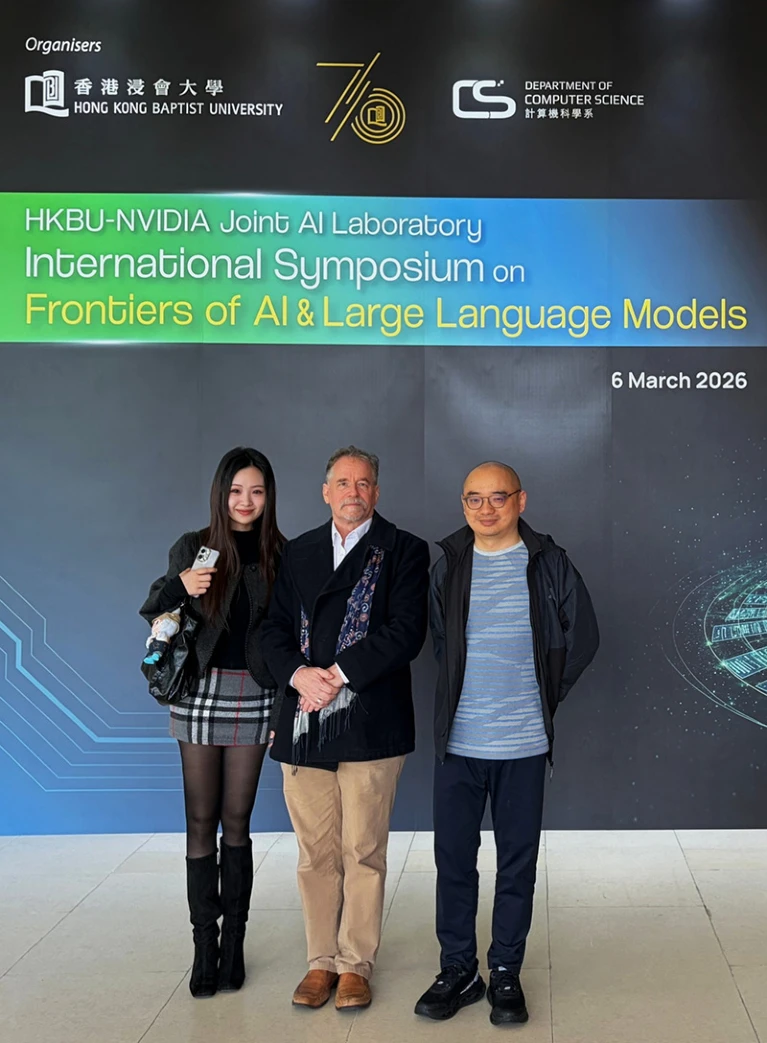
Yu Ruobin, Stuart Christie and Simon Wang (left to right) used vibe coding to create a custom poetry laboratory.Credit: HKBU staff

