


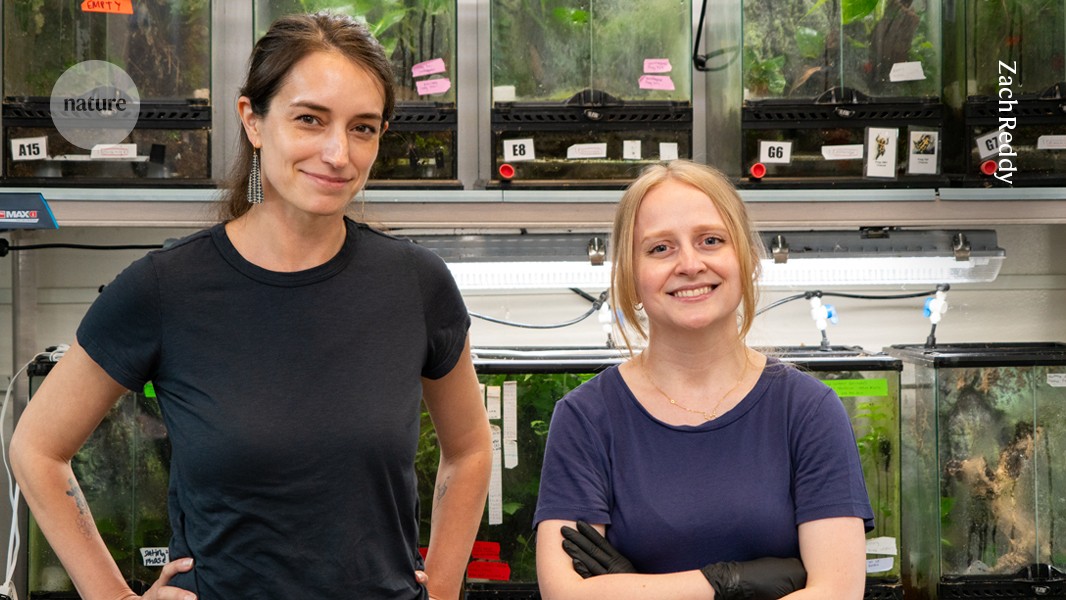

Billie Goolsby (right) and Lauren O’Connell study parent–offspring communication in frogs.Credit: Zach Reddy
When the tadpoles of some poison frogs talk to their parents, they don’t croak or sing. Instead, they speak in a language of vibration, performing a wriggling dance against their mother’s or father’s body. The parents somehow judge their offspring’s hunger from this vibration.
Scientists don’t yet know exactly how the tadpole vibrations translate into parental marching orders. But when Billie Goolsby started her PhD research at Stanford University in California in 2020, she felt uniquely equipped to investigate the question. Goolsby was born hard of hearing, and her mother spoke to her using a language that, like the amphibians’ communication, included touch.

A sit in the sauna can save endangered frogs
“Parent–offspring communication is often the most crucial and the primary interaction that social creatures have,” Goolsby says. “Parents really care about what their babies say.”
The various species of poison frog that Goolsby’s PhD adviser, Lauren O’Connell, studies in the laboratory care for their young in ways that might seem surprising. In many species, fathers give their newly hatched tadpoles piggybacks to pools of water, such as rainwater cupped in a leaf. A mimic poison frog (Ranitomeya imitator) father puts each of its 2–4 tadpoles in a separate pool and patrols the pools daily. If he stands in the water and feels a tadpole vibrating, he sings relentlessly to his mate until she comes to join him. The mother feels the tadpole’s jiggling for herself and decides whether she needs to lay an unfertilized egg for it to eat.
To try to decode a family’s conversation, Goolsby teamed up with Stanford engineers and built a one-of-a-kind robot that mimics a tadpole’s vibrations. Her project has begun to unlock the secrets of an amphibian language — and has also transformed how the scientists around her collaborate and communicate.
Goolsby calls her schoolteacher mother “a superhero”. When Goolsby was growing up, her mum worked out ways to communicate with her, such as using touch to guide her through a noisy crowd. She taught Goolsby to enunciate words by paying attention to how the sounds felt in her mouth. “Touch, to me, is much more salient” than it is to other people, Goolsby says.
When she moved from her small secondary school in Georgia to Boston University in Massachusetts, Goolsby struggled in the large lecture classes. “I told my chemistry professor that I was hard of hearing, but I really wanted to stay in science,” she recalls. “And he said to me, ‘people like you don’t stay in science or medicine’.”

Mimic poison frog tadpoles communicate their needs by wiggling.Credit: Zach Reddy
During American Sign Language (ASL) classes in the university’s Deaf Studies programme, however, Goolsby met faculty members who were Deaf or hard of hearing and she got a different message, she says: “You can do anything. And you can do it as your full self.” She learnt to tell people what she needed, such as asking people to stay close and face her while speaking.
While studying biology, Goolsby started thinking about the “adaptive ways that animals succeed in their environments”. For example, she wondered, how do the members of a frog family — with land-based parents and aquatic babies — speak to one another?
TadBot is born
Goolsby looked for ways to answer this question when she started in O’Connell’s lab. If she had a tool that could artificially imitate a tadpole’s dance, she could control the stimulus the frog parents received, and decode the signal that tells them to feed their young. But no such tool existed.
My mission to make life more user friendly for the disability community
Goolsby sent an e-mail to the Biomimetics and Dexterous Manipulation laboratory at Stanford, which had made devices inspired by biology, including a robot that climbs walls like a gecko. What would they think, she asked, about building a robotic tadpole?
It would have to be tiny, noiseless and work underwater and it would need to ‘wiggle’ similarly to a real tadpole. “I was a little bit nervous presenting this to the robotics folks,” Goolsby says. “This is a long list of demands.”
But Tony Chen, the senior graduate student who answered her e-mail, says the project immediately grabbed his attention. “It’s such an interesting engineering challenge.”
The robot would sit inside a small, artificial water pool — a film canister, actually — in its parents’ enclosure. Chen considered powering the robot with pneumatics, pushing air through it, but that would produce bubbles. He also thought about using hydraulics to power the robot with water. But that risked raising the canister’s water level too high.

The TadBot robotic tadpole designed by engineers at Stanford University is able to closely mimic a real tadpole’s hunger vibrations. Credit: Zach Reddy
He settled on a motor situated outside the enclosure (where its noise and pulsations wouldn’t bother the frogs or interfere with their signalling), connected by a long cord to the robot’s wiggling mechanism. Chen covered the robot’s two-centimetre-long body with dark-grey silicone to mimic the skin of a real tadpole.
He gained a new appreciation for the difficulties of animal-behaviour research: many variables couldn’t be controlled, the experiments took a long time and the test subjects couldn’t fill out a survey afterwards. After each trial of their robot, the researchers came together to talk about what had or hadn’t worked.
For instance, when the first iteration of TadBot danced for its parents, something got lost in translation. The frog fathers saw the robotic tadpole wiggling and, bizarrely, climbed on top of it. “The frogs were riding this tadpole like a bull,” O’Connell says, laughing.
That robot model was too big and clunky, O’Connell says, and the vibrations weren’t right. The researchers realized the tadpole language was more subtle than they’d thought.
Ripples of influence
A breakthrough didn’t come until Goolsby chatted at a conference with sensory biologist Loranzie Rogers, who was at the time doing his own PhD research at the University of Washington in Seattle on how toadfish (which are fish, not amphibians) respond to sounds. Rogers offered to visit Goolsby at Stanford and bring his equipment along.
Once Rogers had helped the researchers to measure the amplitude and frequency of real tadpoles’ begging vibrations, “we were able to tune our TadBot to get that exact signal”, Goolsby says. Finally, her robot was up and shimmying.

I’m a lip-reading scientist: here’s how I can discuss science with you
Once TadBot was vibrating in the right way, the frog parents visited it more often. The scientists had cracked at least part of the code. But would the frog mum and dad care for their robotic baby as they would a real one?

