


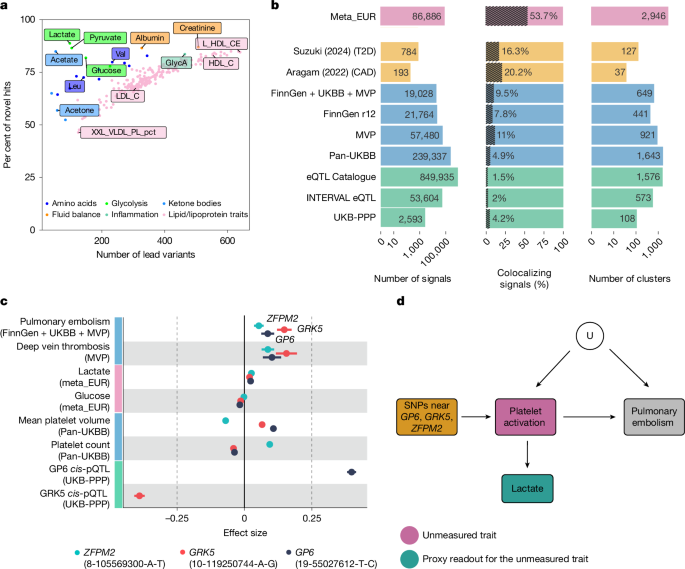
Suzuki, K. et al. Genetic drivers of heterogeneity in type 2 diabetes pathophysiology. Nature 627, 347–357 (2024).
Zhou, W. et al. Global Biobank Meta-analysis Initiative: powering genetic discovery across human disease. Cell Genom. 2, 100192 (2022).
Yengo, L. et al. A saturated map of common genetic variants associated with human height. Nature 610, 704–712 (2022).
COVID-19 Host Genetics Initiative A second update on mapping the human genetic architecture of COVID-19. Nature 621, E7–E26 (2023).
Aragam, K. G. et al. Discovery and systematic characterization of risk variants and genes for coronary artery disease in over a million participants. Nat. Genet. 54, 1803–1815 (2022).
Lotta, L. A. et al. Genetic predisposition to an impaired metabolism of the branched-chain amino acids and risk of type 2 diabetes: a Mendelian randomisation analysis. PLoS Med. 13, e1002179 (2016).
Vanweert, F., Schrauwen, P. & Phielix, E. Role of branched-chain amino acid metabolism in the pathogenesis of obesity and type 2 diabetes-related metabolic disturbances BCAA metabolism in type 2 diabetes. Nutr. Diabetes 12, 35 (2022).
Karjalainen, M. K. et al. Genome-wide characterization of circulating metabolic biomarkers. Nature 628, 130–138 (2024).
Richardson, T. G. et al. Characterising metabolomic signatures of lipid-modifying therapies through drug target mendelian randomisation. PLoS Biol. 20, e3001547 (2022).
Smith, C. J. et al. Integrative analysis of metabolite GWAS illuminates the molecular basis of pleiotropy and genetic correlation. eLife 11, e79348 (2022).
Rahu, I., Tambets, R., Fauman, E. B. & Alasoo, K. Mendelian randomization with proxy exposures: challenges and opportunities. Genetics 231, iyaf210 (2025).
van der Meer, D. et al. Pleiotropic and sex-specific genetic mechanisms of circulating metabolic markers. Nat. Commun. 16, 4961 (2025).
Zoodsma, M. et al. A genetic map of human metabolism across the allele frequency spectrum. Nat. Genet. 57, 2445–2455 (2025).
Graham, S. E. et al. The power of genetic diversity in genome-wide association studies of lipids. Nature 600, 675–679 (2021).
Nag, A. et al. Effects of protein-coding variants on blood metabolite measurements and clinical biomarkers in the UK Biobank. Am. J. Hum. Genet. 110, 487–498 (2023).
Sanderson, E. et al. Mendelian randomization. Nat. Rev. Methods Primers 2, 1–21 (2022).
Stender, S., Gellert-Kristensen, H. & Smith, G. D. Reclaiming mendelian randomization from the deluge of papers and misleading findings. Lipids Health Dis. 23, 286 (2024).
Burgess, S., Woolf, B., Mason, A. M., Ala-Korpela, M. & Gill, D. Addressing the credibility crisis in Mendelian randomization. BMC Med. 22, 374 (2024).
Karczewski, K. J. et al. Pan-UK Biobank genome-wide association analyses enhance discovery and resolution of ancestry-enriched effects. Nat. Genet. 57, 2408–2417 (2025).
Mitt, M. et al. Improved imputation accuracy of rare and low-frequency variants using population-specific high-coverage WGS-based imputation reference panel. Eur. J. Hum. Genet. 25, 869–876 (2017).
Shi, S. et al. A Genomics England haplotype reference panel and imputation of UK Biobank. Nat. Genet. 56, 1800–1803 (2024).
Taliun, D. et al. Sequencing of 53,831 diverse genomes from the NHLBI TOPMed Program. Nature 590, 290–299 (2021).
Kanai, M. et al. Meta-analysis fine-mapping is often miscalibrated at single-variant resolution. Cell Genom. 2, 100210 (2022).
Jaganathan, K. et al. Predicting splicing from primary sequence with deep learning. Cell 176, 535–548.e24 (2019).
Avsec, Ž et al. Advancing regulatory variant effect prediction with AlphaGenome. Nature 649, 1206–1218 (2026).
Jesse, M., Riet, A.-E. & Alasoo, K. Ultra-fast genetic colocalisation across millions of traits. Preprint at bioRxiv https://doi.org/10.1101/2025.08.25.672103 (2025).
Takeuchi, Y. et al. Genetic architecture of circulating metabolic biomarkers across ancestral populations. Preprint at medRxiv https://doi.org/10.64898/2025.12.03.25341540 (2025).
Kurki, M. I. et al. FinnGen provides genetic insights from a well-phenotyped isolated population. Nature 613, 508–518 (2023).
Verma, A. et al. Diversity and scale: genetic architecture of 2068 traits in the VA Million Veteran Program. Science 385, eadj1182 (2024).
Kerimov, N. et al. eQTL Catalogue 2023: new datasets, X chromosome QTLs, and improved detection and visualisation of transcript-level QTLs. PLoS Genet. 19, e1010932 (2023).
Tokolyi, A. et al. The contribution of genetic determinants of blood gene expression and splicing to molecular phenotypes and health outcomes. Nat. Genet. 57, 616–625 (2025).
Sun, B. B. et al. Plasma proteomic associations with genetics and health in the UK Biobank. Nature 622, 329–338 (2023).
Momozawa, Y. et al. IBD risk loci are enriched in multigenic regulatory modules encompassing putative causative genes. Nat. Commun. 9, 2427 (2018).
Akbari, P. et al. A genome-wide association study of blood cell morphology identifies cellular proteins implicated in disease aetiology. Nat. Commun. 14, 5023 (2023).
Buniello, A. et al. Open Targets Platform: facilitating therapeutic hypotheses building in drug discovery. Nucleic Acids Res. 53, D1467–D1475 (2025).
Downes, K. et al. G protein-coupled receptor kinase 5 regulates thrombin signaling in platelets via PAR-1. Blood Adv. 6, 2319–2330 (2022).
Jones, C. I. et al. Mapping the platelet profile for functional genomic studies and demonstration of the effect size of the GP6 locus. J. Thromb. Haemost. 5, 1756–1765 (2007).
Rodriguez, B. A. T. et al. A platelet function modulator of thrombin activation is causally linked to cardiovascular disease and affects PAR4 receptor signaling. Am. J. Hum. Genet. 107, 211–221 (2020).
Li, C. et al. G protein-coupled receptor kinase 5 regulates thrombin signaling in platelets. Res. Pract. Thromb. Haemost. 8, 102556 (2024).
Heijnen, H. F., Oorschot, V., Sixma, J. J., Slot, J. W. & James, D. E. Thrombin stimulates glucose transport in human platelets via the translocation of the glucose transporter GLUT-3 from alpha-granules to the cell surface. J. Cell Biol. 138, 323–330 (1997).
Detwiler, T. C. & Zivkovic, R. V. Control of energy metabolism in platelets. A comparison of aerobic and anaerobic metabolism in washed rat platelets. Biochim. Biophys. Acta 197, 117–126 (1970).
Vanni, S. et al. Prognostic value of plasma lactate levels among patients with acute pulmonary embolism: the thrombo-embolism lactate outcome study. Ann. Emerg. Med. 61, 330–338 (2013).
Vanni, S. et al. High plasma lactate levels are associated with increased risk of in-hospital mortality in patients with pulmonary embolism: high plasma lactate levels and PE. Acad. Emerg. Med. 18, 830–835 (2011).
Leidi, A. et al. Risk stratification in patients with acute pulmonary embolism: current evidence and perspectives. J. Clin. Med. 11, 2533 (2022).
Hawkes, G. et al. Whole-genome sequencing analysis identifies rare, large-effect noncoding variants and regulatory regions associated with circulating protein levels. Nat. Genet. 57, 626–634 (2025).
Mann, G., Mora, S., Madu, G. & Adegoke, O. A. J. Branched-chain amino acids: catabolism in skeletal muscle and implications for muscle and whole-body metabolism. Front. Physiol. 12, 702826 (2021).
Cheng, J. et al. Accurate proteome-wide missense variant effect prediction with AlphaMissense. Science 381, eadg7492 (2023).
Spence, J. P. et al. Specificity, length and luck drive gene rankings in association studies. Nature 649, 918–925 (2026).
Lotta, L. A. et al. Association between low-density lipoprotein cholesterol-lowering genetic variants and risk of type 2 diabetes: a meta-analysis. JAMA 316, 1383–1391 (2016).
Burgess, S. et al. Guidelines for performing Mendelian randomization investigations: update for summer 2023. Wellcome Open Res. 4, 186 (2019).
Gill, D. et al. Common pitfalls in drug target Mendelian randomization and how to avoid them. BMC Med. 22, 473 (2024).
Carugo, S., Sirtori, C. R., Corsini, A., Tokgozoglu, L. & Ruscica, M. PCSK9 inhibition and risk of diabetes: should we worry?. Curr. Atheroscler. Rep. 24, 995–1004 (2022).
Mahendran, Y. et al. Genetic evidence of a causal effect of insulin resistance on branched-chain amino acid levels. Diabetologia 60, 873–878 (2017).
Wang, Q., Holmes, M. V., Davey Smith, G. & Ala-Korpela, M. Genetic support for a causal role of insulin resistance on circulating branched-chain amino acids and inflammation. Diabetes Care 40, 1779–1786 (2017).
Filipski, K. J. et al. Discovery of first branched-chain ketoacid dehydrogenase kinase (BDK) inhibitor clinical candidate PF-07328948. J. Med. Chem. 68, 2466–2482 (2025).
Schlosser, P. et al. Genetic studies of paired metabolomes reveal enzymatic and transport processes at the interface of plasma and urine. Nat. Genet. 55, 995–1008 (2023).
Surendran, P. et al. Rare and common genetic determinants of metabolic individuality and their effects on human health. Nat. Med. 1, 12 (2022).
Reed, Z. E. et al. Exploring pleiotropy in Mendelian randomisation analyses: what are genetic variants associated with ‘cigarette smoking initiation’ really capturing? Genet. Epidemiol. 49, e22583 (2025).
Sollis, E. et al. The NHGRI-EBI GWAS Catalog: knowledgebase and deposition resource. Nucleic Acids Res. 51, D977–D985 (2023).
Kartau, J. & Pirinen, M. FINEMAP-miss: fine-mapping genome-wide association studies with missing genotype information. Bioinformatics 41, btaf616 (2025).
Yang, Z. et al. CARMA is a new Bayesian model for fine-mapping in genome-wide association meta-analyses. Nat. Genet. 55, 1057–1065 (2023).
Milani, L. et al. The Estonian Biobank’s journey from biobanking to personalized medicine. Nat. Commun. 16, 3270 (2025).
Leitsalu, L. et al. Cohort profile: Estonian Biobank of the Estonian Genome Center, University of Tartu. Int. J. Epidemiol. 44, 1137–1147 (2015).
Bycroft, C. et al. The UK Biobank resource with deep phenotyping and genomic data. Nature 562, 203–209 (2018).
Julkunen, H. et al. Atlas of plasma NMR biomarkers for health and disease in 118,461 individuals from the UK Biobank. Nat. Commun. 14, 604 (2023).
Nightingale Health Biobank Collaborative Group Metabolomic and genomic prediction of common diseases in 700,217 participants in three national biobanks. Nat. Commun. 15, 10092 (2024).
Ritchie, S. C. et al. Quality control and removal of technical variation of NMR metabolic biomarker data in ~120,000 UK Biobank participants. Sci. Data 10, 64 (2023).
Mbatchou, J. et al. Computationally efficient whole-genome regression for quantitative and binary traits. Nat. Genet. 53, 1097–1103 (2021).
Bulik-Sullivan, B. et al. An atlas of genetic correlations across human diseases and traits. Nat. Genet. 47, 1236–1241 (2015).
Bulik-Sullivan, B. K. et al. LD Score regression distinguishes confounding from polygenicity in genome-wide association studies. Nat. Genet. 47, 291–295 (2015).
Kerimov, N. et al. A compendium of uniformly processed human gene expression and splicing quantitative trait loci. Nat. Genet. 53, 1290–1299 (2021).
Giambartolomei, C. et al. Bayesian test for colocalisation between pairs of genetic association studies using summary statistics. PLoS Genet. 10, e1004383 (2014).
pyliftover. PyPI https://pypi.org/project/pyliftover/ (2024).
Shirley, M. D., Ma, Z., Pedersen, B. S. & Wheelan, S. J. Efficient ‘pythonic’ access to FASTA files using pyfaidx. Preprint at PeerJ https://doi.org/10.7287/peerj.preprints.970v1 (2015).
Wang, G., Sarkar, A., Carbonetto, P. & Stephens, M. A simple new approach to variable selection in regression, with application to genetic fine mapping. J. R. Stat. Soc. B 82, 1273–1300 (2020).
Zou, Y., Carbonetto, P., Wang, G. & Stephens, M. Fine-mapping from summary data with the ‘sum of single effects’ model. PLoS Genet. 18, e1010299 (2022).
Benner, C. et al. Prospects of fine-mapping trait-associated genomic regions by using summary statistics from genome-wide association studies. Am. J. Hum. Genet. 101, 539–551 (2017).
Hormozdiari, F. et al. Colocalization of GWAS and eQTL signals detects target genes. Am. J. Hum. Genet. 99, 1245–1260 (2016).
McLaren, W. et al. The Ensembl variant effect predictor. Genome Biol. 17, 122 (2016).
Skrivankova, V. W. et al. Strengthening the reporting of observational studies in epidemiology using mendelian randomisation (STROBE-MR): explanation and elaboration. BMJ 375, n2233 (2021).
Yavorska, O. O. & Burgess, S. MendelianRandomization: an R package for performing Mendelian randomization analyses using summarized data. Int. J. Epidemiol. 46, 1734–1739 (2017).
Tambets, R., Kolde, A., Kolberg, P., Love, M. I. & Alasoo, K. Extensive co-regulation of neighboring genes complicates the use of eQTLs in target gene prioritization. HGG Adv. 5, 100348 (2024).
Zhu, A. et al. MRLocus: Identifying causal genes mediating a trait through Bayesian estimation of allelic heterogeneity. PLoS Genet. 17, e1009455 (2021).
Bowden, J., Davey Smith, G. & Burgess, S. Mendelian randomization with invalid instruments: effect estimation and bias detection through Egger regression. Int. J. Epidemiol. 44, 512–525 (2015).
van der Graaf, A. et al. MR-link-2: pleiotropy robust cis Mendelian randomization validated in three independent reference datasets of causality. Nat. Commun. 16, 6112 (2025).
Burgess, S., Zuber, V., Valdes-Marquez, E., Sun, B. B. & Hopewell, J. C. Mendelian randomization with fine-mapped genetic data: choosing from large numbers of correlated instrumental variables. Genet. Epidemiol. 41, 714–725 (2017).
UK10K Consortium et al The UK10K project identifies rare variants in health and disease. Nature 526, 82–90 (2015).
Abramson, J. et al. Accurate structure prediction of biomolecular interactions with AlphaFold 3. Nature 630, 493–500 (2024).
Jumper, J. et al. Highly accurate protein structure prediction with AlphaFold. Nature 596, 583–589 (2021).
Varadi, M. et al. AlphaFold Protein Structure Database in 2024: providing structure coverage for over 214 million protein sequences. Nucleic Acids Res. 52, D368–D375 (2024).
Meng, E. C. et al. UCSF ChimeraX: Tools for structure building and analysis. Protein Sci. 32, e4792 (2023).
Tambets, R. & Alasoo, K. Fine-mapping results for the EstBB-UKBB NMR metabolic trait meta-analysis. Zenodo https://doi.org/10.5281/zenodo.18132538 (2026).
Alasoo, K. & Jesse, M. Colocalisation results for the Tambets et al NMR metabolic trait GWAS study. Zenodo https://doi.org/10.5281/zenodo.17945143 (2025).

