


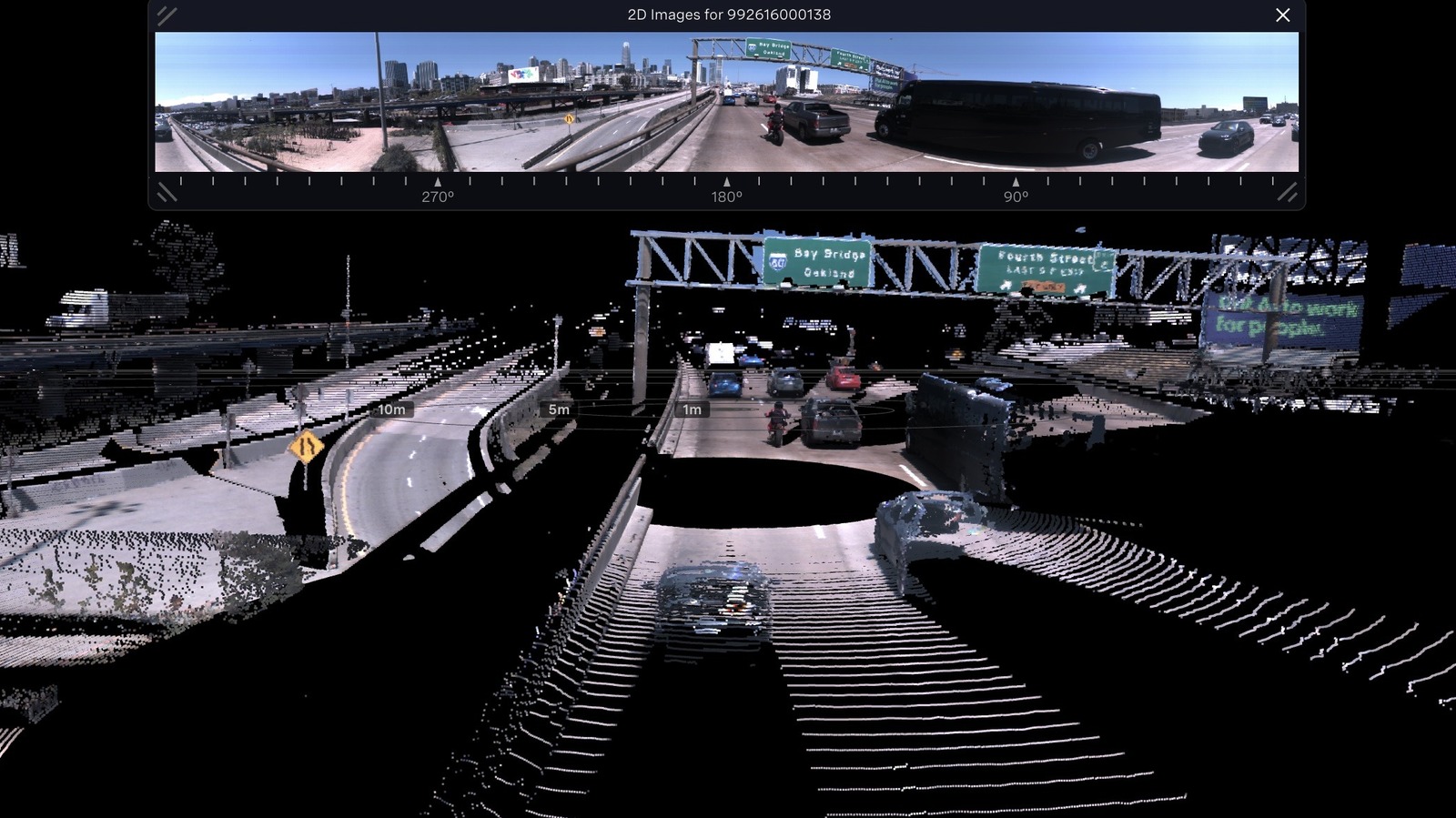
Cameras and lidar are what enable autonomous driving systems to perceive the environment around them. That is, except for in the case of Tesla, which stopped equipping its cars with lidar to save money. Lidar company Ouster now offers a new solution, with sensors adopting the philosophy of a popular meme: “Why not both?”
Ouster’s Rev8 lidar sensors are capable of capturing both images and lidar distance data at the same time in the same hardware, reports TechCrunch, eliminating the need for separate lidar and camera systems. The OS1 Max sensor, in particular, is designed for automotive applications, with a range of up to 200 meters while also capturing 360-degree video with what Ouster calls its “native color lidar.”
“For all of human history, it’s been: you buy a lidar sensor, you buy a camera, and you try to make sense of the combination with some higher-level reasoning, and waste an enormous amount of time doing this,” [Ouster CEO Angus Pacala] told TechCrunch. “And companies only get really halfway there in terms of calibrating and fusing the data streams.”
Ouster’s new sensors, he said, change this equation.
“The goal is to obviate cameras. There’s no reason that one sensor can’t do both,” he said.
How this works
Although the Merriam-Webster Dictionary, among others, accepts the word “lidar” as a noun today, its roots are in an acronym that stands for “Light Detection and Ranging.” Lidar uses lasers to measure distances between the sensor and the world around it. Computers then use that data to form a 3D map of their surroundings. A laser is a form of light, and what Ouster has done is design a sensor that can capture color images with megapixel resolution in addition to lidar data from its lasers.
On top of that, Ouster announced that its Rev8 sensors are qualified for the NVIDIA Drive platform. Lucid has already tapped this platform in its desire to be the first brand offering Level 4 autonomy to consumers. This is the level where no human intervention should ever be required, the equivalent of KITT’s Auto Cruise feature on “Knight Rider.” (We’ve seen how well Waymo achieves this in practice.) The sensors could also have uses at lower autonomy levels. I imagine a lot would depend on their prices, which Ouster has not listed on its website. After all, to truly replace separate cameras and lidar sensors, the Rev8 sensors would have to cost less than the hardware they’re replacing.

